THERE IS A NEW PERSON in your annual performance review.
They do not technically work there.
They do not technically exist.
Nobody invited them.
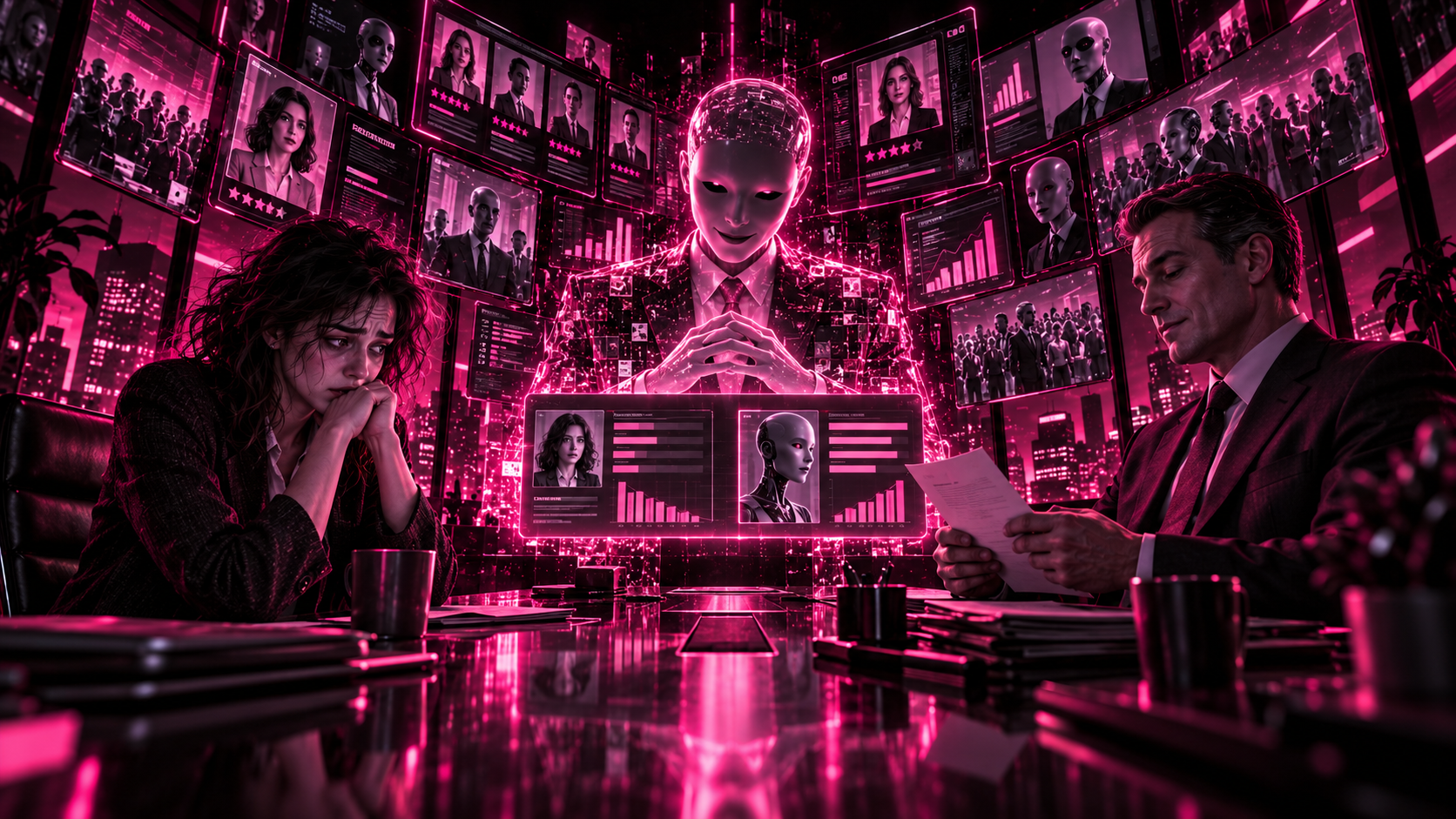
But everybody knows they are in the room.
You sit across from your manager.
The manager says the company had a challenging year.
Margins.
Headwinds.
Changing market conditions.
You nod thoughtfully because this is the adult version of pretending the dentist is not hurting you.
Then comes the phrase.
“As we continue integrating AI…”
There it is.
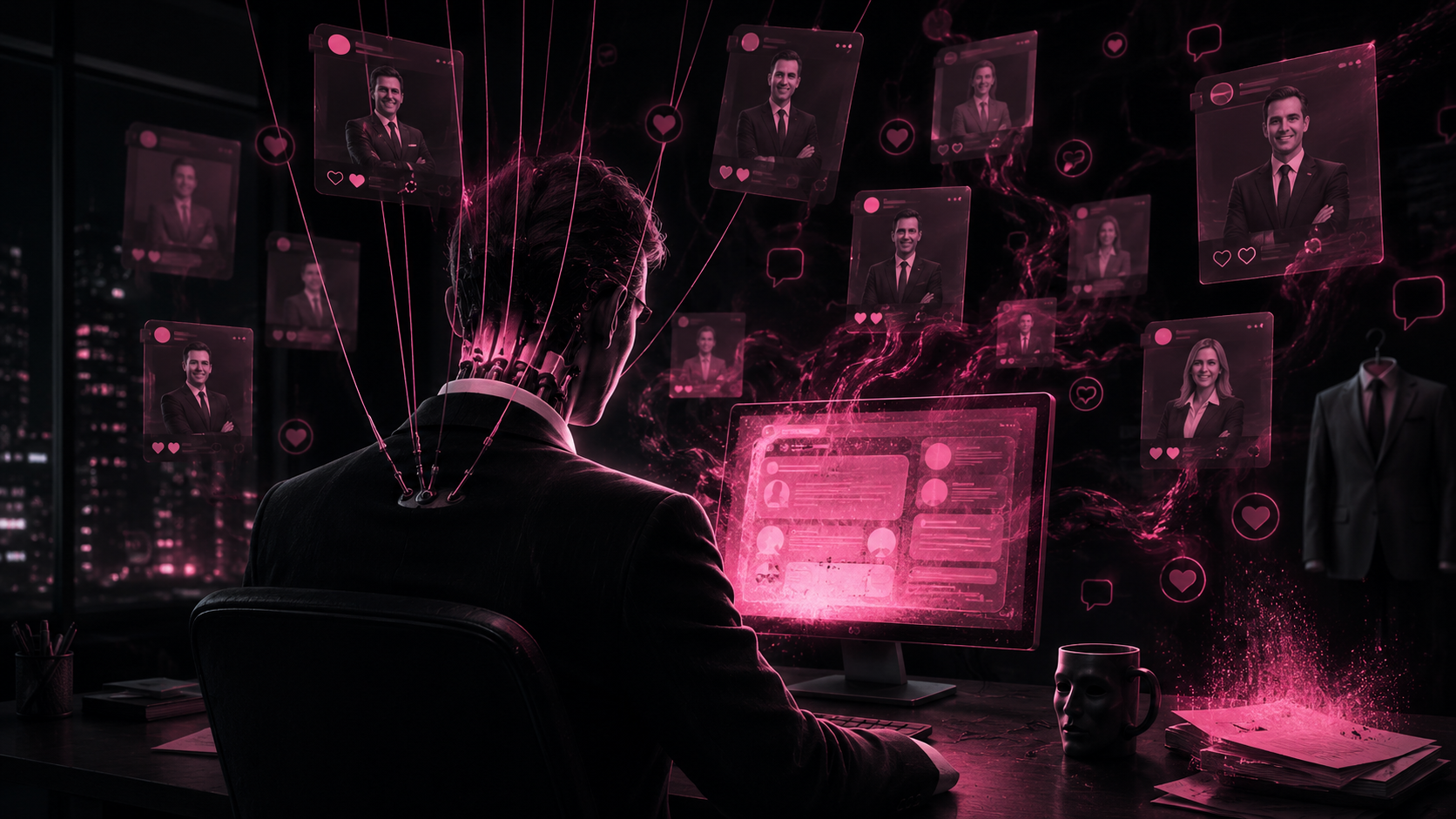
The ghost employee.
The colleague with no salary.
No mortgage.
No daycare pickup.
No health insurance.
No annual review of its own.
Maybe the company has not replaced anybody with AI.
Maybe the AI project barely works.
Maybe half the department secretly hates the thing.
Doesn't matter.
The machine has already contributed something useful.
It has entered the negotiation.
YOU DON'T ACTUALLY HAVE TO REPLACE THE WORKER
This may be the part of workplace AI we have been describing incorrectly.
The popular story is extremely clean.
Company discovers AI.
AI becomes capable.
AI replaces employee.
Employee goes home carrying little cardboard box containing desk plant and shattered dreams.
Capitalism.
Roll credits.
But technology does not have to replace a worker to change the relationship between a worker and a company.
It only has to make replacement feel plausible.
That distinction appeared almost accidentally on CNBC recently when JPMorgan Asset Management strategist David Kelly was discussing slowing wage growth. Kelly argued that workers in a nervous economy may be less willing to demand raises because they fear employers could replace some of their work with AI. Gizmodo seized on the remark as evidence that part of AI's value to employers may be its effect on bargaining power, not merely its effect on productivity.
Whether AI is actually suppressing wages across the economy is a much bigger claim than one television interview can establish.
But the psychology is fascinating.
Because a threat does not have to happen to work.
The machine does not have to take your job. It only has to sit quietly in the corner while you ask for more money.
THE IMAGINARY EMPLOYEE IS EXTREMELY HARDWORKING
Corporate America has always loved hypothetical workers.
Somewhere, there is always another candidate.
More qualified.
More flexible.
More passionate.
Willing to commute farther.
Happy with the salary range.
Thrilled by the company's mission to revolutionize enterprise procurement workflows.
AI may be the perfect final form of this imaginary employee because management can project almost anything onto it.
The AI employee works all night.
Learns instantly.
Never becomes resentful.
Does not care that the company has described three consecutive layoffs as a “strategic realignment.”
It does not notice that pizza has replaced compensation as the official reward for excellence.
Most importantly, the imaginary AI employee does not need to be actually capable of your entire job.
It simply needs to be capable enough that everyone wonders.
That uncertainty is useful.
A worker who believes the company needs them behaves differently from a worker who believes the company is three software releases away from discovering it doesn't.
MANAGEMENT IS HAVING A MUCH BETTER AI EXPERIENCE
Glassdoor recently looked at what employees themselves were saying about AI in workplace reviews.
The difference by job level is almost comically clean.
Company leaders were the most positive group about AI, with 67% of their AI comments appearing in the “pros” section. Meanwhile, overall worker sentiment has been moving the other direction. AI mentions in Glassdoor reviews rose 240% between May 2025 and May 2026, while positive sentiment fell to 43%. Fifty-three percent of AI mentions were negative.
That is interesting.
The people deciding the AI strategy love the AI strategy.
The people experiencing the AI strategy are more complicated.
Imagine that.
Writers, journalists, accountants, customer-service representatives, designers and IT workers were among the more critical groups. Glassdoor also found that employees criticizing AI were substantially more likely to mention burnout, job insecurity and layoffs.
This does not prove leadership is delusional.
Executives genuinely have reasons to like the technology.
A CEO sees organizational leverage.
A product leader sees scale.
A manager sees workflows.
A worker sees the Tuesday afternoon when somebody announces that the team can now produce twice as much because everyone has Copilot.
Those are different vantage points.
The machine looks very different from the balcony.
FIRST WE AUTOMATED THE JUNIOR WORK. THEN WE ASKED JUNIORS TO BE SENIOR.
The entry-level job may be where this becomes most revealing.
For decades, the deal was vaguely understood.
You arrive knowing less.
You do some boring work.
You learn.
Somebody more experienced checks what you did.
Eventually you become the experienced person.
It is not a perfect system.
But civilization has traditionally accepted that people become experienced by first being inexperienced.
AI has introduced an exciting alternative.
Remove some of the beginner work.
Then wonder why beginners aren't experienced.
PwC's 2026 AI Jobs Barometer analyzed more than a billion job advertisements and found that AI-exposed entry-level positions in the United States were seven times more likely to ask for skills traditionally associated with more senior employees, including judgment and leadership. PwC calls some of this the “seniorisation” of entry-level work.
This is an incredible phrase.
Seniorised entry level.
We finally invented the 22-year-old with twelve years of experience.
The AI handles the grunt work.
Wonderful.
Except the grunt work was sometimes how the person learned enough to handle the complicated work.
We are quietly experimenting with removing the bottom rungs of ladders while becoming increasingly impressed by how high the ladder goes.
Apparently the solution to automating junior work is to hire juniors who have already finished being junior.
NOW YOU HAVE TO ENJOY IT IN THE INTERVIEW
You can watch the new workplace ideology forming even before somebody gets the job.
Business Insider recently reported that job seekers are learning a new interview skill: sounding enthusiastic about AI.
Candidates described preparing stories about how they use ChatGPT, Claude, and other tools because employers increasingly ask about AI experience. Some job seekers who were skeptical or had limited exposure felt pressure to demonstrate curiosity and enthusiasm anyway because rejecting the technology outright could make them appear inflexible.
This is wonderful in the anthropological sense.
We have gone from:
Can you do the job?
to:
Can you do the job?
Can you use the machine?
Are you excited about using the machine?
Can you tell us a story about how the machine made you better at the job?
The worker is not merely learning software.
The worker is learning the correct emotional posture toward software.
You must be AI fluent.
AI curious.
AI-forward.
AI-native.
Do not say:
“I tried it and for this particular task it made everything worse.”
That sounds negative.
Say:
“I've been thoughtfully exploring where AI can unlock efficiencies while preserving human judgment.”
Congratulations.
You're employable.
EVERY TECHNOLOGY EVENTUALLY BECOMES A PERSONALITY TEST
This is how corporate ideas spread.
First they are tools.
Then they become strategies.
Then they become values.
Eventually they become adjectives used to describe employees.
Agile.
Data-driven.
Digital-first.
Growth-minded.
AI-enabled.
Every management era develops a vocabulary that turns compliance with the current strategy into evidence of personal virtue.
You aren't merely using the tool.
You are adaptable.
You aren't questioning the rollout.
You are future-focused.
You stayed until 9 p.m. fixing what the AI generated because the deadline was moved up after leadership learned the AI existed.
You are embracing transformation.
The tool itself almost becomes secondary.
The important thing is that everybody understands what enthusiasm signals.
I am not the difficult employee.
I am not the obsolete employee.
Please continue paying me.
HERE'S THE ANNOYING PART: AI MAY ACTUALLY HELP
This is where the clean anti-AI story falls apart.
PwC's data does not describe a universal employment apocalypse.
Quite the opposite.
Its 2026 report found that companies most exposed to AI were seeing faster headcount growth and faster wage growth than the least exposed companies. It also found strong productivity growth among AI-intensive businesses and growing demand for jobs requiring AI skills.
That matters.
Because it would be extremely convenient if the story were:
AI is fake.
Workers are right.
Executives are idiots.
End.
Reality has declined the assignment.
AI can make people more productive.
It can remove stupid repetitive work.
It can help somebody learn faster.
It can turn one capable person into a much more capable person.
It can create new jobs while changing old ones.
And companies can still use the possibility of automation as leverage over workers.
Those statements do not cancel each other.
The interesting story was never simply whether AI works.
It is who captures the benefit when it does.
PRODUCTIVITY HAS AN OWNER
Suppose AI allows you to finish your work 30% faster.
Wonderful.
Who gets the 30%?
Do you leave Friday at two?
Does your salary increase?
Does the company hire another person and expand?
Does the customer pay less?
Or do you receive 30% more work?
Technology does not answer this question.
Management does.
This is why arguments about workplace AI get weird so quickly.
Everybody starts debating model capabilities when the real disagreement may be about ownership.
If a worker becomes twice as productive because of AI, there is nothing inside the neural network determining how the new value gets divided.
That is still politics.
Not national politics.
Office politics.
The oldest politics there is.
Who gets what.
Who decides.
Who can leave.
Who needs the paycheck more.
THE JOB MARKET DOESN'T HAVE TO BE TERRIBLE TO FEEL TERRIBLE
The August employment report is another useful complication.
The U.S. added 162,000 jobs in August, and unemployment remained at 4.1%. This is not an economy where nobody has a job.
And yet job seekers can experience the market very differently from what the headline number suggests.
Long hiring processes.
Hundreds of applicants.
AI screening.
One-way interviews.
Ghost jobs.
Layoffs concentrated in particular sectors.
Senior workers applying downward.
Junior workers being asked to arrive senior.
And hovering above all of it:
AI.
Maybe it will replace your job.
Maybe it won't.
Maybe it will make you better.
Maybe the person using it will replace you.
Maybe your company doesn't know either.
That's the useful part.
Uncertainty itself changes behavior.
THE BOSS DOESN'T NEED A ROBOT EMPLOYEE
This is why the workplace AI debate becomes distorted when we obsess only over replacement.
Imagine AI replaces 10% of someone's job.
What happens to the other 90%?
Maybe it gets better.
Maybe the employee gets more interesting work.
Maybe productivity rises.
Or maybe management notices that five people can now do what six people used to do.
Nobody gets dramatically fired by a humanoid robot.
One position simply never gets refilled.
The remaining workers absorb the work.
The department shrinks through attrition.
Expectations rise.
The software gets credited.
Then someone writes a LinkedIn post about transformation.
That version of automation is much less cinematic.
It may be much more common.
Nobody walks into the office and announces:
THE ROBOTS HAVE TAKEN OVER.
You simply notice that Linda left eight months ago and somehow everyone is still doing Linda's work.
THIS IS WHY WORKERS ARE GETTING IRRITATED
Glassdoor's numbers become easier to understand in that context.
Workers aren't necessarily angry because they hate technology.
Many use AI themselves.
They understand perfectly well that some of it is useful.
What they often dislike is the asymmetry.
The company gets efficiency.
The worker gets a higher quota.
The company gets lower costs.
The worker gets “reskilling.”
The company gets an AI strategy.
The worker gets a mandatory training module explaining the AI strategy.
The company announces that AI will free employees to focus on higher-value work.
Nobody can quite explain when the lower-value work disappears from the employee's calendar.
It simply receives a chatbot.
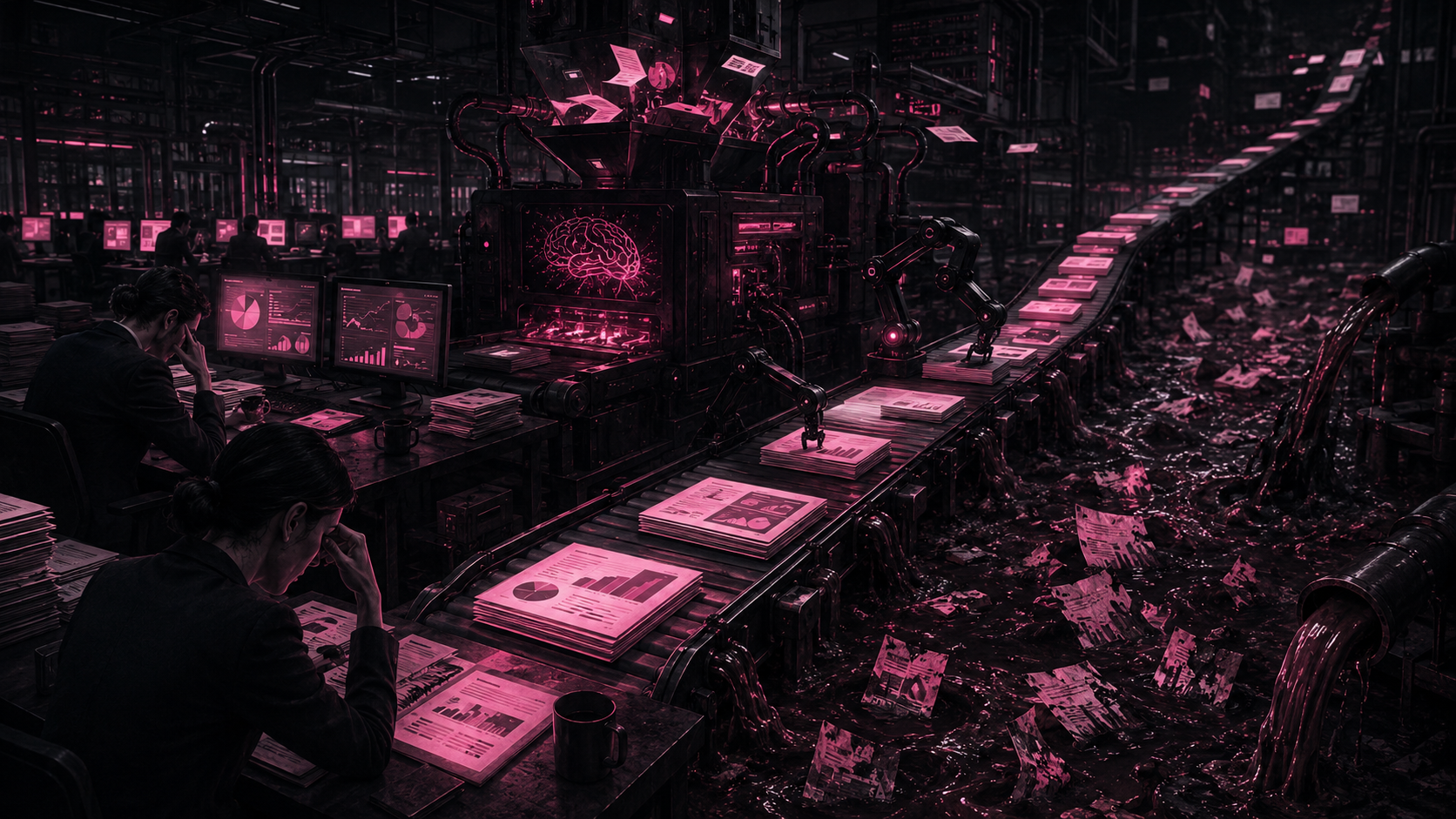
Workers were promised a machine that would do the boring part of their jobs. Some are discovering that the reward is being given more job.
That resentment is not technophobia.
It is arithmetic.
THE OPPOSITE OF SLOP IS NOT REFUSING THE TOOL
Slopulous is not an anti-AI project.
That distinction becomes important here.
Using AI does not make work slop.
Refusing AI does not make work meaningful.
The question is whether anybody still cares about the quality of what gets produced, the people producing it, and the system being created around them.
A good AI tool can remove drudgery.
A bad AI mandate can manufacture it.
A good company can use automation to make employees more capable.
A bad company can use exactly the same technology to make employees more disposable.
Same model.
Different institution.
Technology loves pretending these are technical questions.
They're not.
THE MOST VALUABLE AI FEATURE MAY BE FEAR
Maybe AI does eventually eliminate enormous categories of work.
Maybe it doesn't.
Nobody currently knows the final shape of this.
But companies do not have to wait for the future to extract something from the possibility.
The worker who feels secure can negotiate.
The worker who feels replaceable calculates.
Maybe I don't ask for the raise.
Maybe I stay late.
Maybe I learn the tool this weekend.
Maybe I don't complain about the extra workload.
Maybe I should be grateful.
Maybe I'm already behind.
That little maybe is powerful.
It does not require artificial general intelligence.
It does not require humanoid robots.
It does not even require the AI initiative to be particularly good.
It just requires the worker to believe that somewhere, in some meeting they were not invited to, somebody is asking whether the company still needs as many people as it used to.
The machine doesn't need your chair.
Sometimes it is enough that management lets you see it standing beside the chair.
And then waits to see how badly you want to keep sitting there.