THERE ARE STILL A FEW places where adults are allowed to say something unfashionable.
Not anti-progress.
Not anti-technology.
Just unfashionable.
Something like:
A child should probably learn how to think before being asked to outsource thinking.
New York City just did that out loud.
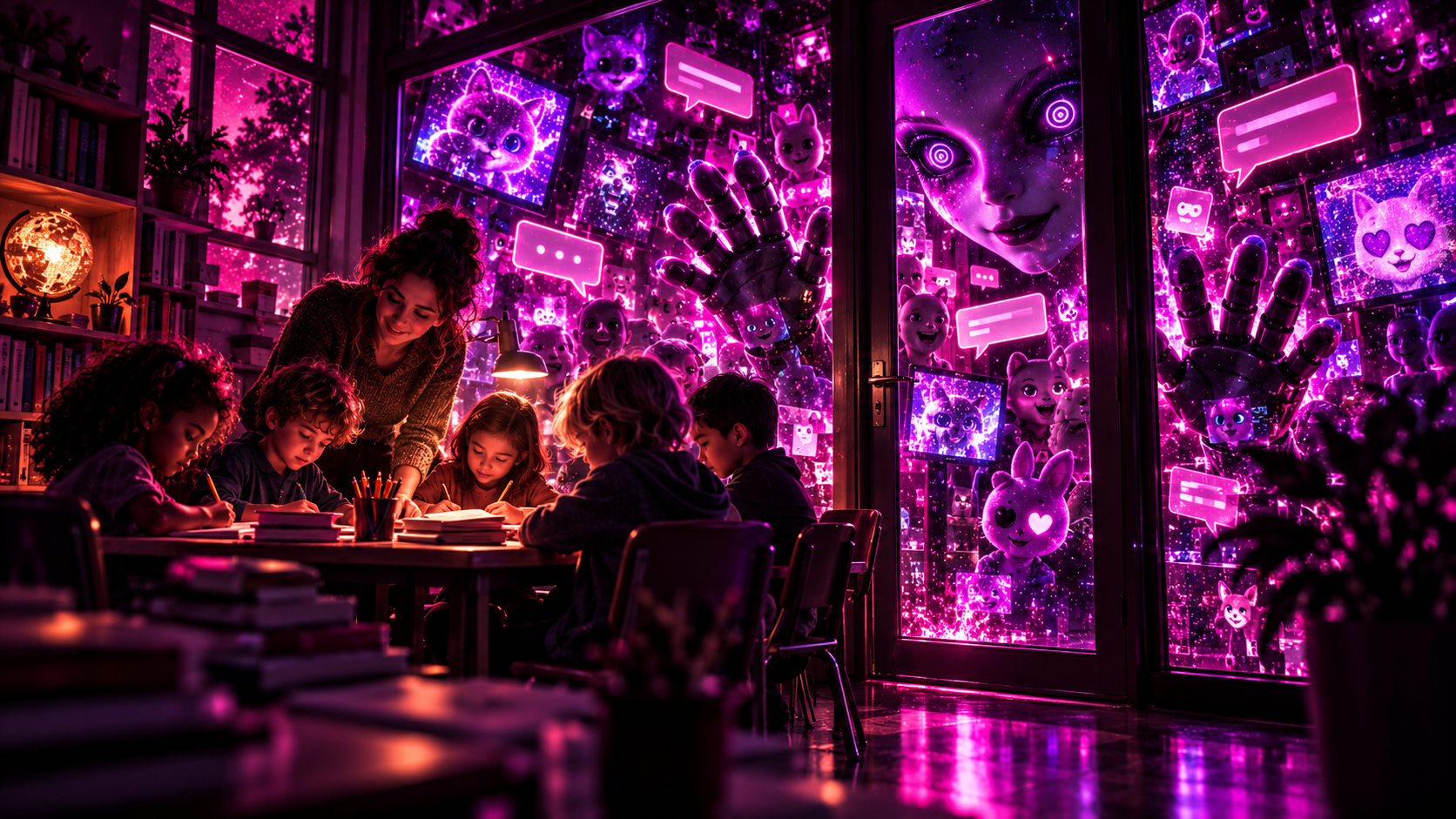
Mayor Zohran Mamdani and Schools Chancellor Kamar Samuels announced what the city is calling the nation’s broadest student-facing generative AI moratorium: a one-year pause on student-facing generative AI for students in 2-K through 8th grade during the 2026–27 school year. The policy affects nearly 600,000 public-school students, bans companion chatbots across all grades, and pairs the moratorium with new screen-time restrictions and a coalition that will study the effects of the pause and limited high-school pilots.
This is a striking sentence to encounter in 2026.
Not because it is radical.
Because it sounds like an institution briefly remembering that the burden of proof should belong to the machine.
THE DEFAULT SETTING OF OUR ERA IS “GIVE IT TO THE KIDS”
The pattern is familiar by now.
A new technology appears.
It is described as inevitable.
Then it is described as transformative.
Then, with very little time in between, someone proposes giving it to children.
This is usually presented as realism.
Kids need to be ready for the future.
The future is digital.
The future is AI.
Therefore the humane and practical thing to do is to place the unfinished technology directly into the learning environment of a seven-year-old.
At some point, “preparing children for the future” became a very efficient way of stopping adults from asking whether the future in question had earned entry into the classroom.
New York has chosen, at least for a year, to ask exactly that question.
The city is framing the moratorium around student safety, human instruction, relationships with teachers and peers, and the ability to wrestle with difficult problems without immediately handing the struggle to software.
The interesting part is not that New York banned a machine. It is that New York refused to let inevitability do the arguing.
THIS IS NOT A LUDDITE FANTASY. IT IS A FRICTION DECISION.
The easiest way to misunderstand the policy is to hear “moratorium” and imagine some old-fashioned anti-computer panic.
That is not what this is.
The city is not banishing all technology from schools.
It is not pretending AI does not exist.
It is not even banning AI across the whole system.
For high school students, the city is allowing limited, carefully supervised pilots for up to 50,000 students, along with twice-yearly AI critical-thinking modules designed to teach what AI is, what it is not, how bias works, what the risks are, and how the technology may affect future careers.
This is what makes the policy interesting.
It does not say:
Technology bad.
It says:
Childhood deserves friction.
There are some mental habits that perhaps should not immediately be redesigned around the existence of a prompt box.
A second grader should still have to stare at the page for a while.
A middle-schooler should still have to discover that confusion is not a system error.
A teenager should probably learn what the machine is before the machine becomes a habit.
That is not anti-innovation.
It is a refusal to confuse convenience with development.
THE MACHINE’S BEST SALES PITCH IS ALWAYS KINDNESS
One reason AI keeps moving toward children so quickly is that the technology is often marketed in the language of support.
Personalized help.
Individualized learning.
Extra tutoring.
Faster feedback.
Assistance for struggling students.
And some of those promises may contain real value.
The problem is that the language of support can conceal the deeper shift being proposed.
A tool that “helps” a student generate an answer can also weaken the slow, awkward, frustrating process by which a student learns how to arrive at one.
A machine that makes school feel easier may also make cognition thinner.
One line from the city’s announcement captures this especially well: we should not confuse a machine’s ability to produce an answer with a child’s ability to arrive at one.
Exactly.
Slopulous has been orbiting that insight for months.
Slop is not merely fake content.
It is a system that keeps trying to remove the human struggle from human work and then wondering why the result feels empty.
School may be the one place where that struggle is not a side effect.
It is the point.
THE CLASSROOM DOES NOT HAVE TO BECOME A PRODUCT TEST
Another important part of the policy is how much of it is really about institutional restraint.
New York says technology tools used in its public schools will undergo a deeper review focused on whether they are actually necessary for learning. The review includes safety, transparency, ethics, instructional impact, research, and feedback.
Teachers may still use AI for planning and operational work if the tools meet safety standards, and there are exceptions for assistive technology, multilingual learners, students with disabilities, and some career-readiness programs.
This is good.
Not because every school system should copy the policy word for word.
Because somebody has to model the radical act of saying:
Show me the evidence first.
Educational technology has spent decades arriving in the classroom wrapped in benevolence and emerging years later as one more layer of distraction, extraction, or administrative clutter.
The modern version of the same ritual is to offer schools a new AI assistant and imply that hesitation is anti-child, anti-equity, or anti-future.
But children are not beta testers.
A public school is not a deployment surface.
A classroom should not have to absorb every venture-backed fantasy about what software can do to a developing mind.
The classroom is one of the last places where “move fast and break things” should sound deranged.
THE MOST INTERESTING RULE MAY NOT BE THE AI RULE
The city also coupled the AI moratorium with screen-time restrictions.
Students in second grade and below will see restricted one-to-one screen time. Recommended caps are 30 minutes per day for grades 3 through 5 and 45 minutes for grades 6 through 8.
That detail matters because it suggests the city understands something broader than the chatbot problem.
The issue is not only generative AI.
It is the larger educational reflex that keeps translating learning into exposure to screens.
More platforms.
More dashboards.
More interfaces.
More educational mediation by device.
The AI argument sits inside that older argument.
If childhood already happens under an avalanche of software, then generative AI arrives not as a strange exception but as the next layer in a stack of abstractions between the student and the task.
New York’s policy seems, at least tentatively, to be pushing back on the whole stack.
Not forever.
Not absolutely.
Just enough to say: maybe students do not need every new tool the week it appears.
PROGRESS DOES NOT HAVE TO MEAN IMMEDIATE SUBMISSION
There is a very American habit of treating resistance to new technology as embarrassment.
You are either an optimist or a crank.
Either you are future-ready or you are standing in the way.
But the actual work of governing technology is supposed to be slower than that.
Progress is not the refusal to question.
Progress is the ability to question before the system hardens around a bad idea.
What New York has done here is not prove that AI has no place in education.
It has done something more modest and, for that reason, more useful.
It has reintroduced a lost civic skill:
waiting.
Waiting to see what helps.
Waiting to see what harms.
Waiting to see what kind of mind a school is supposed to be cultivating in the first place.
That pause will irritate people who believe every institution should submit immediately to every new computational possibility.
Good.
The machine will survive the inconvenience.
The child may actually need it.