There is a specific kind of parental shame the internet is very good at producing.
You hand a child a tablet because you need twenty minutes. Dinner is burning. Somebody has to answer an email. There is laundry in three geological layers. The youngest person in the house has asked the same question seventeen times and has now moved on to dismantling the sofa.
So you put on a cartoon.
Not forever. Not because you have abandoned the project of civilization. Twenty minutes.
Then you look over and the cartoon is gone.
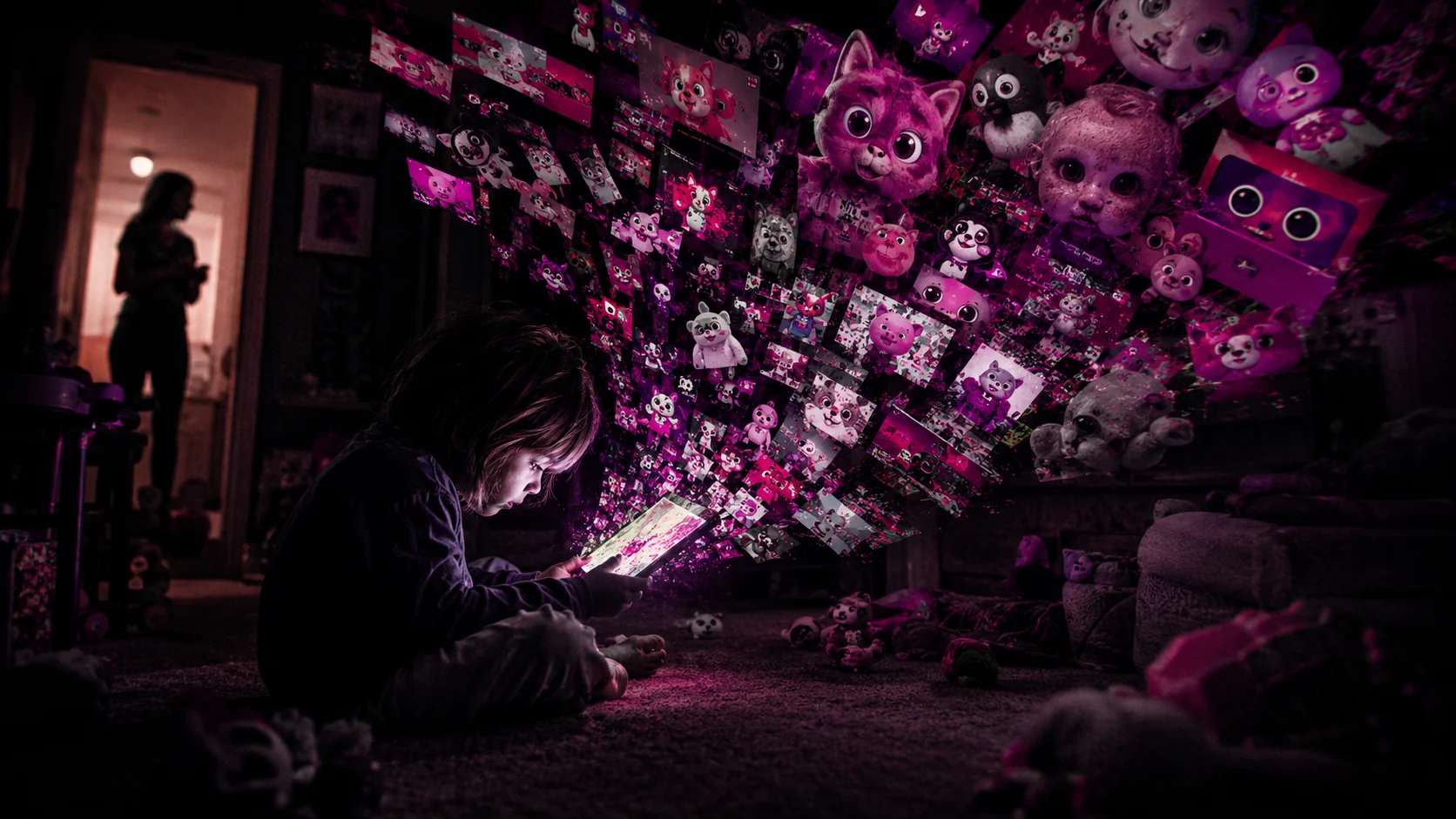
In its place is a pink rabbit driving a school bus through a supermarket while a synthetic child’s voice explains the alphabet incorrectly.
This is when the parenting advice arrives.
Monitor screen time. Co-view. Curate. Set boundaries. Check every channel. Review every recommendation. Learn every setting. Audit every thumbnail. Become, apparently, the unpaid standards-and-practices department for a media ecosystem valued in the trillions.
Parents did not build the feed.
Yet somehow they are expected to stand at the bottom of it with a bucket.
The screen-time argument is too small
We talk about children and screens as if the main variable were minutes. Thirty minutes good. Four hours bad. Put the device down. Go outside. Touch grass, junior.
Time matters, obviously. But the fixation on duration can hide a more uncomfortable question: what is the screen doing during those minutes?
An hour spent following a coherent story is not the same experience as an hour of rapid-fire fragments selected by a recommendation engine. A video call with a grandparent is not a slot-machine feed. Drawing on a tablet is not autoplay. Watching a carefully chosen documentary is not the same as letting a toddler drift through a chain of content generated because the previous thousand toddlers did not click away.
The rectangle is not the medium anymore.
The system behind the rectangle is.
The feed has become an accidental caregiver
Business Insider reported in July 2026 on the growing amount of AI slop attached to kid-oriented TikTok tags, citing Kapwing’s analysis of hashtags such as #babysong, #nurseryrhyme and #kidslearning. Kapwing separately reported that more than half of the videos it sampled in TikTok’s Kids category were AI slop.
TikTok is not a preschool app. But that is almost beside the point. Very young children encounter it on parents’ phones, older siblings’ devices, reposts, clips, and the general leakiness of modern media. YouTube Kids may have a separate interface; the internet does not respect the conceptual walls between them.
That is how the recommendation system becomes an accidental caregiver.
Not because a parent deliberately said, “Please allow a ranking model trained on engagement data to choose the next cultural object my three-year-old encounters.”
Because autoplay was on.
Parents are being asked to solve a supply-chain problem
This is what bothers me about the moral panic around “bad parents and screens.” It takes a structural problem and shrinks it until it fits inside a household.
Yes, parents make choices. Of course they do. But the choices are being made inside an environment engineered by companies that decide what is recommended, what is monetized, what is labeled, what is easy to block, and what quietly starts playing next.
Fairplay’s 2026 campaign against AI slop makes this explicit. Its demands are aimed primarily at the platform, not the exhausted person trying to unload a dishwasher. The group wants AI-generated children’s content labeled and restricted, wants stronger recommendation rules for minors, and wants a parental control that can disable AI-generated content altogether.
The logic is simple: if a product can identify enough about a child’s viewing behavior to recommend another video within milliseconds, perhaps it can also take some responsibility for what that video is.
What can a parent actually do?
Until the platforms grow a more useful conscience, there are still ways to make the environment less slop-friendly.
Choose the thing before choosing the app. Search for a specific show, creator, playlist or channel instead of opening a feed and asking the recommendation engine to improvise childhood.
Autoplay is not a babysitter credential. Turn it off where possible. A video ending is a useful little piece of friction. It creates a moment in which another choice has to be made.
Prefer libraries over rivers. Saved playlists, subscriptions and known creators create boundaries. Infinite-scroll feeds are rivers. Rivers are very good at carrying you somewhere you did not intend to go.
Watch the first few minutes occasionally. You do not have to co-view every frame of a child’s life. But checking what a channel actually does is more useful than trusting a thumbnail that says “LEARNING” in seven colors.
Teach skepticism without making everything terrifying. Older kids can understand that not every image is real, not every narrator is a person, and not every “educational” video knows what it is talking about. Media literacy works better as curiosity than panic.
Do not confuse AI with slop. This matters too. If children learn that “AI” simply means “fake garbage,” they are not learning much. The useful distinction is between accountable, intentional work and anonymous output designed primarily to capture attention.
Someone has to choose
There is no perfect childhood media diet. There never was. Children have always loved things adults considered stupid, commercial, repetitive, ugly, or spiritually corrosive. Some of those children grew up fine. Some became advertising executives.
The difference now is the chooser.
A parent once selected a VHS tape, a channel, a DVD, a book, a game. The selection could be terrible, but it was legible. Somebody picked the thing.
Now the first choice often belongs to the parent and every choice after that belongs to software.
That is a remarkable transfer of authority for something we still describe casually as “screen time.”
Maybe the goal is not to ban the screen or defeat the algorithm. Maybe it is simply to put choosing back into the experience.
Pick the show.
Pick the channel.
Let it end.
Allow silence to happen.
Because childhood does not need an infinite supply of content.
It needs enough room for something to become memorable.