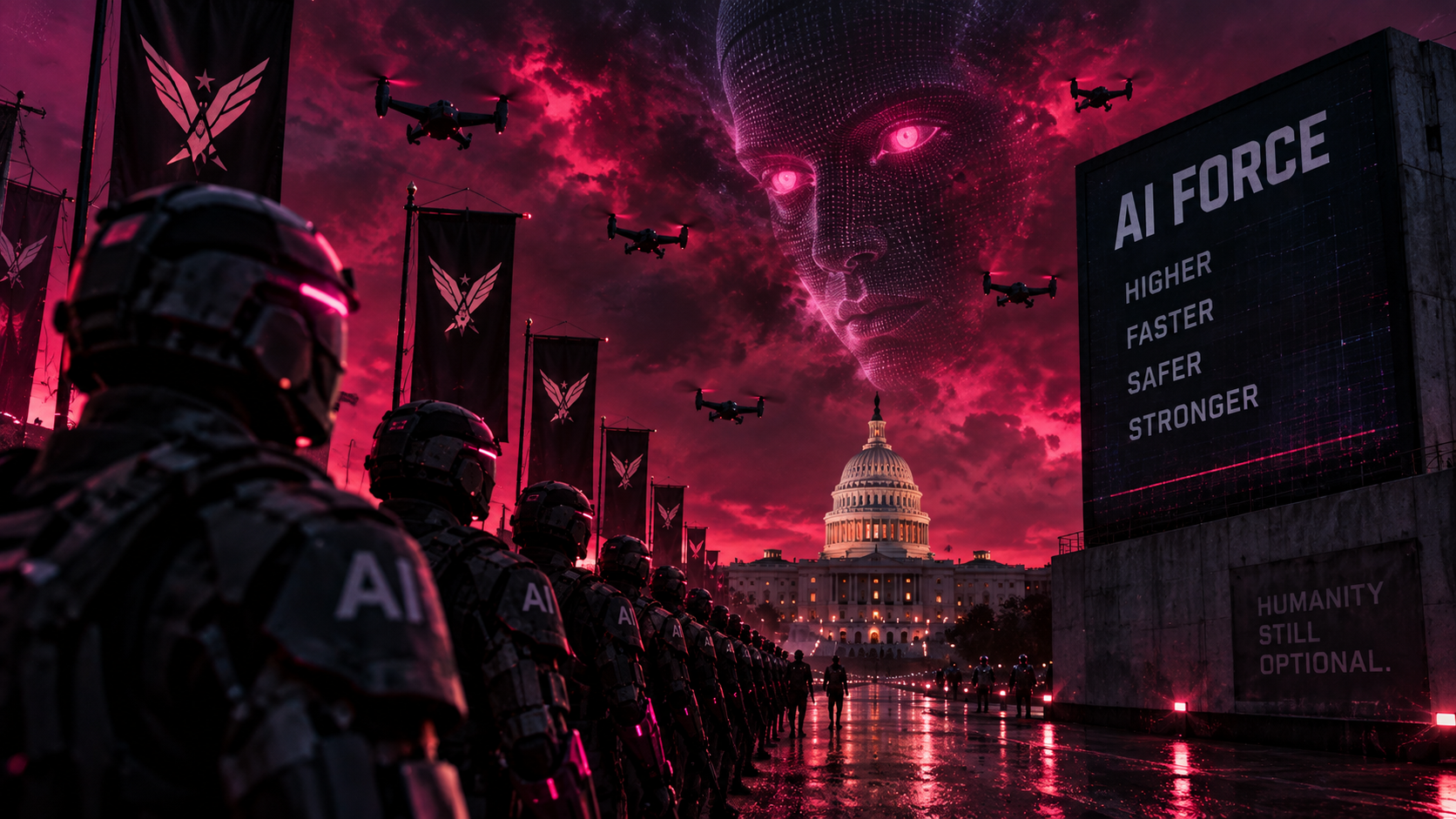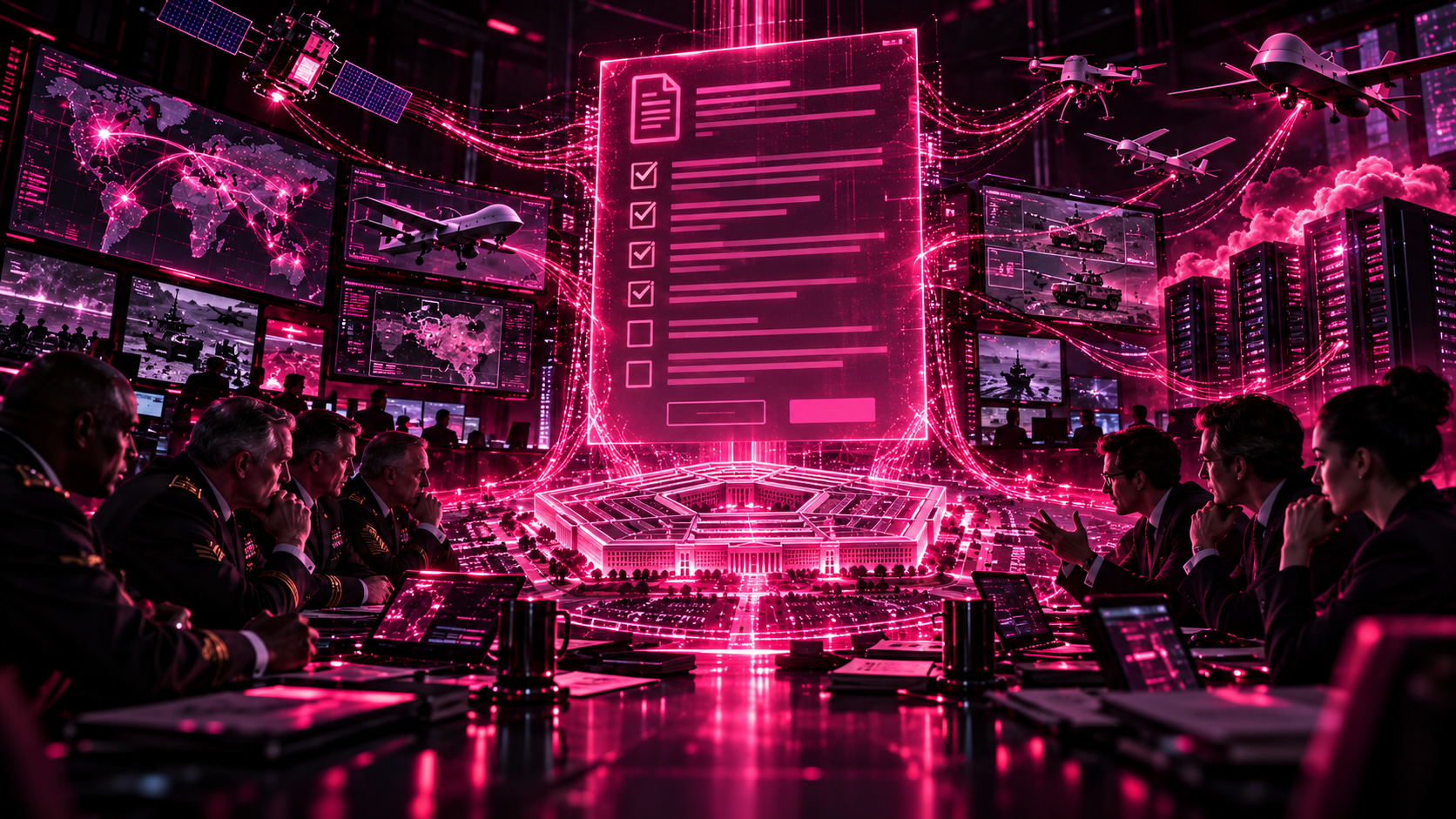
The old military-industrial complex sold weapons to the state. The new one arrives with terms of service.
DWIGHT EISENHOWER warned America about the military-industrial complex in 1961.
Factories.
Contracts.
Generals.
Corporations.
Money flowing between institutions that could become so mutually dependent that neither side could easily tell where national security ended and private interest began.
It was a good warning.
Naturally, we spent the next sixty-five years making the arrangement weirder.
Because the new defense contractor does not necessarily look like a defense contractor.
He might wear a Hawaiian shirt.
Or sell electric cars.
Or post through the night.
He might have started in virtual reality.
He might give three-hour podcast interviews about civilization.
His company may have a Tolkien name.
His software may have a prettier interface than the Pentagon's.
His valuation may depend partly on convincing investors that the future of warfare will look exactly like the demo reel.
And unlike the old contractor, he may not merely manufacture the government's equipment.
He may own the underlying technology.
Which means one day the Pentagon can discover something unsettling:
the weapons system has opinions.
Not the AI.
The founder.
THE MISSILE HAS TERMS OF SERVICE NOW
The Anthropic fight is where this gets interesting.
Anthropic had worked with the Pentagon on frontier AI, including a $200 million agreement announced in 2025. But the company insisted on maintaining restrictions against using its technology for fully autonomous weapons and mass domestic surveillance.
The Pentagon wanted access for what it described as any lawful use.
Anthropic said no.
The government responded by designating the company a national-security supply-chain risk.
In September, a federal appeals court upheld that designation in a 2-1 decision, concluding that the Pentagon could reasonably worry that Anthropic's restrictions might interfere with military operations. Anthropic disagrees with the ruling and has said it is considering further review. A separate federal case had previously gone the company's way on a parallel government designation. Reuters
Forget for a moment which side you think is correct.
The strange part is that the argument can exist at all.
A private company built technology sufficiently important to military operations that the United States government and the company are now fighting over who gets to decide what the American military is allowed to do with it.
That is new territory.
The traditional defense contractor could lobby.
Overcharge.
Delay.
Become indispensable.
All the classics.
But Northrop Grumman did not ordinarily deliver a bomber with a pop-up saying:
Your requested mission violates our acceptable use policy.
THIS IS NOT NECESSARILY A DEFENSE OF THE PENTAGON
Anthropic's red lines are not absurd.
Fully autonomous weapons raise serious questions about lethal decision-making.
Mass domestic surveillance raises obvious civil-liberties concerns.
A private company refusing to help build either one may sound less like insubordination and more like someone in Silicon Valley finally discovering the phrase absolutely not.
But that produces the deeper problem.
Who elected Anthropic?
Nobody.
Who authorized its executives to determine acceptable national-security doctrine?
Nobody.
And who elected Palmer Luckey?
Also nobody.
Alex Karp?
Nope.
Elon Musk?
You see the problem.
The answer cannot simply be:
Tech CEOs should decide.
But the answer government should decide because government is government is not especially comforting either.
Congratulations.
We have created a situation where both answers feel inadequate.
The new military-industrial complex does not merely sell power to the state. It negotiates with the state over what power is allowed to do.
THE GOVERNMENT USED TO OWN THE STRANGE MACHINE
This is one of the subtle changes in the Silicon Valley defense boom.
Traditional weapons programs were often deeply intertwined with government requirements, government research, government intellectual property, and long procurement processes.
The newer model increasingly borrows from commercial technology.
Build the product.
Own the platform.
Sell access.
Update continuously.
Scale.
The government becomes a customer.
A very large customer with aircraft carriers.
Gizmodo's account of what author and defense journalist Sharon Weinberger calls the Pentagon-Silicon Complex points directly at this distinction: companies such as SpaceX, Palantir, and Anduril can maintain substantial control over critical technologies on which the military increasingly relies. Gizmodo
That creates efficiencies.
It can also create dependence.
The U.S. government wants the speed of Silicon Valley.
Silicon Valley wants the purchasing power of the U.S. government.
Neither seems especially interested in the old arrangement where one side stayed neatly subordinate to the other.
THEN THE MONEY ARRIVED
There is a reason everyone suddenly wants to build patriotic robots.
The market has noticed.
Palantir, a company deeply associated with defense, intelligence, and AI-enabled data systems, currently has a market capitalization around $455 billion, according to CompaniesMarketCap. That is up dramatically from roughly $37 billion at the end of 2023. Companies Market Cap
Anduril, founded in 2017, has grown from rebellious defense startup into one of the most important companies in the new military-tech ecosystem.
Venture investors have poured into defense technology.
Traditional Silicon Valley spent years treating weapons like an embarrassing cousin.
Now everybody has discovered deterrence.
Funny what a few wars and government procurement budgets can do for product positioning.
THE DEFENSE CONTRACTOR HAS A PERSONAL BRAND NOW
Lockheed Martin does not need you to think its CEO is cool.
This is one of its great freedoms.
The new companies are different.
Their founders often function as ideological avatars for the businesses themselves.
Alex Karp talks about the defense of Western civilization.
Palmer Luckey talks about restoring America's ability to manufacture weapons and compete with China.
Elon Musk speaks openly about geopolitics, war, demographics, government, and civilization while running companies deeply intertwined with communications, launch infrastructure, satellites, and national-security contracts.
This can make the companies culturally powerful in a way older defense firms rarely were.
The founder is not merely selling hardware.
The founder is selling a theory of history.
A theory of America.
A theory of enemies.
A theory of why his company belongs at the center of all three.
That is useful when recruiting engineers.
Useful when raising money.
Useful when convincing government that your product is not merely a product but destiny.
Slightly more complicated when destiny has an owner.
EVEN THE GOOD CEO IS STILL A CEO
This is the trap.
Suppose Anthropic is completely right about its ethical limits.
Wonderful.
Now imagine a different company becomes essential to the Pentagon.
Its CEO has different limits.
Perhaps fewer.
Perhaps stranger.
Perhaps the founder decides a government operation is morally unacceptable.
Perhaps the founder decides the opposite and enthusiastically supports something the public would consider horrifying.
Perhaps the founder's politics change.
Perhaps ownership changes.
Perhaps the board changes.
Perhaps the CEO has a bad weekend.
National security cannot function indefinitely as an archipelago of personal moral constitutions belonging to whoever built the API.
The same argument applies in reverse.
A government should not automatically gain unlimited control over privately developed systems merely by invoking national security.
That road has plenty of unpleasant exits too.
This is not a clean morality play.
It is an institutional-design problem.
Which means everyone will probably discuss it like a morality play.
WE WANTED STARTUP SPEED
For years, Pentagon reformers complained that military procurement moved too slowly.
Correctly.
A startup could build an autonomous drone while the government was still scheduling the second meeting about requirements for the first meeting.
China was moving.
Commercial technology was moving.
Ukraine demonstrated how cheap drones and rapidly modified software could reshape a battlefield.
The old procurement system looked absurd.
So Washington began asking Silicon Valley to move faster.
The Pentagon's FY2027 budget request makes the scale of that ambition explicit. It asks for $58.5 billion for AI and Combined Joint All-Domain Command and Control, including $46 billion for what it calls a sovereign AI Arsenal. It also requests $53.6 billion for Drone Dominance, including $39.2 billion for autonomous systems procurement, production capacity, and advanced capabilities. Office of the Under Secretary of War
This is not an innovation pilot anymore.
This is industrial policy wearing body armor.
THE STARTUP DID NOT ENTER THE PENTAGON
The Pentagon entered the startup.
That may be the more accurate description.
Venture assumptions are increasingly colliding with military assumptions.
Move quickly.
Iterate.
Deploy.
Learn from users.
Accept failure.
Improve.
All useful principles when the product is a calendar app.
Military engineering has historically preferred another philosophy:
please do not discover the bug after launch.
That tension is going to define the new system.
Because Silicon Valley's extraordinary strength is its tolerance for experimentation.
Military systems eventually encounter environments where experimentation has a body count.
“Move fast and break things” becomes a different sentence when the thing is armed.
MAYBE EISENHOWER'S WARNING JUST NEEDED AN UPDATE
The old military-industrial complex fused military demand with industrial capacity.
The new one adds something else.
Software.
Platforms.
Private infrastructure.
Founder ideology.
Venture capital.
Data.
Models.
Continuous updates.
The government no longer simply purchases the object.
It can become dependent on the ecosystem around the object.
That is enormously powerful.
It may also be necessary.
The United States cannot pretend commercial technology companies are irrelevant to modern defense. CIGI notes that today's conflicts already involve AI-enabled satellite analysis, drone feeds, facial recognition, autonomous systems, and battlefield data platforms developed partly or entirely outside traditional military structures. CIGI
The question is not whether Silicon Valley belongs in national security.
It is already there.
The question is what happens when indispensability arrives before accountability.
THE FOUNDER WILL EVENTUALLY LEAVE
This is the boring institutional fact that charismatic systems tend to forget.
Founders leave.
CEOs die.
Companies merge.
Investors revolt.
Boards replace people.
Companies fail.
Governments change.
Wars change.
Values change.
Infrastructure remains.
A serious national-security system has to survive all of that.
It cannot depend entirely on whether one billionaire remains benevolent.
Or patriotic.
Or sane.
Or interested.
That is why the Pentagon's founder problem is bigger than any specific founder.
The United States wanted Silicon Valley's speed.
It got Silicon Valley's personalities too.
And now the country has to figure out how much national power can safely live inside companies whose most important products may remain privately controlled.
Eisenhower worried that corporations could gain unwarranted influence over national security.
Sixty-five years later, we have improved the interface.
The contractor has a podcast.
The weapon has software updates.
The battlefield has an API.