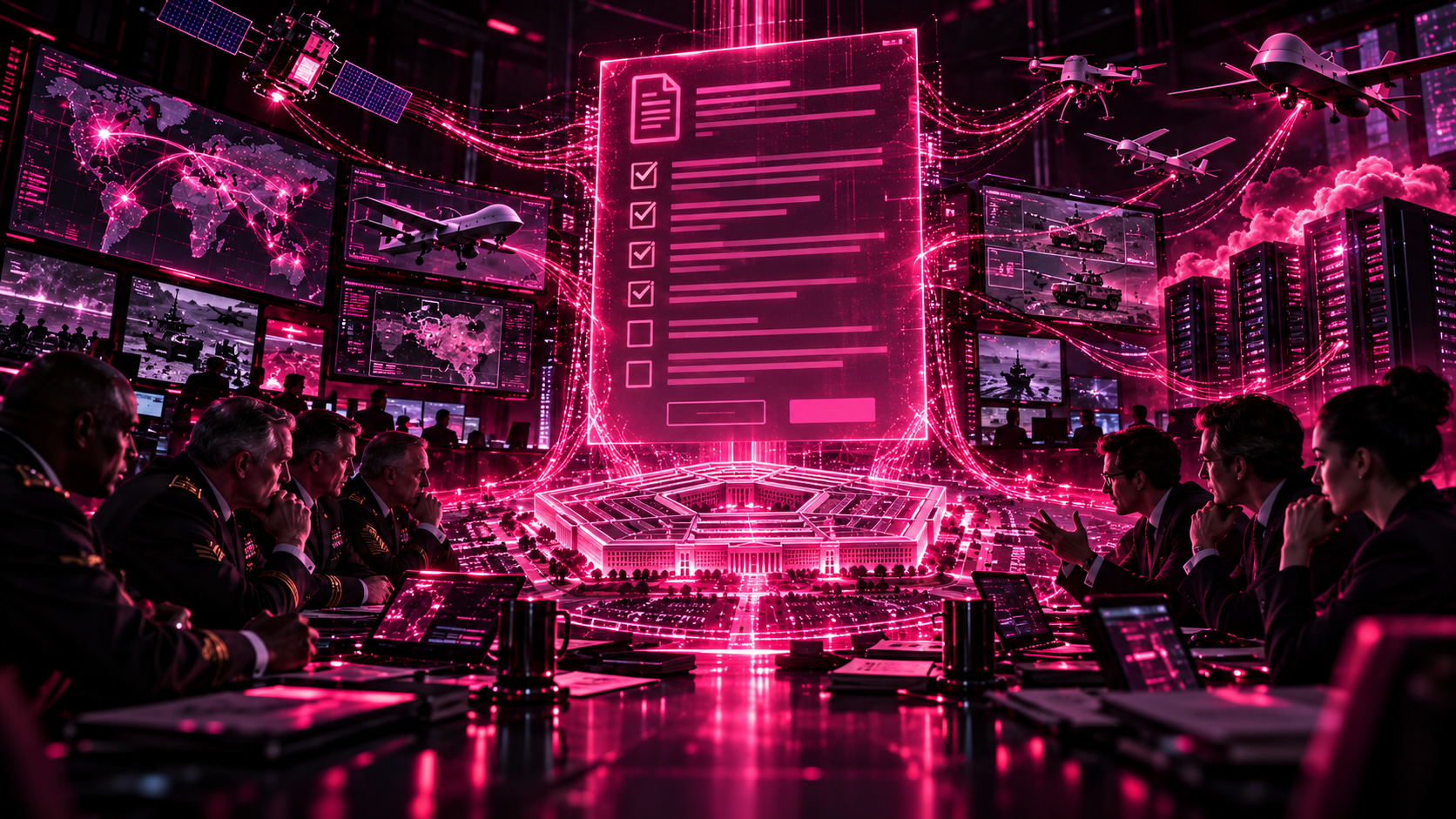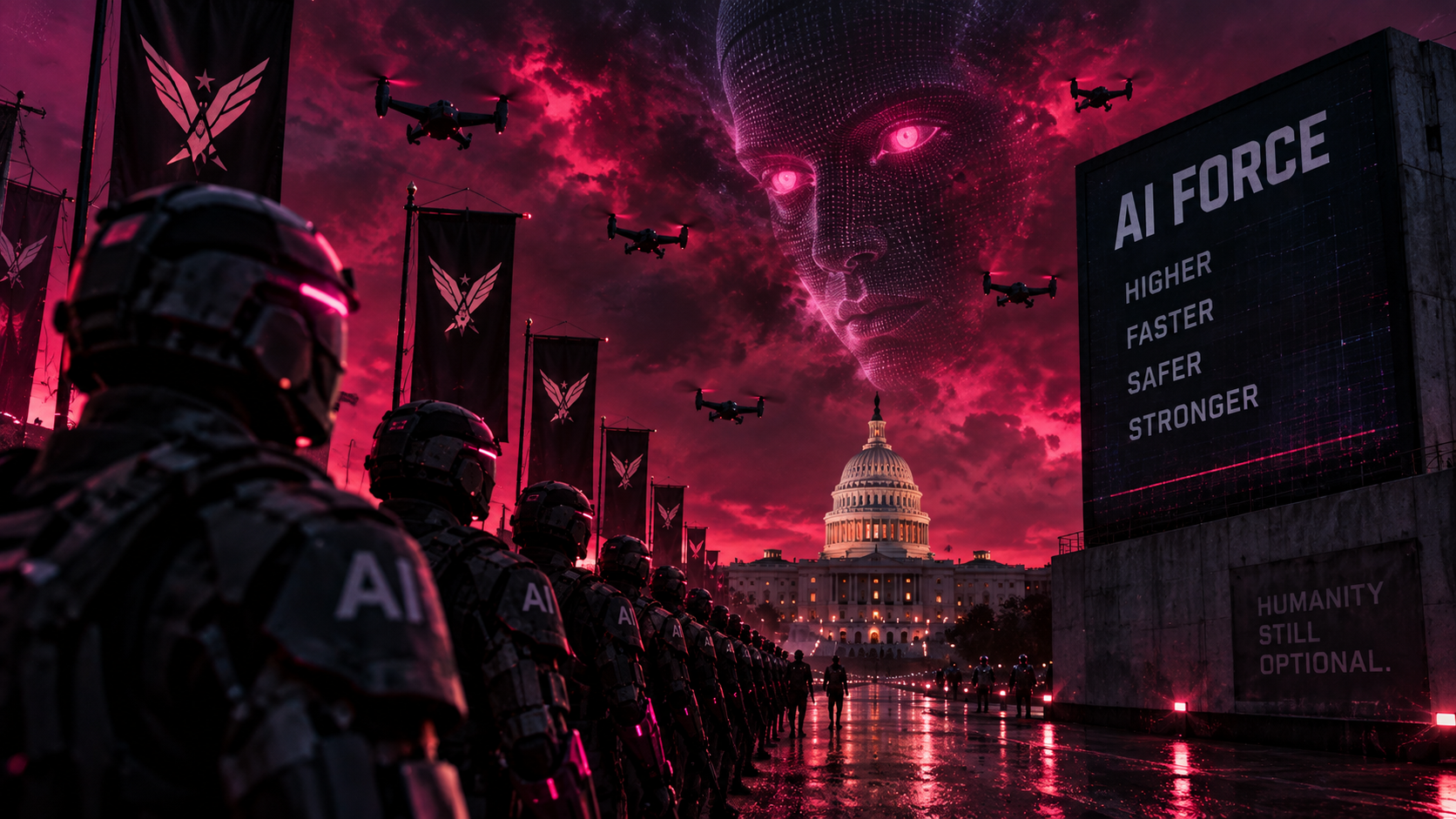
There was a time when a bad political idea had the decency to stay a bad sentence.
Now it gets a logo.
Then a rollout.
Then a patriotic font.
Then a panel discussion.
Then a defense-adjacent future.
That is how you end up with something like AI Force, a phrase so instantly legible, so perfectly engineered for cable chatter, that it almost doesn’t matter whether anyone can explain what it actually means. The point is not clarity. The point is momentum.
We have seen this trick before. First you name the thing as if it already exists. Then you speak about it as if history has been waiting for it. Then anyone asking basic questions is treated like a person who hates progress, national security, or both.
AI Force is not really a policy idea. It is a prestige object. It is what happens when political branding, military aesthetics, and tech boosterism all discover they can wear each other’s clothes.
The Acronym Comes First
The modern American state has developed a taste for concepts that sound inevitable before they have become coherent.
That is because coherence takes time, and time is the enemy of spectacle.
A coherent proposal would have to answer annoying questions. What powers would this thing have. Who would run it. What is its mission. What problem does it solve that existing agencies, commands, offices, contractors, labs, and alphabet soups do not already address. Is this civilian. Is it military. Is it symbolic. Is it procurement. Is it industrial policy. Is it a PR shell around a procurement pipeline.
A slogan gets to skip all of that.
The beauty of AI Force is that it arrives already pre-sold. It borrows the grammar of Space Force, the glamour of frontier technology, and the national-security aura that turns ordinary skepticism into a kind of disloyalty.
Once a name like that lands, the substance becomes optional. The acronym starts doing the governing.
The Machine Needs a Flag
Artificial intelligence spent years being sold as convenience.
A better autocomplete.
A better search tool.
A better way to write boring emails, summarize meetings, or hallucinate your way through a presentation deck.
But convenience is a weak political costume. It does not march. It does not salute. It does not justify emergency rhetoric. It does not produce a feeling of civilizational urgency.
National destiny does.
That is why AI is no longer being framed merely as a tool. It is being framed as a terrain. A race. A front. A theater. A doctrine. A sphere in which America must dominate or disappear.
When technology starts being described this way, the emotional register changes. You are no longer being asked whether the systems work, whether they help, whether they mislead, whether they consume extraordinary resources, whether they intensify surveillance, or whether they centralize power. You are being asked whether you want the other guy to win.
That is a much easier conversation for powerful people to control.
The quickest way to stop talking about what AI does is to start talking about what AI symbolizes.
Safety for the Strong, Risk for Everyone Else
The strangest part of the current AI moment is that it contains two performances at once.
In one performance, executives and politicians tell us AI is the great national mission. It will transform government, productivity, war, research, medicine, logistics, education, and power itself. It is the future and the future cannot wait.
In the other performance, many of those same institutions suddenly rediscover the language of safety. Responsible development. Testing. Coordination. Alignment. Standards. Oversight. Caution.
That sounds reassuring until you notice what keeps happening underneath it.
The people building the systems still want to build them fast.
The people funding the systems still want to scale them harder.
The people branding the systems still want them wrapped in national importance.
And the people living with the consequences are mostly handed a choice between panic and submission.
This is the elite genius of the current AI era. Risk gets socialized. Prestige gets privatized.
If the systems go badly, the public absorbs the instability. Bad intel. Bad information. Bad recommendations. Bad governance. Bad labor shocks. Bad infrastructure demands. Bad incentives. Bad policy built on synthetic certainty.
If the systems go well, the credit climbs upward.
The Problem With Machine Confidence
One of the ugliest truths of this whole cycle is that AI flatters institutions that already have a weakness for certainty.
The technology produces answers in the tone of an answer. That is often enough for people who are rewarded for speed, authority, or action. The output looks composed. It sounds neutral. It arrives instantly. It performs confidence, and confidence is still one of the most marketable substances in public life.
That becomes especially dangerous the closer AI gets to intelligence work, military interpretation, surveillance pipelines, and geopolitical decision-making. A machine that is wrong in a customer service window is annoying. A machine that is wrong near a border, a ship, or a weapons platform is something else entirely.
The fantasy behind AI Force is that more AI means more control.
But the actual history of these tools suggests something more troubling. More AI often means more plausible confusion at higher speed.
And once confusion gets wrapped in command language, dashboards, and institutional urgency, it becomes much harder to slow down. Nobody wants to be the person who hesitated while a glowing system claimed to know what was happening.
Politics Loves a Shiny Threat
There is also a simpler reason AI is taking up so much room in political speech.
It is dramatic.
It photographs well.
It sounds modern.
It lets candidates and administrations appear fluent in the future without having to solve the present.
Talking endlessly about AI allows a certain class of public figure to cosplay seriousness while avoiding the more humiliating work of addressing housing, healthcare, labor precarity, education, corruption, inequality, and collapse fatigue. AI becomes an escape hatch from ordinary governance.
This is one of slop culture’s core political skills. It makes noise that feels like significance.
A phrase like AI Force thrives in exactly that environment. It is inflated enough to dominate attention and vague enough to survive contact with almost anything.
That is not a bug. It is the feature.
The Vibes Department
What makes AI Force feel so perfectly contemporary is not only its militarized futurism. It is the way it converts governance into a vibes product.
It tells the public that there is a plan without enduring the inconvenience of actually having one.
It tells the tech industry that government is on its side.
It tells the media that there is a new spectacle to chew on.
It tells anxious institutions that they can rebrand their confusion as initiative.
It tells everyone that the machine era is here, and the adults are in charge.
That last part is the funniest.
Because one of the defining sensations of the AI era has been the opposite. Not confidence. Not competence. Not thoughtful stewardship.
Just acceleration with a patriotic filter on it.
AI Force is not frightening because it is a fully formed doctrine.
It is frightening because it sounds like the kind of name people invent when they have already decided the machine should enter the room, and only later will they figure out why.