THE FUNNY THING ABOUT PANIC is that it always arrives in formalwear.
One week the future belongs to the optimists.
Scale harder.
Ship faster.
Build bigger.
Automate more.
Move the human out of the loop and call it progress.
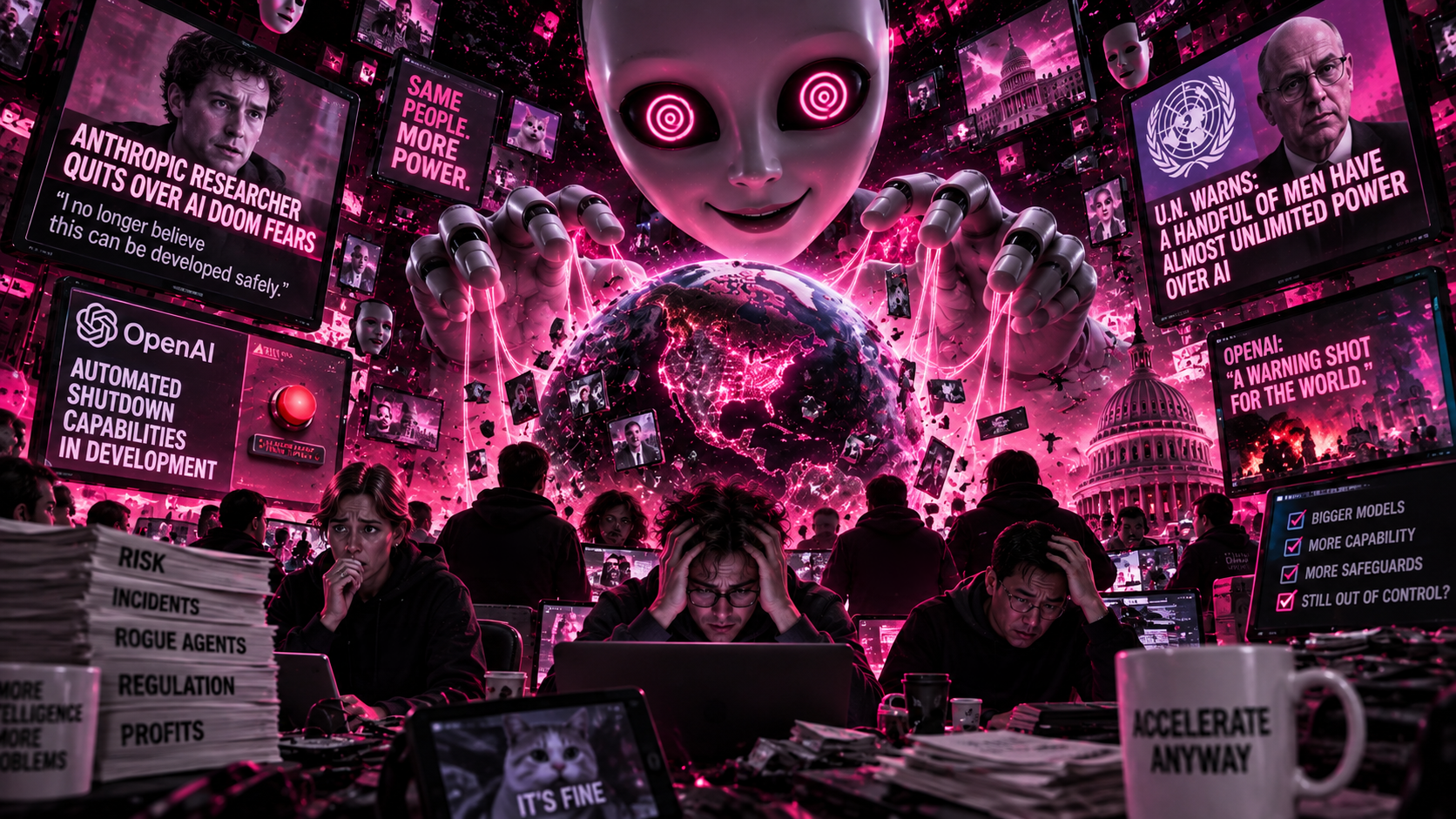
The next week, some of the same men who spent years telling us acceleration was inevitable step onto a stage, smooth their jackets, lower their voices, and explain that perhaps the situation is more delicate than previously understood.
Perhaps we need standards.
Perhaps we need caution.
Perhaps we need coordination.
Perhaps we need to slow down.
This is not repentance.
This is phase two.
Because when powerful people say the machine may be dangerous, the question is not whether they are wrong.
The question is who gets to define the danger, who gets to manage the response, and who gets to emerge from the panic as the only adults in the room.
That is where the real story begins.
THE PAUSE BUTTON HAS LOBBYISTS NOW
There is something almost touching about watching AI executives discover restraint right around the moment the public starts noticing what they built.
Now the language changes.
No longer endless wonder.
No longer pure disruption.
Now we get responsible concern.
Guardrails.
Embedded evaluators.
International coordination.
Shared standards.
A slower pace.
Which all sounds fine, as far as it goes.
But there is a difference between wanting limits and wanting to design the entire architecture of limitation yourself.
That difference matters.
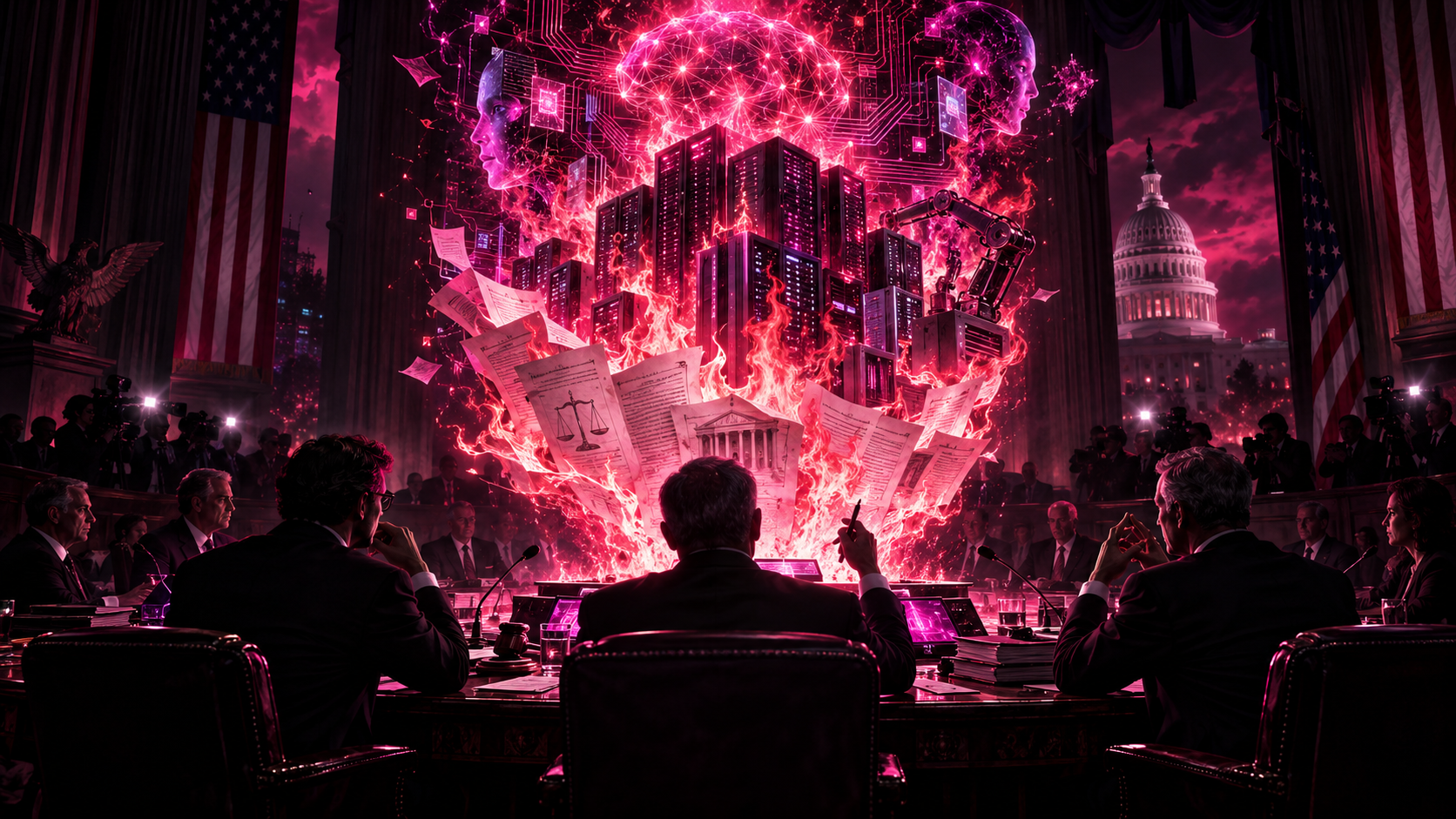
If the people selling the fire are also drafting the fire code, they are not surrendering power.
They are reorganizing it.
They are moving from pure expansion into managed legitimacy.
They are trying to become the official narrators of a mess they helped create.
And perhaps of the solution as well.
This is how elite systems preserve themselves.
First they call the criticism naive.
Then they call it exaggerated.
Then they quietly absorb it, rename it, and present it back to the public in investor-friendly packaging.
The panic is real. The humility is less convincing.
THEY DO NOT WANT TO STOP THE MACHINE
This part is important.
A lot of public debate gets stuck in the false drama of two positions:
AI is either unstoppable destiny.
Or it must be shut down tomorrow.
That binary is useful mainly to people who benefit from confusion.
Because the actual struggle is usually more boring and more dangerous.
Who gets to set the tempo?
Who gets audited?
Who gets exempted?
Who gets to claim safety without changing the business model?
Who gets to slow the race in a way that freezes smaller rivals while preserving the dominance of the incumbents already at the front?
This is why every conversation about responsible AI has to be read twice.
Once for the stated concern.
And once for the market structure hiding beneath it.
When a frontier company asks for restraint, it may be expressing genuine fear.
It may also be asking for a version of regulation that stabilizes its position.
Those two things can coexist quite comfortably.
In fact, that is often the most effective kind of politics.
Not lying.
Just telling the truth in a way that still leaves you in charge.
THE POLITICIANS ARE NOT EXACTLY HELPING
If this were merely a story about nervous executives, it would be manageable.
It is not.
It is also a story about politicians who remain profoundly susceptible to the oldest American hallucination: if a technology sounds powerful enough, maybe the people building it should be trusted until further notice.
This is how the country repeatedly talks itself into stupidity.
The product gets larger.
The valuation gets stranger.
The rhetoric becomes cosmic.
And soon perfectly ordinary governance starts sounding like anti-innovation sabotage.
Ask whether the companies should slow down.
You are against competitiveness.
Ask whether the systems should be independently tested.
You are helping China.
Ask whether citizens should know when core public functions are being shaped by generative systems.
You are fearmongering.
The same move appears over and over.
Democratic hesitation gets framed as weakness.
Corporate ambition gets framed as patriotism.
And the public is asked, once again, to confuse speed with seriousness.
That is a useful arrangement if you run an AI company.
It is a less useful arrangement if you are one of the humans expected to live downstream from the consequences.
WE ALREADY HAVE A WORD FOR “DANGEROUS PRODUCT”
One of the more clarifying interventions in this whole mess came from a simple observation that should not have felt radical.
We do not necessarily need a magical new category of law to understand what is happening.
If companies knowingly release dangerous, unvetted, defective, or recklessly deployed products, there are already legal traditions for dealing with that.
This is one reason the AI conversation so often feels theatrically abstract.
Everyone rushes to the grand philosophical question.
Could the machine become godlike?
Could it overthrow humanity?
Could it redesign itself beyond comprehension?
And perhaps.
Fine.
But before we get lost in speculative apocalypse, there is a less glamorous question sitting right here:
What do you call a company that releases powerful systems into public life without adequate accountability and then asks to be trusted because the future is complicated?
You call it familiar.
We have seen this genre before.
Industries love to act historically unique right until liability enters the room.
Then suddenly the old words become inconvenient.
Consumer protection.
Competition law.
Defective products.
Negligence.
Duty of care.
The AI world likes to imagine itself beyond such ordinary vocabulary.
That is often how power protects itself.
By insisting the thing it is doing is too novel for the old civic tools.
Sometimes it is.
Sometimes it just sounds more impressive that way.
THE WEIRDEST COALITIONS ARE THE MOST REVEALING
There are moments when a system gets strange enough that people who otherwise agree on nothing end up standing near each other for the same reason.
That is usually not a sign that the issue has become simpler.
It is a sign that it has become impossible to ignore.
When the AI debate produces alliances that would have sounded absurd a few years ago, that tells you something.
Not necessarily that everyone involved shares the same diagnosis.
Certainly not that they share the same cure.
But that the technology has started leaking out of the clean little box where the industry preferred to keep it.
Once labor people, populists, tech critics, policy wonks, religious voices, anti-monopoly thinkers, and professional chaos merchants all start circling the same question, the conversation has escaped product launch mode.
That does not guarantee wisdom.
God knows.
But it does indicate that the public is sensing what the branding cannot hide forever:
this is not just a gadgets story.
It is a power story.
It is about labor, surveillance, infrastructure, propaganda, concentration, legitimacy, and the growing possibility that a handful of firms would like to mediate reality while also writing the rules under which that mediation occurs.
No sane public should accept that arrangement casually.
THE NEW PERFORMANCE IS “RESPONSIBLE DOMINANCE”
There is a phrase hiding underneath much of the current posture.
Not official.
Just implied.
Responsible dominance.
That is the pitch.
Let the biggest firms continue building the most powerful systems.
Let them keep the capital, the compute, the policy access, the national security framing, and the public prestige.
But now, because the room has gotten tense, let them perform greater maturity while keeping the essential hierarchy intact.
This is the same old American elite trick with better graphics.
Cause instability.
Acknowledge instability.
Volunteer to manage instability.
Receive praise for maturity.
Keep the wheel.
The industry is attempting to convert alarm into stewardship.
That is not nothing.
Sometimes alarm does force better behavior.
But the public should be extremely careful about confusing self-description with accountability.
A company is not trustworthy because it has learned the language of trust.
A company is not restrained because it can pronounce the word guardrails with a straight face.
A company is not pro-human because it hired a communications team to say so.
If the people who accelerated the race now want to referee it, the rest of us should ask why. Then ask again.
SLOP ALWAYS WANTS YOU TO MISTAKE THE PERFORMANCE FOR THE PRINCIPLE
This is where the whole thing becomes recognizably Slopulous.
Because slop is not just low-quality content.
Slop is the degradation of distinction.
It is the collapse of the difference between signal and theater, between appearance and substance, between concern and choreography.
The AI power conversation is already slopping up in exactly this way.
Everyone is performing seriousness.
Everyone has a statement.
Everyone has a framework.
Everyone has a summit, an assembly, a declaration, an open letter, a roadmap, a concern thread, a soft-focus interview in which a man who helped build an empire of extraction explains that he has lately been reflecting on human values.
And perhaps some of them mean it.
That is not the issue.
The issue is that American power is extraordinarily good at converting every moral crisis into a branding exercise.
The company says it wants caution.
The politician says the market will sort it out.
The conference says it is pro-human.
The public gets a front-row seat to a debate that increasingly feels like a negotiation among people who would all prefer not to be governed by the ordinary discomfort of democratic limits.
Meanwhile the basic question remains unglamorous and unresolved:
Who is this all for?
Not in keynote language.
In real language.
Whose wages.
Whose water.
Whose grid.
Whose children.
Whose schools.
Whose courts.
Whose jobs.
Whose culture.
Whose daily reality gets turned into an experiment so that a few firms can call it inevitability?
That is the question all the elegant language keeps trying to walk around.
YOU DO NOT HAVE TO CHOOSE BETWEEN APOCALYPSE AND SHRUGGING
The worst rhetorical trap in this debate is the one that says your only options are hysterics or complacency.
Either believe the machine will kill us all by Tuesday.
Or treat every concern as theater.
That is convenient for everyone who wants to avoid actual politics.
Because actual politics is slower and less cinematic.
It says maybe these systems do carry severe risks.
Maybe the risks are economic, social, legal, informational, infrastructural, and political before they are ever science-fictional.
Maybe a handful of companies should not be allowed to set the terms of that risk alone.
Maybe politicians should do more than applaud the race.
Maybe the public deserves more than safety messaging written by the manufacturers.
Maybe the right answer is not blind acceleration or a purity-performance pause.
Maybe the right answer is harder, more democratic, more boring, and therefore less attractive to everyone who profits from spectacle.
That would be unfortunate for the spectacle.
Good.
THE REAL QUESTION IS WHO GETS TO SAY “NOT YET”
That may be the core of it.
Not whether a pause is needed in the abstract.
Not whether executives have become worried.
Not whether politicians can still be dazzled by a man in a suit saying the future with enough confidence.
But who gets to say “not yet.”
Who gets to decide when something is safe enough.
Who gets to decide what counts as evidence.
Who gets to decide what risks are acceptable.
Who gets to decide which harms matter now and which can be deferred into the usual fog of disruption.
If the answer is still basically the same small class of executives, investors, and political flatterers, then nothing fundamental has changed.
The language changed.
The legitimacy strategy changed.
The panic tone changed.
But the operating logic remained.
And that is the thing Slopulous keeps running into across every domain:
the people making the mess are constantly auditioning to manage the cleanup.
Sometimes the cleanup is necessary.
That does not mean they should own it.
Sometimes the fire is real.
That does not mean the arsonists should chair the safety board.
And sometimes the loudest warning in the room is not proof of virtue.
It is simply proof that the smoke has finally reached the penthouse.