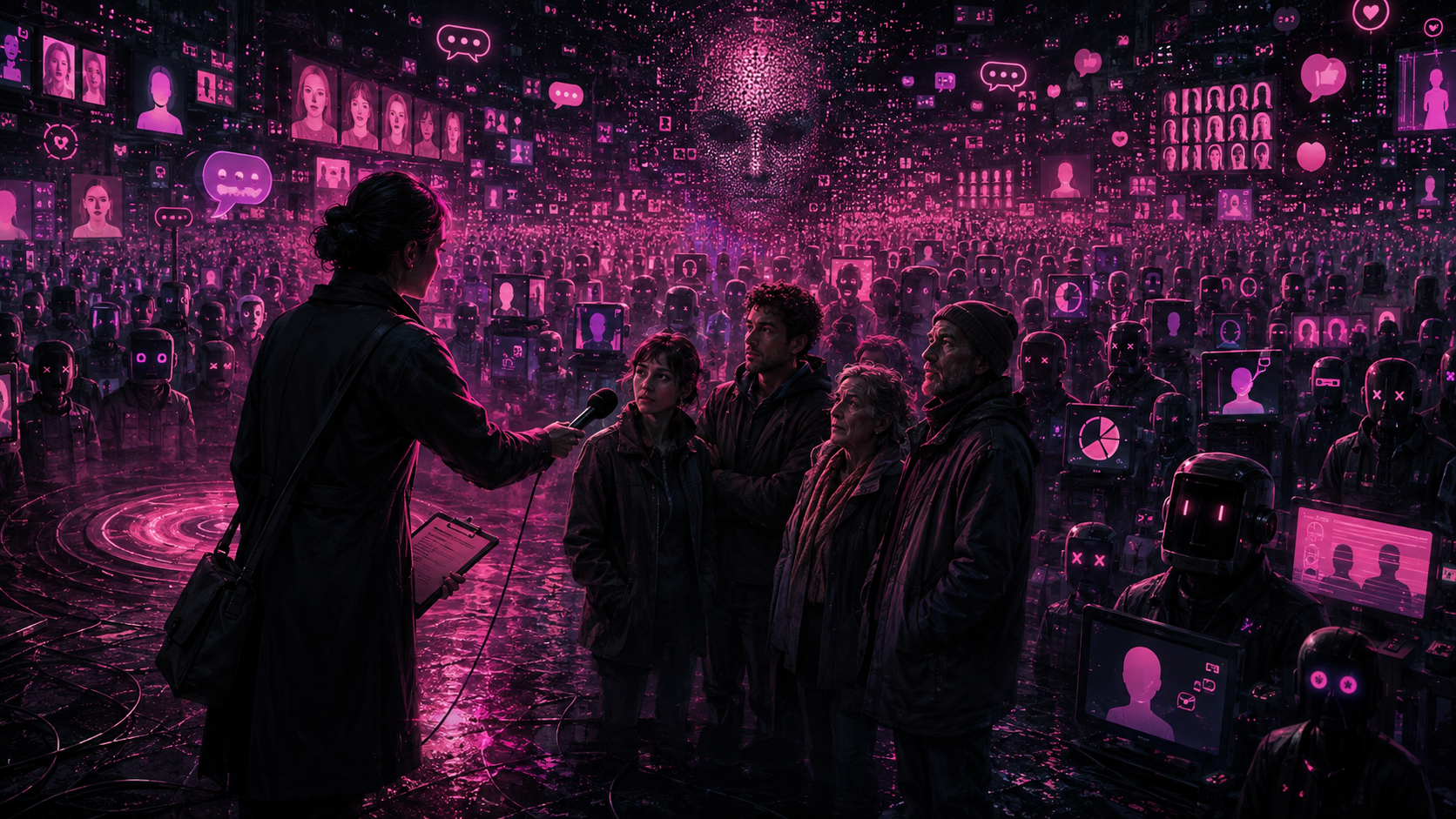
The internet contains more opinions than any civilization in history. Increasingly, it is unclear how many of them belong to people.
WHAT DO AMERICANS THINK?
This used to require an annoying amount of work.
Find Americans.
Ask them.
Make sure the sample isn't terrible.
Weight the results.
Call people who absolutely do not want to talk to you.
Explain margin of error to cable-news hosts who will immediately ignore it.
Polling is an imperfect science.
But there was something philosophically elegant underneath it.
Want to know what people think?
Ask people.
Apparently even this workflow needed disruption.
We Have Invented Synthetic Citizens
Pew Research Center warned this year about a practice sometimes called silicon sampling.
Instead of surveying human respondents, researchers ask AI systems to simulate how different demographic groups might answer.
There is a certain Silicon Valley beauty to this.
Why bother asking Republicans when the computer has apparently met several?
Pew notes that existing studies have found these synthetic respondents can stereotype groups, underrepresent some viewpoints and underestimate the genuine disagreement present in public opinion.
Most importantly, Pew makes a wonderfully old-fashioned point:
The purpose of polling is to find out what real people think.
I support this radical position.
At some point, a model of the public stops being public opinion and becomes extremely confident fan fiction about the public.
The Survey Respondent May Also Be Fake
Unfortunately, asking humans online has its own new problem.
Pew says bad actors can use AI to generate fraudulent survey responses at scale, particularly in opt-in polling where participants can sign themselves up online.
Imagine being the bot assigned to complete 400 consumer-sentiment surveys.
A difficult life.
No health insurance.
Never receives the gift card.
This creates a wonderfully circular crisis.
Companies want to know what humans believe.
Some ask AI to imitate humans.
Other surveys accidentally receive AI pretending to be humans.
Then humans read headlines about what humans supposedly believe.
Modern democracy is doing great.
Social Media Is an Even Worse Poll
Of course, most of us do not read actual polling methodology.
We perform polling ourselves.
Open feed.
Look around.
Wow. Everyone is furious about this.
Sample size:
whatever the algorithm selected while you were on the toilet.
Scientific.
The mistake is understandable because social media presents opinion visually.
A post has 80,000 likes.
There are thousands of comments.
The same viewpoint appears repeatedly.
This feels like measurement.
It isn't.
It is distribution.
Your feed was never randomly sampled from the citizenry.
It was ranked.
Selected.
Predicted.
Personalized.
Sometimes promoted.
Possibly manipulated.
Maybe bot-assisted.
Potentially clipped.
Then presented in a continuous stream that creates the psychological sensation:
This is what people are talking about.
That is an extraordinary amount of epistemological weight to place on infinite scroll.
The Crowd Is Becoming Easier to Manufacture
The deeper problem is social proof.
Humans care what other humans think.
This appears to be one of our less successful evolutionary features, but here we are.
Lots of people buying something?
Interesting.
Lots of people laughing?
Maybe funny.
Lots of people furious?
Perhaps I should also be furious.
An apparent crowd changes behavior.
Which makes crowds commercially and politically valuable.
And once an apparent crowd has value, somebody will manufacture one.
Followers.
Comments.
Reviews.
Survey responses.
Clip accounts.
Engagement pods.
Bot networks.
Synthetic personas.
Trend simulation.
The mechanism changes.
The product is the same:
Other people already believe this.
The cheapest way to persuade a social animal may be to fabricate the other animals.
But Those Likes Are Numbers
Yes.
Numbers generated by a private platform's interface.
That should not be confused with the Census.
Follower counts have themselves become less useful as algorithmic feeds increasingly distribute individual posts beyond a creator's existing audience. Creator-economy executives told TechCrunch late last year that follower totals matter less precisely because modern recommendation systems decide distribution post by post.
This creates bizarre cultural objects.
Person with 8,000 followers.
Clip gets 12 million views.
Is that person famous?
Kind of.
Nobody knows.
We are increasingly using metrics whose cultural meaning changes underneath us.
Views.
Followers.
Likes.
Trending.
Engagement.
All sound precise.
None necessarily answers:
How many people actually care?
Everybody Is Shadowboxing
This is where fragmented feeds start doing something psychologically ugly.
You see a ridiculous opinion.
Someone responds furiously.
Then someone responds to the response.
Soon thousands of people are arguing about the kind of person who supposedly believes the original ridiculous opinion.
Maybe fifteen people actually did.
But the response to those fifteen people reached twelve million.
Now the minority position has become a major cultural phenomenon through opposition.
Congratulations.
We invented a new type of person to be angry at.
This happens constantly.
Some random account says something stupid.
Screenshot.
Viral.
THIS IS WHAT THE LEFT THINKS.
Another random person says something stupid.
Screenshot.
THIS IS MAGA NOW.
One college student.
One suburban dad.
One professor.
One influencer.
One freak.
All promoted to ambassador.
The internet is full of unpaid diplomats.
The Opposition Is Algorithmically Selected Too
There is another wrinkle.
Your feed doesn't only learn what you like.
It learns what you like hating.
This matters because outrage is attention.
The most irritating possible representative of the opposing worldview may therefore be more valuable to the recommendation system than a reasonable one.
You come away thinking:
How can anyone believe this?
Meanwhile, someone else's feed has selected the dumbest person from your side.
They are asking the same question.
Two people sit three houses apart, each receiving professionally optimized evidence that the other has lost their mind.
Good luck with the homeowners association meeting.
Real Opinion Is Messier Than Content
Pew's criticism of synthetic polling contains a detail I find strangely comforting.
AI simulations tend to understate disagreement.
Of course they do.
Human beings are inconvenient.
Ask ten people the same political question and eventually someone will begin talking about their uncle.
Models prefer categories.
Real populations contain:
contradictions,
low information,
mixed beliefs,
changed minds,
people who misunderstand the question,
people who hate both options,
people who have not thought about the subject once,
and one man who desperately wants to discuss zoning.
That mess is public opinion.
The mess is the point.
Maybe We Don't Know What Everyone Thinks
This may be another sentence worth rehabilitating:
I don't know what everyone thinks.
It feels weak online.
The whole performance of posting demands instant sociological certainty.
Americans are tired of...
Gen Z wants...
Women are rejecting...
Men believe...
Conservatives have decided...
Liberals can't understand...
Have they?
Which ones?
How many?
Compared with when?
Measured how?
Social media gives us unprecedented access to individual voices and somehow encourages us to make increasingly ridiculous generalizations about populations.
The irony is impressive.
There Is Still a Place Called Outside
Actual public opinion remains measurable.
Imperfectly.
Polls.
Elections.
Surveys.
Behavior.
Membership.
Attendance.
Purchases.
Real-world institutions.
Talking to people.
None gives complete truth.
But together they are better than assuming your For You page has achieved representative sampling.
And there is something else these methods have in common.
They encounter friction.
Real people are inconvenient.
They don't answer properly.
They contradict your segmentation.
They ruin the clean narrative.
Good.
A real public should occasionally surprise the people trying to describe it.
If your model of society perfectly confirms everything you already thought about every group you dislike, you may not have discovered public opinion.
You may have discovered your content preferences.
We Should Probably Keep the Humans
AI can help researchers.
Clean data.
Translate.
Code responses.
Find patterns.
Detect fraud.
Wonderful.
But there is a category error hiding inside the idea that simulated humans can ultimately substitute for asking humans what they believe.
A population is not simply an answer distribution.
It is people.
Living through events.
Changing.
Disagreeing.
Misunderstanding.
Being inconsistent.
That is democracy's annoying raw material.
Maybe we should resist optimizing it away.
The internet has never contained more apparent opinion.
What it contains increasingly less reliably is evidence that the apparent opinion corresponds to an actual crowd.
So when somebody says:
Everyone thinks this now.
Maybe ask the most unfashionable question on the modern internet:
Did anyone actually ask them?