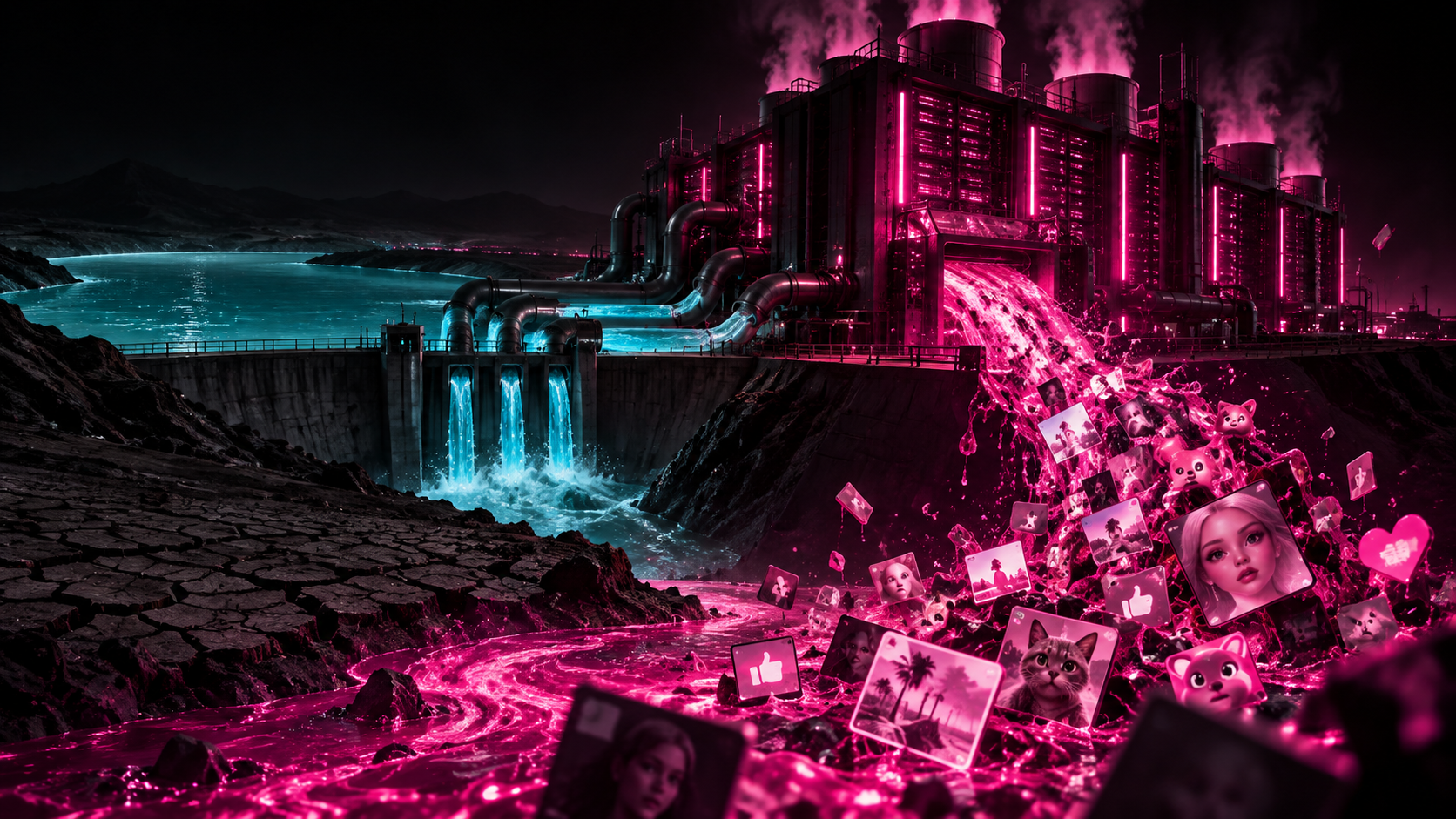
The internet used to feel weightless. Now every stupid image, endless prompt, and synthetic video is attached to pipes, pumps, cooling towers, power plants, and somebody’s water.
THE STRANGEST THING about artificial intelligence is how clean it looks from this side of the screen.
You type.
It answers.
No smoke.
No factory.
No delivery truck.
No pallet wrapped in plastic.
No pile of scraps on the floor.
Ask for an email.
Ask for a picture.
Ask for forty pictures because the first thirty-nine made the guy’s hands look like ceremonial forks.
Ask a chatbot whether your coworker secretly hates you.
Generate a fake Pixar trailer about your dog.
Generate twelve more.
Nothing appears to have happened.
The little cursor blinks.
The answer arrives.
The cloud has performed another miracle.
Except the cloud is a building.
The building is hot.
The heat has to go somewhere.
And increasingly, somewhere in that chain, there is water.
Quite a lot of it.
The United Nations University published a report this year estimating that by 2030 the water footprint associated with global data-center electricity use could reach 9.3 trillion liters per year, roughly equivalent to the basic annual domestic water needs of 1.3 billion people in Sub-Saharan Africa. The same research projects global data-center electricity demand could reach 945 terawatt-hours by then.
Suddenly the phrase AI slop sounds more literal.
The slop is thirsty.
WE CALLED IT THE CLOUD BECAUSE “INDUSTRIAL COOLING COMPLEX” WAS BAD MARKETING
The cloud may be one of the great branding achievements of modern technology.
Cloud.
Soft.
White.
Weightless.
Somewhere above us.
A little vapor where your photos live.
Nobody would have adopted The Enormous Warehouse Full of Computers That Gets Extremely Hot with quite the same enthusiasm.
But that is closer to the physical reality.
AI runs on servers.
Servers use electricity.
Servers make heat.
Heat needs to be removed.
Depending on how a data center is built and where its electricity comes from, water may be consumed directly through cooling systems and indirectly through the power plants producing its electricity.
Lawrence Berkeley National Laboratory has found that water use varies enormously depending on cooling architecture, climate, workload, and power source. Its U.S. data-center research also shows the growing role of GPU-heavy AI servers in electricity demand.
This is important because the internet loves a simple number.
One prompt uses X bottles of water.
One image drinks Y ounces.
Very shareable.
Frequently misleading.
There is no universal amount of water consumed by every AI query.
A prompt running in a cool region on a particular machine powered one way is not environmentally identical to the same prompt running somewhere hot, dry, and dependent on water-intensive electricity.
The machine does not have one thirst.
It has geography.
The cloud has a zip code.
And that zip code matters.
THE REALLY WEIRD PART IS THAT WE ARE USING INDUSTRIAL INFRASTRUCTURE TO MAKE ABSOLUTE NONSENSE
There are uses of computing where large resource requirements are at least easy to understand.
Climate modeling.
Drug discovery.
Weather forecasting.
Engineering.
Medical research.
Scientific simulation.
Then there is:
make Popeye look like a Balenciaga model.
The environmental problem gets culturally stranger once generative AI moves from occasional tool to infinite-content machine.
Because slop has no natural stopping point.
If one synthetic image costs almost nothing to the person requesting it, why make one?
Make twenty.
If a six-second AI video does not work, regenerate it.
Again.
Again.
Make the cat talk.
Now make the cat president.
Now put the president-cat in Minecraft.
Wrong aspect ratio.
Again.
The United Nations University report makes the scale difference between AI activities unusually concrete. It estimates that a typical AI-generated image can require around 1,450 times the energy of a basic text-classification task. A complex generated video can carry an electricity-associated water footprint of roughly 4.1 liters, compared with about 29 milliliters for an AI-generated image, depending on the assumptions used in the analysis.
One image is not draining Lake Erie.
That is not the point.
The point is volume.
Slop is a volume business.
THE FIRST ENVIRONMENTAL PROBLEM WAS TRAINING. THE NEXT ONE IS US.
For years the environmental discussion around AI focused on training.
Training the enormous model.
The giant compute run.
The spectacular number.
That made intuitive sense.
Training looks like the expensive part.
Then the model finishes training and millions of people begin asking it things.
Billions of times.
Every day.
That second phase is called inference.
And according to the UNU analysis, inference now represents an estimated 80 to 90 percent of AI energy use once systems are deployed at scale.
This changes the shape of the problem.
The resource footprint is no longer merely something that happened once in a laboratory.
It happens when we use the thing.
And use it.
And use it.
And regenerate it because the first answer was too long.
And regenerate it because the second answer used a word we did not like.
And ask another model to summarize the first model.
And ask a third model to turn that summary into a LinkedIn post.
And then ask a fourth one to make the LinkedIn post “sound more human.”
We have built a machine that can consume industrial resources in order to simulate the exact amount of human effort we were trying to avoid.
Beautiful.
EFFICIENCY WILL SAVE US, RIGHT?
This is usually where technology offers its favorite answer.
Efficiency.
The chips will improve.
Cooling will improve.
Models will improve.
Data centers will recycle more water.
And all of that is happening.
Microsoft, for example, says newer direct-to-chip cooling designs can save more than 125 million liters of water per facility annually, and the industry is experimenting with air cooling, closed-loop systems, reclaimed water, and other approaches designed to reduce freshwater demand.
Good.
Seriously.
More of that.
The problem is that efficiency has a terrible habit of making things cheaper.
And cheaper things get used more.
This is the old rebound effect.
You make the machine dramatically more efficient.
Wonderful.
Then someone notices that generating video is now cheap enough to put inside every social app on Earth.
The savings disappear underneath demand.
The UNU report explicitly warns about this. Lower per-query resource use can be overwhelmed by exploding volume as AI becomes cheaper, faster, and embedded in more products.
You improve the straw.
Then everybody starts drinking from ten straws.
THE SLOP ECONOMY HAS NO CONCEPT OF “ENOUGH”
This is the part that feels less like an engineering problem and more like a cultural one.
AI researchers can make the systems more efficient.
Data-center engineers can improve cooling.
Utilities can reuse water.
Governments can require better reporting.
All necessary.
But none of those things answer the stranger question:
Why are we generating so much garbage?
The economics of slop are brutally simple.
Creation approaches zero cost.
Distribution approaches zero cost.
Attention remains valuable.
Therefore make more.
More articles.
More thumbnails.
More songs.
More videos.
More fake influencers.
More fake podcasts.
More children's cartoons made by nobody.
More product reviews for products nobody touched.
More inspirational images of cabins that do not exist.
More reels.
More posts.
More content about the content.
The machine makes abundance technically possible.
The platform makes abundance financially rational.
Then the physical world gets handed the bill.
Slop feels infinite because the interface hides everything that is finite.
Electricity is finite.
Water is local.
Land is somewhere.
Minerals came out of something.
Servers become waste.
The scroll just keeps going.
SOMEBODY LIVES NEXT TO THE CLOUD
This is where the abstraction breaks.
A data center is not built in cyberspace.
It gets built beside somebody.
Beside roads.
Beside substations.
Beside farms.
Beside neighborhoods.
Inside watersheds.
The UNU report points to places including Querétaro, Mexico, where compute infrastructure is expanding amid prolonged drought conditions, and Uruguay, where plans for a water-intensive data center became politically contentious during a severe water crisis. The report's broader point is not that every data center causes a local water emergency. It is that global AI services can produce concentrated local costs while the benefits are consumed somewhere else.
That asymmetry is worth sitting with.
A teenager in London asks for a video.
A marketing agency in New York regenerates 300 backgrounds.
A bot farm somewhere produces 80,000 posts.
The infrastructure serving all of it may be pulling electricity, land, and water from a place whose residents did not ask to become the plumbing behind the global content machine.
The prompt is global.
The pipe is local.
WATER IS A TERRIBLE RESOURCE TO ABSTRACT
Carbon is strangely easy to turn into accounting.
Tons.
Credits.
Offsets.
Targets.
Water resists this because water is radically local.
A gallon in Finland is not environmentally equivalent to a gallon in Arizona.
The significance changes with drought, watershed health, season, competing agricultural use, population, local infrastructure, and whether the water is potable, reclaimed, or otherwise sourced.
That is why organizations such as the Water-AI Nexus are pushing the industry toward a more location-specific approach to data-center water use rather than treating every liter as environmentally interchangeable. The initiative brings water utilities, researchers, and technology companies together around both reducing the water needs of AI infrastructure and using AI to improve water management itself.
This is the reasonable version of the conversation.
AI can help solve water problems.
AI also uses infrastructure with a water footprint.
Both things can be true.
Slopulous does not need AI to be Satan.
Reality is much more interesting than that.
THE PROBLEM IS NOT THAT YOU ASKED CHATGPT ONE QUESTION
Environmental conversations become useless when they turn ordinary people into tiny moral criminals.
Did you ask AI to fix an Excel formula?
Congratulations.
You destroyed a wetland.
That is dumb.
Individuals matter at scale, but the important decisions are structural.
What models become defaults?
Which tasks are routed to enormous models when smaller ones would work?
How long are default responses?
What resolution does an image generator use?
Does every search need generative AI?
Does every app need a chatbot?
Does every email need to pass through a language model?
Does the toaster need intelligence?
Must the toothbrush summarize my brushing journey?
The UNU researchers make essentially this argument when they call for “fit-for-purpose” AI, meaning using the lightest model and lowest-energy format that actually solves the problem.
That sounds boring.
Good.
We desperately need boring.
MAYBE NOT EVERYTHING NEEDS TO BE GENERATED
There was a brief period when generating something felt magical.
Write me a poem.
Make me a picture.
Turn this into a video.
Now the magic is becoming plumbing.
AI is being inserted into everything because inserting AI into everything is currently considered evidence of innovation.
We rarely ask whether the thing being generated needed to exist.
That may become one of the defining questions of the next phase of the internet.
Not:
Can AI make it?
Obviously.
The more useful question:
Was this worth making?
Was the twentieth synthetic thumbnail worth computing?
Was the thousandth SEO article?
Was the fake product reviewer?
The six-hour playlist of machine-made music?
The automatically generated corporate podcast nobody will hear?
The children's video assembled because an algorithm noticed that toddlers click brightly colored trucks?
Every piece is tiny.
Every cost is dispersed.
Every individual act feels meaningless.
Then you multiply by billions.
That is slop's favorite mathematical trick.
Nothing matters individually.
Everything matters collectively.
THE MACHINE DOES NOT DRINK. THE SYSTEM DOES.
This distinction matters too.
There is something silly about saying AI is “drinking the water.”
The model is not thirsty.
It has no mouth.
The system we built around it is thirsty.
Our demand is thirsty.
Our business model is thirsty.
Our insistence that every digital surface become generative is thirsty.
Our refusal to distinguish useful computation from industrial-scale filler is thirsty.
The machine just reveals the strange physicality underneath digital culture.
The internet was never immaterial.
We were simply very good at hiding the machinery.
Now the machinery is getting large enough that the pipes are becoming visible.
And perhaps that is useful.
Because slop becomes harder to dismiss as harmless clutter once you remember that clutter has infrastructure.
There are servers behind the fake article.
Cooling behind the fake photograph.
Electricity behind the fake video.
Water somewhere behind the electricity.
People living beside the water.
The scroll eventually reaches the ground.
FROM SLURP TO SLOP
This may be the perfect environmental symbol for the generative internet.
A machine uses extraordinary engineering, expensive chips, huge capital, global electrical infrastructure, cooling systems, data centers, and actual water in order to produce:
another picture of Jesus made out of shrimp.
Civilization is incredible.
The answer cannot be that every AI query is immoral.
It cannot be that technology stops.
It probably cannot even be that AI uses no water.
Factories use resources.
Hospitals use resources.
Farms use resources.
Libraries use electricity.
Human activity has a footprint.
The question is what we are spending that footprint on.
Useful work?
Scientific discovery?
Accessibility?
Education?
Tools people genuinely need?
Great.
But if an increasing share of the machine exists simply to produce more disposable material for an attention economy already drowning in disposable material, then the environmental question becomes inseparable from the cultural one.
We are not merely consuming resources.
We are consuming resources to manufacture things designed to be forgotten almost immediately.
That is the slop problem in its purest form.
Water becomes electricity.
Electricity becomes computation.
Computation becomes content.
Content becomes a swipe.
Then it disappears.
And somewhere far away, the cooling tower keeps running.