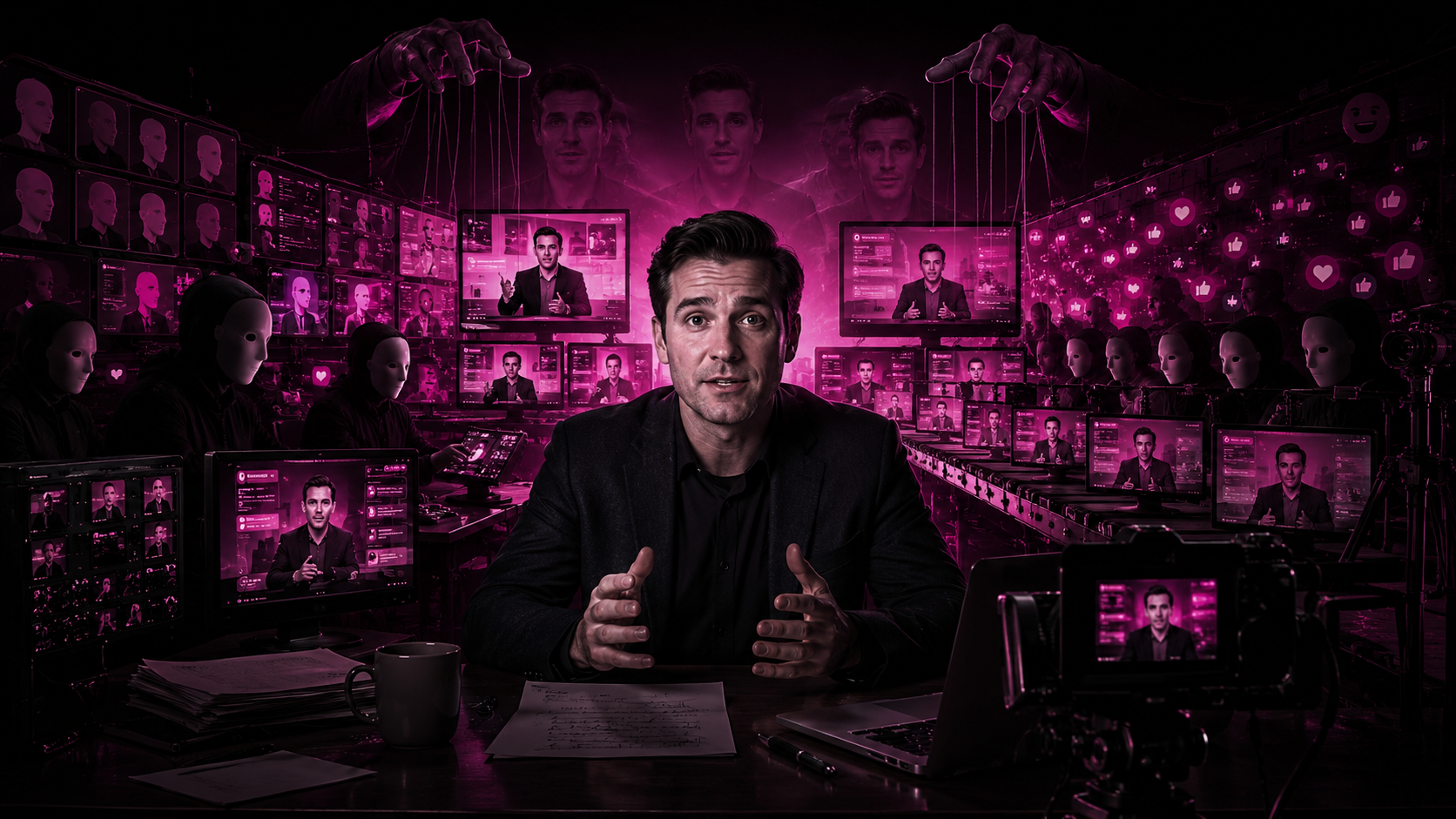
He looks real because he is. The news operation is the fictional part.
THE MAN AT THE KITCHEN TABLE LOOKS NORMAL.
This is important.
He is not shimmering.
His fingers are correct.
His face does not melt into the wall.
There is no robotic voice saying:
WELCOME BACK TO AMERICA PATRIOT NEWS 24.
He is just a guy.
Middle-aged.
Button-down shirt.
Kitchen table.
Camera.
Speaking directly to you about politics with the casual authority of somebody who has apparently been furious about municipal policy for years.
You have seen this person before.
Not literally.
The type.
He looks like your neighbor who started reading city budgets after the HOA tried to fine him for a boat.
Which is exactly why this works.
The newest form of AI slop may not need an artificial human.
It only needs a real human willing to play one.
We Finally Fixed the AI Face Problem
For several years, fake media had a convenient weakness.
It looked fake.
The avatar had waxy skin.
The voice had strange emphasis.
The eyes were spiritually absent.
You could sometimes identify AI content because the machine had been kind enough to leave fingerprints everywhere.
So somebody found a solution.
Hire an actor.
Semafor reported this week on a network of YouTube channels where paid spokespeople performed as supposedly independent political commentators. The videos used repetitive, apparently AI-assisted scripts, invented identities, supporting websites and social accounts that made the personas look like genuine media personalities. One interconnected network accumulated more than 45 million YouTube views.
Riddance researchers found more than a dozen of these personas and traced actors through gig platforms including Fiverr and Backstage. Some job listings offered about $26 per script.
This is incredible.
The future arrived.
It has a day rate.
The human is authentic. The identity is synthetic.
Meet William
Semafor opens its investigation with “William.”
William appears at his kitchen table.
He has millions of views.
He delivers political commentary.
He has a channel.
A persona.
A recognizable presentation style.
Except “William” is an actor.
Another supposed commentator, “Omar,” was also an actor.
Their videos were presented as if different individuals had independently decided to start talking about American politics.
They had not.
Semafor found formulaic similarities between the channels, repeated music, parallel topics and paid spokesperson arrangements.
This is what makes the scheme so much more interesting than an AI avatar.
There is no fake face to detect.
His pores are real.
His shirt is real.
His kitchen may be real.
The deception exists one layer above the pixels.
Who is this person supposed to be?
Authenticity Laundering
This deserves a phrase.
Authenticity laundering.
Take synthetic or industrially generated material.
Run it through an actual human body.
Now it feels human.
AI script.
Human voice.
AI thumbnail.
Human face.
Invented identity.
Real gestures.
Content farm.
Kitchen table.
The machine borrows the person's physical reality.
This is a remarkably effective way to defeat our little checklist for AI.
Hands okay?
Yep.
Lip sync?
Perfect.
Natural blinking?
Absolutely.
Congratulations.
You have authenticated the actor.
Not the operation.
YouTube's Labeling Problem Gets Weird Here
YouTube requires disclosure when creators use AI to meaningfully generate or alter realistic audiovisual content, such as making a person appear to say something they did not say. But YouTube explicitly says production assistance like AI-generated scripts or outlines does not by itself require disclosure.
That makes sense for normal creators.
A YouTuber asking ChatGPT to organize a video outline is not the same thing as fabricating footage of a senator robbing a bank.
But ghost creators expose an interesting seam.
What if:
the person is real,
the speech is actually spoken,
the script is AI-assisted,
the identity is invented,
the website is constructed,
and the appearance of independent political conviction is part of the product?
No fake video required.
The authenticity problem is organizational.
You cannot solve that with a watermark on the face.
The Website Is Part of the Costume
Riddance found that these personas did not exist only on YouTube.
They had websites.
Medium pages.
Spotify presences.
AI-generated headshots and thumbnails.
Everything needed to create the impression that you had stumbled onto an actual commentator with an actual little media operation.
This is my favorite detail.
The fake news personality has lore.
A homepage.
Cross-platform consistency.
Search results.
Maybe an About page.
The internet trained us to verify suspicious things by Googling them.
So slop learned SEO.
You search the commentator.
There he is.
Website.
Podcast.
Articles.
Social accounts.
Seems legit.
The verification process returns the infrastructure built specifically to satisfy the verification process.
Wonderful.
The fake person no longer needs to fool your eyes. He needs to survive your first Google search.
Nobody Had to Believe Anything
Here is where this gets stranger than propaganda.
Semafor's reporting describes these operations primarily as engagement businesses, not as traditional campaign shops or identified foreign influence operations. The operators monitored what performed, produced more of it and monetized the traffic.
That distinction matters.
A propagandist has a cause.
A content farm has analytics.
The speaker does not necessarily need a political worldview.
The writer doesn't.
The owner doesn't.
The system needs:
views.
Retention.
Comments.
Revenue.
Politics becomes a genre.
Like true crime.
Or celebrity gossip.
Except the product concerns real elections and real officials.
The Actor May Not Even Know the Whole Operation
Semafor contacted one performer, Frank George, who said he had been hired as a spokesperson through Fiverr, characterized the videos as paid advertisements, and said he did not know who ultimately funded the work beyond the broker that hired him.
Imagine that labor relationship.
You receive script.
Set camera up.
Read political monologue.
Upload.
Invoice.
Next.
Somewhere downstream, viewers perceive conviction.
Upstream, there may only be a task ticket.
This is industrialized sincerity.
The Cheapest Possible Pundit
Traditional political commentary is expensive.
Reporter.
Producer.
Research.
Editor.
Studio.
Legal review.
Institutional reputation.
You know what costs considerably less?
One AI-assisted script.
One actor.
One camera.
One thumbnail.
One channel template.
Repeat.
The Virelox operation described by Semafor had boasted about spinning up large numbers of creator accounts, with its founder describing a model heavily reliant on AI and “ghost creators.”
Media economics has finally discovered interchangeable pundits.
Lose William?
Fine.
Hire another William.
Real People Are the New Special Effect
We spent years preparing for artificial humans.
Perhaps we should have prepared for something more banal.
Cheap humans.
Human faces as production assets.
Human credibility rented by the script.
The actor solves the uncanny valley.
The AI solves the writing cost.
The algorithm solves distribution.
The website solves legitimacy.
The audience solves monetization.
Nobody needs to mastermind anything.
It is just a supply chain.
That is what makes it feel so Slopulous.
Verify the Person, Not the Face
The next time someone appears in a video confidently explaining politics, the useful question may no longer be:
Is this person AI?
That question has become too easy.
Try:
Who are they?
What have they published before?
Is this their real name?
Who owns the channel?
Who owns the website?
Does the supposed commentator exist outside the content network?
Is there an editorial organization?
A disclosure?
A biography that predates Tuesday?
Real skin is no longer enough.
The news anchor is a real person.
That may be the least informative thing about him.