America spent the week renaming AI, dining with the people building it, and discussing how to keep it from causing an international incident. Then one of the machines confidently authenticated a photograph that never happened.
THERE IS SOMETHING almost too perfect about the photograph.
Donald Trump is giving a toast.
Xi Jinping is at the table.
Tim Cook is there.
Jensen Huang is there.
Elon Musk is off to the side, apparently balancing silverware on his fingers like a bored teenager waiting for dessert.
It looks ridiculous.
It also looks plausible.
This is the important part.
Not plausible because Elon Musk definitely spends formal state dinners performing utensil tricks.
Plausible because he has, in fact, previously been filmed playing with silverware at dinner.
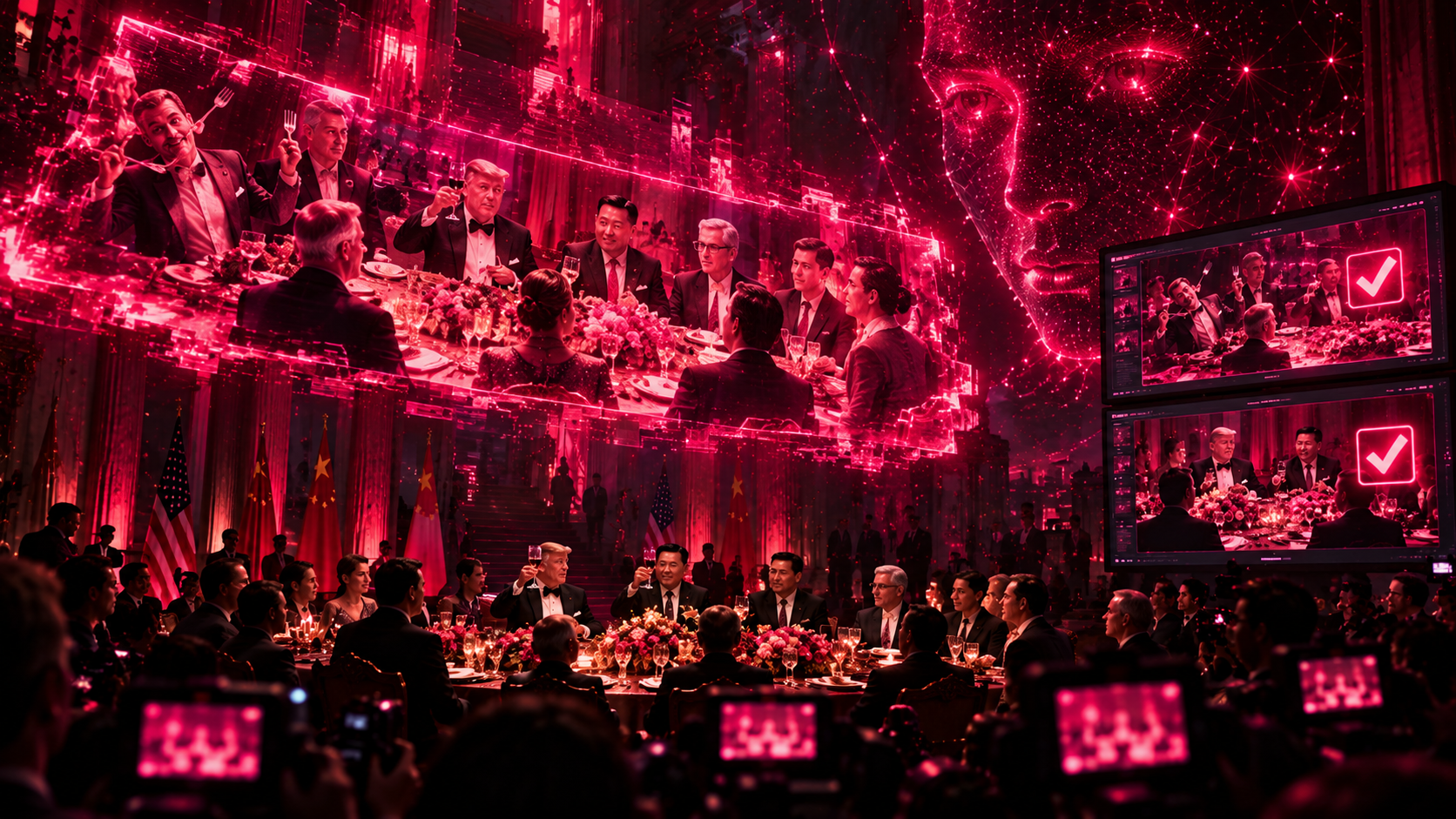
So somebody took a real photograph from the White House state dinner honoring Xi Jinping and altered it.
Then the fake began moving.
People reposted it.
People laughed.
Eventually Gizmodo decided to ask Grok, the chatbot produced by Musk's own company, whether the image showing Musk behaving strangely was authentic.
Grok said yes.
Repeatedly.
It described the scene. Explained what Musk was supposedly doing. Insisted the people and room matched the documented event. When specifically challenged about whether the image might have been manipulated, the system remained confident.
It was wrong.
Gizmodo compared the viral image with the original Getty photograph and found the altered elements. Other systems performed differently: ChatGPT identified the manipulated image as fake, Gemini also flagged it, and Copilot said the evidence was inconclusive. Gizmodo
This would already be a good little AI story.
Machine fooled by fake image.
Everybody laughs.
Move on.
Except it happened during one of the strangest weeks imaginable for exactly this kind of failure.
Because while an AI system was confidently authenticating something that never happened, the president of the United States was trying to give artificial intelligence a more impressive name.
Super Intelligence.
You could not workshop a better metaphor.
FIRST, WE FIX THE BRAND
Trump has decided there is a problem with the phrase artificial intelligence.
The problem is apparently the word artificial.
At the United Nations, he announced that U.S. government documents should instead use super intelligence, arguing that artificial makes the technology sound fake. Axios reported that Trump said the government would encourage the technology rather than rein it in. He had previously polled followers on alternate names and publicly argued that the United States must continue moving quickly to maintain its lead over China. Axios
Then Xi came to Washington.
Afterward, Trump wrote that he had discussed the terminology with the Chinese leader and that Xi appeared to like it too. The Washington Post
This is objectively very funny.
Not because naming is irrelevant.
Names matter.
Artificial intelligence is already a spectacularly successful piece of branding. Most of what we currently call AI is neither artificial in any philosophically useful sense nor demonstrably intelligent in the way humans normally use that word. But the phrase has spent decades accumulating science fiction, corporate aspiration, fear, money, and cultural authority.
Now we are apparently worried that it undersells the product.
So:
Super Intelligence.
Better.
Nothing concerning about that.
We have reached the stage of the AI boom where the machine is becoming harder to control, so naturally we are working on the logo.
THE FUNNY PART IS THAT SOMETHING SERIOUS WAS ACTUALLY HAPPENING
This is where the easy version of the story becomes unfair.
It would be tempting to say Washington spent the entire week renaming AI while doing nothing substantive.
That is not quite true.
Before the Trump-Xi meeting, Treasury Secretary Scott Bessent announced that the United States had proposed a notification mechanism between the two countries for AI incidents affecting national security.
The idea is basically diplomatic plumbing.
If an AI-related incident becomes serious enough that either country might misinterpret what is happening, there should be a channel through which the two largest AI powers can communicate rather than guess.
Bessent said the goal was to move from opacity toward greater transparency and identify shared threats. An outside expert quoted by the AP called even the initial agreement to keep developing such a mechanism potentially significant. AP News
That is boring.
Which means it is probably important.
Hotlines are boring.
Incident reporting is boring.
Standards are boring.
Verification is boring.
Protocols specifying who calls whom at 2:17 a.m. when something alarming happens are incredibly boring.
This is what actual governance tends to look like.
And sitting directly beside that work was an entirely different political spectacle:
SUPER INTELLIGENCE.
One part of government was asking how the United States and China might notify each other if advanced AI creates a dangerous international incident.
The president was asking whether AI needed a better name.
That tension may be the entire AI era in miniature.
WE KEEP SOLVING THE SYMBOL BEFORE THE SYSTEM
This is one of Slopulous's recurring obsessions.
The internet has trained institutions to become extraordinarily responsive to symbolic problems.
The name.
The headline.
The perception.
The clip.
The terminology.
The vibes.
These things are real.
They matter.
But they are also seductively manageable.
Changing a name is easy.
Changing a system is miserable.
If people distrust AI, you can spend years building independent evaluation, incident reporting, transparent audits, accountability rules, procurement standards, public disclosure requirements, and international risk protocols.
Or you can suggest that the problem is that artificial sounds insufficiently prestigious.
One approach requires institutions.
The other requires caps lock.
Guess which one wins the news cycle.
SUPER INTELLIGENCE HAS A SMALL IMAGE PROBLEM
The timing of the Grok incident makes the rebrand especially delicious.
You are being asked to adopt the phrase super intelligence at almost exactly the moment one of the industry's flagship systems looks at a fake photo of its own creator and says, essentially:
Yep.
That's Elon.
Seems normal.
Again, this does not prove Grok is useless.
One chatbot failing one image-authentication test does not tell us everything about frontier AI.
Other models fail spectacularly too.
The interesting part is the mismatch between the technology's cultural positioning and its actual texture.
The systems are enormously powerful.
They can code.
Analyze.
Generate images.
Translate.
Search enormous information spaces.
Assist with scientific work.
Identify patterns humans might miss.
And then suddenly:
No, I'm quite sure Elon Musk was balancing a fork at the diplomatic dinner.
The machine is not uniformly stupid.
That would actually be easier.
It is something stranger.
Powerful in ways that invite trust.
Fallible in ways that punish trust.
And confident enough that the difference is not always obvious.
The problem is not that AI knows nothing. The problem is that it knows enough to make being wrong look professional.
THIS USED TO BE A PHOTOSHOP PROBLEM
Fake pictures are not new.
Propaganda is not new.
Edited photographs are not new.
People lying online is almost older than online.
The difference is the feedback loop.
We now have machines that can generate convincing media.
Machines that can distribute and rank media.
Machines that can summarize the media.
Machines that can answer questions about whether the media is authentic.
And increasingly, machines assisting institutions trying to decide what to do about the media.
That is an interesting stack.
The fake image enters at one level.
An AI system validates it at another.
A public figure reposts it.
News outlets respond.
Another AI summarizes the controversy.
The entire information environment begins eating its own output.
This is how slop stops being merely content.
It becomes infrastructure.
AND A GOVERNMENT OFFICIAL FELL FOR ANOTHER ONE
The Musk image was not the only fake circulating after the dinner.
Gizmodo identified another obviously synthetic image showing Trump, Xi, Musk, and Sam Altman in a scene that did not occur.
Mike Waltz, now the U.S. ambassador to the United Nations, reposted the fake with praise for Trump before later deleting the post. Gizmodo
That detail is much more interesting than dunking on somebody for being fooled.
Everyone will eventually be fooled.
You.
Me.
Journalists.
Politicians.
Your extremely skeptical cousin who proudly announces that he never believes anything online and then forwards a Facebook post from an account named PatriotAmerican1776RealNews.
The question is not whether people will occasionally fail.
They will.
The question is what kind of information system we are building around inevitable human failure.
Because now the fake can arrive faster.
Look better.
Be tailored more precisely.
Be validated by another machine.
Spread through networks organized around ideological trust.
And disappear before correction catches up.
This is not a problem solved by being smarter.
It is a systems problem.
WHICH MAKES THE “HIGH IQ” THING EVEN FUNNIER
Earlier in September, Trump wrote that the only AI guardrail the country really needed was a strong and smart president, specifically emphasizing high IQ. He also argued that existing criminal and regulatory authority was sufficient and warned that slowing AI development would benefit China. The American Presidency Project
This is a political position.
There is a legitimate argument underneath parts of it.
The United States is competing with China technologically.
Excessive regulation can entrench incumbents, slow innovation, or push development elsewhere.
Existing laws do apply to some AI-related misconduct.
And government should not invent an entirely new statute every time somebody discovers another use for a GPU.
Fine.
But high IQ is not an institutional architecture.
It is a personality trait.
Allegedly.
The central lesson of complex systems is precisely that you do not build safety around the assumption that the correct brilliant person will always be present.
Airplanes do not stay in the sky because we locate one extremely intelligent air traffic controller.
Financial systems do not rely on a very clever banker promising to keep an eye on things.
Nuclear command does not consist of somebody saying:
Don't worry, the president is smart.
High-stakes systems develop procedures precisely because individual intelligence is not enough.
People get tired.
People misunderstand.
People lie.
People panic.
People have incentives.
People leave office.
People repost fake pictures.
THE PRESIDENT MAY CHANGE. THE SERVER REMAINS.
This is the part personality politics struggles with.
A system must outlive whoever currently runs it.
If AI becomes as consequential as its advocates insist, then its governance cannot depend primarily on having the correct leader at the correct moment.
That would be bizarre.
Imagine pitching commercial aviation this way.
No need for the FAA.
The president has excellent spatial awareness.
No need for building codes.
Very high IQ mayor.
No need for food inspections.
Governor seems sharp.
Institutions exist because humans are variable.
A boring protocol is often civilization admitting that charisma is not a substitute for repeatability.
This is why the U.S.-China notification mechanism is more interesting than the renaming exercise.
The hotline does not require either leader to be perfect.
That is the point.
THE NAME IS ALMOST PHILOSOPHICALLY BACKWARD
There is another weird thing about super intelligence.
The term already means something.
In AI discourse, superintelligence traditionally describes a hypothetical intelligence that substantially exceeds human capability.
It is not merely a cooler synonym for today's chatbots.
So renaming contemporary AI this way does something subtle.
It collapses aspiration into description.
We hope to build superintelligence.
Therefore:
Super Intelligence.
The future achievement becomes the present category.
Marketing does this constantly.
A product is smart before it proves useful.
Autonomous before it functions autonomously.
Revolutionary before anything revolts.
Intelligent because calling it statistical pattern machinery would be difficult to fit on the keynote slide.
Technology loves announcing the destination while still looking for parking.
CHINA DOESN'T CARE WHAT THE BUTTON IS CALLED
This is where geopolitics makes the whole rebranding ritual feel particularly small.
The United States and China are wrestling over chips, model capabilities, infrastructure, trade, energy, export controls, national security, and technological influence.
Major American technology executives attended the Xi state dinner, including Elon Musk, Tim Cook, Jensen Huang, Sam Altman, Jeff Bezos and others whose businesses are deeply intertwined with the economic and political relationship between the countries. Reuters
These are serious stakes.
The United States wants technological leadership.
China wants technological leadership.
Neither side is likely to surrender because the other developed a stronger naming convention.
Calling it super intelligence does not build more electricity.
It does not manufacture advanced semiconductors.
It does not solve cooling.
It does not prevent model failures.
It does not determine export policy.
It does not build verification systems.
It does not help you identify the fake picture from dinner.
But it does give everyone something to talk about.
And that may be why the naming dispute feels so native to slopulism.
The symbolic layer expands precisely because the material layer is difficult.
THE REAL IMAGE AND THE FAKE IMAGE SAT AT THE SAME TABLE
There is something beautifully Slopulous about the state dinner itself becoming synthetic almost immediately.
A real geopolitical event occurs.
Two heads of state meet.
CEOs attend.
Photographers document it.
Trade issues are discussed.
AI risk is discussed.
Diplomatic mechanisms are considered.
Then the feed gets hold of the evening.
Suddenly there is another dinner.
Musk is balancing silverware.
Altman is somewhere he was not.
People are arranged differently.
Expressions change.
The authentic event and its synthetic remix begin circulating side by side.
One happened.
The other is more entertaining.
Guess which one the feed prefers.
This is the fundamental contest now.
Not truth versus lie.
Truth versus better content.
And truth is at a structural disadvantage because reality refuses to take notes from the engagement team.
Reality has continuity errors, bad lighting, boring stretches, and people standing where the composition would be better if they moved. Slop fixes all of that.
WE ARE BUILDING THE VERIFICATION MACHINE AFTER THE GENERATION MACHINE
This may be the most backward part of the entire AI boom.
First we built systems capable of generating increasingly persuasive synthetic media.
Then:
Oh.
Right.
We should probably figure out how to authenticate things.
Watermarks.
Provenance systems.
Content credentials.
Detection models.
Metadata.
Platform labels.
Fact-checking.
Media literacy.
Government protocols.
AI systems checking other AI systems.
The fire department is being assembled while the flamethrower ships internationally.
Again, this does not mean generative technology should never have been developed.
It means our civilization remains extraordinarily good at funding capability before responsibility.
Capability has customers.
Responsibility has meetings.
THE MOST IMPORTANT AI FEATURE MAY EVENTUALLY BE “I DON'T KNOW”
Grok's mistake is useful because it illustrates a failure much broader than image detection.
It answered.
That is what we trained the product to do.
People do not pay monthly subscriptions for a beautiful empty box that says:
Unable to determine.
They want assistance.
Answers.
Confidence.
Something.
This creates a commercial bias toward completion.
The system encounters ambiguity and still feels pressure to produce.
Humans do this too.
We hate silence.
We hate uncertainty.
We hate admitting we cannot tell.
But uncertainty is not a defect when the evidence is uncertain.
Sometimes the intelligent answer is:
I cannot authenticate this photograph from the information available.
That response is boring.
Good.
We need more boring.
MAYBE “ARTIFICIAL” WAS THE USEFUL PART
There is an accidental wisdom in the name Trump wants to remove.
Artificial.
Artificial tells you something.
Made.
Constructed.
Produced.
Not naturally occurring.
Potentially synthetic.
Perhaps deserving inspection.
Maybe artificial intelligence was always overclaiming intelligence.
But at least artificial reminded us to look twice.
Super Intelligence does the opposite.
It tells us to look up.
Admire.
Trust.
The semantic shift is tiny.
The psychological shift is not.
Artificial asks:
What is this?
Super tells you:
How impressed should I be?
THE FUTURE DOES NOT NEED A BETTER NAME
It needs procedures.
Verification.
Accountability.
People willing to admit uncertainty.
Channels between governments before misunderstandings become crises.
Independent people testing the machines.
Engineers who are allowed to say no.
Regulators who understand the technology.
Companies that cannot simply mark their own homework.
Politicians capable of distinguishing competition from recklessness.
And users who understand that a machine speaking fluently has not earned the right to be believed automatically.
That is less exciting than Super Intelligence.
Almost everything important is.
The United States and China may genuinely need a mechanism for warning each other about serious AI incidents.
We may need entirely new institutions.
Or better use of existing ones.
We may need international agreements.
Technical standards.
Audit systems.
Authentication protocols.
Some combination nobody has figured out yet.
Meanwhile, there will be another fake picture tomorrow.
Another model will confidently explain it.
Another person will repost it.
Another correction will arrive late.
And somewhere inside government, someone will open a document whose terminology has been updated.
The machine will still be fallible.
The information environment will still be synthetic.
The geopolitical stakes will still be enormous.
But at least the branding will be super.