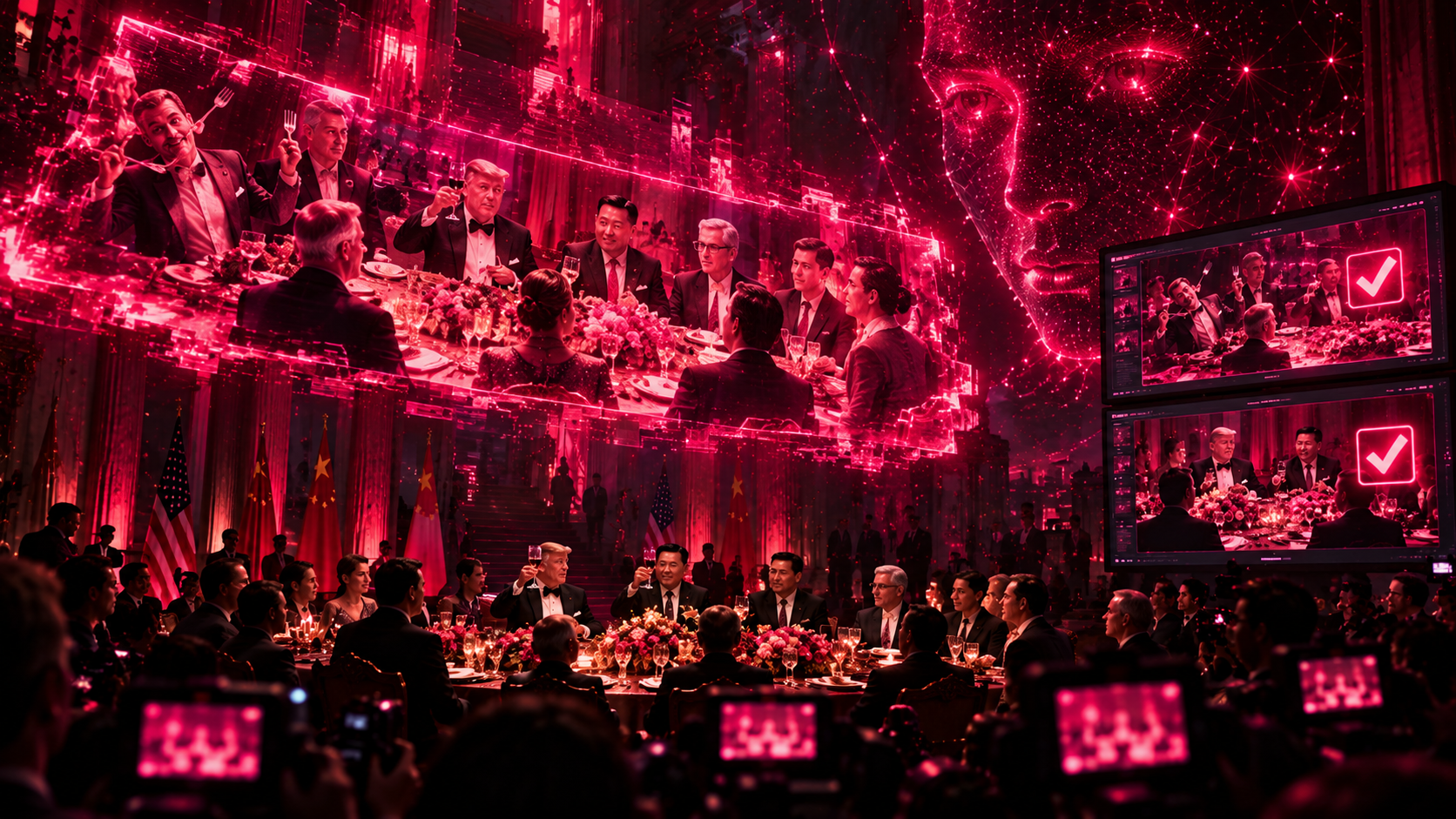
We used to argue about whether an idea would work. Increasingly, the first test is whether it feels right before the applause ends.
THERE IS A SPECIAL category of political idea that becomes more persuasive the less time you spend thinking about it.
You hear it.
Immediately:
Of course.
Finally.
Why aren't we already doing that?
Somebody should do something.
Common sense.
Then somebody reaches for a calculator and ruins the evening.
This happened rather spectacularly at the Republican midterm convention in Dallas.
President Donald Trump told the audience that if Republicans retained control of the House and Senate, every American adult citizen would receive a $5,000 payment, which he called the “Trump dividend.”
The crowd applauded.
The political story was complete.
Vote.
Win.
Five thousand dollars.
The difficult part came several minutes later, when everyone outside the arena began doing arithmetic.
With roughly the number of eligible adults involved, independent estimates put the potential cost above $1 trillion. Trump did not initially provide a financing mechanism, and such a payment would require congressional action. Republicans themselves immediately began arguing over the idea. Rep. Chip Roy questioned how the government would pay for it. Sen. Ted Cruz said the estimated $1.3 trillion cost was enormous and that details still needed to be worked out. Other Republicans defended the proposal's political focus on affordability.
None of this made the original sentence less powerful.
That is the interesting part.
THE NUMBER ARRIVED BEFORE THE MECHANISM
Five thousand dollars.
Excellent number.
Large enough to matter.
Small enough to imagine.
You can already spend it.
Car repair.
Credit card.
Rent.
Christmas.
Groceries.
A vacation you probably should not take but absolutely will.
The proposal did not initially need a 40-page economic framework because the number itself was doing the political work.
Trump tied the payment explicitly to Republican control of Congress. NPR reported him telling the convention audience, in essence, that if Republicans won, voters would win alongside them. At the same event, Trump also asked supporters to behave as if he personally were on the ballot, while Vice President JD Vance urged voters not to abandon the party over individual policy disagreements.
The message was not complicated.
Us wins. You win.
That is much easier to process than:
Here is a detailed fiscal proposal whose distributional effects, congressional pathway, revenue assumptions, borrowing implications, and potential inflationary effects require examination.
Try chanting that.
THIS IS NOT REALLY ABOUT THE $5,000
The payment could eventually be redesigned.
Means-tested.
Limited.
Funded differently.
Abandoned.
Passed in some altered form.
That is ordinary politics.
The interesting thing is the order in which the political product was assembled.
First came the emotional conclusion.
Then came the engineering.
This is increasingly how policy operates inside a feed-shaped political culture.
The proposal has to make immediate intuitive sense.
The mechanism can be patched in later.
The modern political idea increasingly arrives as a finished feeling attached to an unfinished spreadsheet.
THE BEST POLICY STORIES HAVE FOUR PARTS
A good feed-native policy proposal has a remarkably efficient structure.
There is a problem.
There is somebody responsible.
There is an obvious intervention.
There is a satisfying outcome.
That is all the nervous system needs.
Prices are high.
Give people money.
Housing is expensive.
Cap the price.
Jobs are disappearing.
Stop imports.
Taxes are unfair.
Tax somebody else.
College costs too much.
Make it free.
Crime is bad.
Increase punishment.
Healthcare is expensive.
Make the companies pay.
The examples can come from any political ideology because the mechanism is not ideological.
It is narrative.
Bad thing.
Cause.
Action.
Resolution.
That is an excellent TikTok.
Unfortunately, countries tend to continue existing after the fourth frame.
THEN WHAT?
This may be the most important political question nobody wants printed on a campaign sign.
Then what?
Suppose the government sends the checks.
Then what?
Where did the money come from?
Borrowing?
Taxes?
Tariff revenue?
Cuts elsewhere?
Does everybody receive it?
Does income matter?
Does citizenship status matter?
Does employment matter?
Does Congress authorize it?
Does the additional spending affect inflation?
Do people save it?
Spend it?
Pay debt?
What happens to interest rates?
Does the policy interact with other spending?
These questions do not automatically prove the policy is bad.
That distinction matters.
They prove that the sentence is not the policy.
Politics increasingly behaves as though asking those questions is somehow hostile to the moral intention behind the proposal.
It isn't.
It is what happens after the applause.
THE CONVENTION WAS ALMOST TOO PERFECT
The Dallas convention made this whole political aesthetic unusually visible.
Trump's $5,000 proposal dominated coverage precisely because it was simple, unexpected, personally branded, and immediately understandable. Reuters reported that some Republican candidates in competitive races were already distancing themselves from parts of Trump's agenda, while the convention itself remained heavily centered on Trump and his ability to motivate the party's base.
Then Vance took the stage the following night with a different version of the same emotional logic.
NPR reported that he urged voters who disagreed with Republicans on particular issues to support the party anyway because of what he described as the administration's broader accomplishments and the stakes of allowing Democrats to regain control. Trump followed him and again reminded the audience about the proposed $5,000 dividend.
This is normal coalition politics in one sense.
Every party asks supporters to tolerate disagreements.
But inside the feed, the policy details and the coalition story begin merging into one large emotional proposition:
Do you feel like we are on your side?
Increasingly, that may matter before anyone asks exactly what the proposal does.
VIBES ARE NOT NOTHING
This is where technocrats usually become unbearable.
They hear all of this and conclude that voters are stupid.
Wrong.
People live inside economies before economists measure them.
They know when groceries feel expensive.
They know when rent hurts.
They know when childcare consumes the paycheck.
They know when the job market feels hostile.
They know when the official explanation of the economy does not resemble the economy happening inside their house.
At the convention, Republican Sen. Rick Scott explicitly pointed to housing, food, healthcare, and childcare costs as issues families were confronting. Supporters of Trump's proposal argued that affordability needed to be addressed, even as other Republicans objected to the scale or structure of the proposed payments.
Those concerns are real regardless of what one thinks about the $5,000 proposal.
This is precisely why intuitive policies are powerful.
They attach themselves to an existing feeling.
The mistake is not feeling the problem.
The mistake is assuming that a satisfying answer must therefore be an effective one.
POLITICS HAS DISCOVERED THE DEMO VERSION
Software has demos.
Policy increasingly does too.
The demo has one job.
Make the value obvious.
Click here.
Problem solved.
The fine print comes later.
Trump's dividend proposal demonstrates this almost literally.
The benefit was announced with extraordinary clarity.
Five thousand dollars.
The financing was not.
The congressional process was not.
The eligibility details were not.
Questions about inflation and federal borrowing came from lawmakers, economists, journalists, and critics after the proposal had already achieved its most important communication objective:
everybody knew about it.
Politically, that asymmetry is incredibly useful.
The benefit gets eight words.
The tradeoff gets 900.
Guess which one becomes the clip.
THE FEED HATES SECOND-ORDER EFFECTS
Policy has consequences.
Then people respond to those consequences.
Businesses respond.
Workers respond.
Markets respond.
States respond.
Courts respond.
Consumers respond.
Politicians respond.
The next policy gets written in response to those responses.
This is why governing is miserable.
Everything touches everything else.
The feed solves this problem elegantly.
It stops early.
Cause.
Effect.
Done.
Raise tariff.
Foreign company pays.
Done.
Send check.
Family has more money.
Done.
Ban product.
Product disappears.
Done.
Subsidize industry.
Jobs appear.
Done.
The second-order effect is where the boring people live.
Slopulist policy ends exactly where the second-order effect begins.
THIS HAPPENS ON EVERY SIDE
It would be convenient if this pathology belonged exclusively to whichever political faction you already dislike.
Unfortunately, everyone owns a franchise.
The left has intuitive policies whose secondary effects can be waved away because the moral objective feels correct.
The right has intuitive policies whose secondary effects can be waved away because the cultural objective feels correct.
Populists do it.
Technocrats occasionally do it while pretending they don't.
Libertarians discover exceptions.
Socialists discover exceptions.
Free traders discover strategic industries.
Local-control advocates discover local governments they would prefer to overrule.
Small-government politicians discover national emergencies.
Everyone eventually meets a policy they love enough to stop asking annoying questions about it.
That is why slopulism cannot simply mean “the other side has dumb policies.”
That would itself be slop.
THE POLICY BECOMES AN IDENTITY TEST
The problem gets worse when a policy is attached to moral identity.
Now asking whether it works sounds suspicious.
Why are you questioning the $5,000?
Don't you care that people are struggling?
Why question the subsidy?
Don't you support workers?
Why question the restriction?
Don't you care about safety?
Why question the tax?
Are you defending billionaires?
Why question the crackdown?
Are you siding with criminals?
The mechanism quietly disappears.
Now we are determining whether you are a good person.
This is enormously productive online because moral accusation compresses incredibly well.
Economic modeling does not.
Nobody has ever gone viral screaming:
YOUR ELASTICITY ASSUMPTION IS POORLY SPECIFIED.
A tragedy.
WE ARE ALL EXPERTS FOR EIGHT MINUTES
The internet has genuinely democratized expertise.
You can read legislation.
Budgets.
Economic research.
Court decisions.
Scientific papers.
Government reports.
You can hear specialists explain obscure subjects for free.
This is extraordinary.
Unfortunately, the same machine also lets you watch a ninety-second clip and immediately become the most confident person in your group chat.
This produces a peculiar political knowledge.
Enough information to reject authority.
Not always enough information to replace it.
Experts can absolutely be wrong.
Economists disagree.
Government agencies fail.
Institutions defend themselves.
Consultants produce nonsense with impeccable formatting.
Skepticism is healthy.
But skepticism becomes something else when the logic becomes:
The expert says this is complicated, therefore the expert is trying to trick me.
Sometimes it really is complicated.
Sorry.
THE ANNOYING PERSON IS NECESSARY
Every policy proposal needs someone in the room whose entire personality is:
But what happens next?
This person is a nightmare.
Keep them.
Who pays?
What incentive does this create?
How do people qualify?
Who administers it?
What happens if usage exceeds projections?
What happens if fewer people participate?
What happens if the company changes behavior?
What happens if inflation increases?
What happens if Congress changes the program?
What happens when the temporary program becomes politically impossible to end?
The annoying person does not necessarily oppose the proposal.
They oppose magic.
That distinction is increasingly difficult to maintain because feed politics rewards people who sound certain before the details exist.
THE NUMBER IS REAL EVEN WHEN THE PLAN ISN'T YET
There is something psychologically fascinating about attaching a precise number to an imprecise policy.
$5,000.
Precision creates authority.
Not approximately some money.
Not substantial relief.
Exactly five thousand.
The number feels engineered.
The machinery behind it can remain vapor.
This happens everywhere.
Ten percent.
One million homes.
Ten million jobs.
Zero emissions.
Five years.
Twenty percent tariff.
Numbers make political narratives feel like plans.
Sometimes they are.
Sometimes the number is the most developed part of the proposal.
That distinction deserves more attention than it gets.
WE SHOULD NOT WANT LESS INTUITIVE POLITICS
There is another trap here.
The solution is not making government incomprehensible.
Policies should be explainable.
Politicians should be able to tell ordinary people what they are trying to accomplish.
A policy that can only be defended through 300 pages of jargon probably has its own problem.
The goal is not complexity.
The goal is correspondence.
Does the simple story correspond to what the mechanism actually does?
That is the test.
If the answer is yes, wonderful.
If the simple story survives only because everyone agrees not to look beneath it, we have something else.
We have political slop.
THE MOST DANGEROUS PHRASE MAY BE “COMMON SENSE”
Everyone loves common sense.
Common sense is wonderful for avoiding touching a hot stove.
It becomes less reliable when analyzing international trade.
The phrase is politically powerful because it implies that further thought is evidence of corruption.
Obviously this works.
Obviously that doesn't.
Everyone knows.
Any disagreement therefore requires an explanation for why the disagreeing person refuses to acknowledge reality.
Maybe they are an elitist.
A bureaucrat.
A partisan.
A shill.
Captured.
Corrupt.
Now we never have to discuss the mechanism.
This is how certainty becomes a political product.
THE CLIP ENDS. THE GOVERNMENT DOESN'T.
The $5,000 proposal will eventually either become legislation, change substantially, remain a campaign proposal, or disappear.
That part is still politics.
What is already interesting is what happened before any of those outcomes.
The idea completed its emotional journey instantly.
People heard the number.
Some cheered.
Some became furious.
Some called it irresponsible.
Some defended its focus on affordability.
Politicians began positioning themselves around it.
Journalists calculated its potential cost.
The mechanism was still being discussed while the political meaning was already fully alive.
This is the environment policy now has to survive.
The feeling travels at fiber-optic speed.
Implementation uses government Wi-Fi.
REALITY IS THE FINAL COMMENT SECTION
Eventually every political promise encounters something the feed cannot intimidate.
Arithmetic.
Implementation.
Institutions.
Human behavior.
Time.
Reality does not care whether the policy's supporters were compassionate.
It does not care whether opponents were smug.
It does not care whether the convention cheered.
It does not care that the clip received twelve million views.
The money either exists or it doesn't.
Congress votes or it doesn't.
Prices move or they don't.
People adapt.
Markets respond.
The policy works.
Partly works.
Fails.
Produces something nobody predicted.
Then everyone returns online and tells the story of what happened.
That story will probably be simpler too.
Because slopulism does not require policy to be fake.
It requires politics to become satisfied with the feeling of understanding policy before understanding how it works.
And that is a much bigger problem than one $5,000 check.
The proposal changes.
The parties change.
The outrage changes.
The number changes.
The mechanism remains.
Tell people something that feels obviously true.
Give them a villain.
Give them a number.
Give them a solution.
Let the details arrive tomorrow.
By then, the applause is already in the clip.