Politics used to produce propaganda. Now the propaganda is starting to produce the politics.
THERE WAS A TIME when politicians had communications departments.
This arrangement now feels adorable.
The politician did something.
The communications people explained it.
The television people argued about it.
The newspaper wrote something nobody under 35 read.
Your uncle misunderstood the whole thing at Thanksgiving.
Democracy.
Now the order has changed.
The post arrives first.
Sometimes the policy follows.
Sometimes it does not.
Sometimes nobody can remember whether there was a policy because the meme performed better.
A politician holds up an object.
A governor sends a truck somewhere.
A congressman says something engineered to survive fourteen seconds.
A cabinet official films a vertical video.
An anonymous account clips it.
A much larger account reposts it.
Someone adds dramatic music.
Someone else adds subtitles.
Two million people encounter an event whose primary civic meaning is that it made the other side angry.
Twenty-four hours later, the machine needs another one.
This is not simply social media being used for politics.
We have had that for years.
Something stranger has happened.
Politics has learned to behave like social media.
SLOPULISM IS WHAT HAPPENS WHEN THE POST BECOMES THE PRODUCT
The word slopulism has started circulating among writers trying to describe this new political texture.
The definitions vary, which is appropriate for a word containing slop.
A New York Times article summarized by other writers described researchers and commentators reaching for phrases such as “participatory propaganda,” “entrepreneurial opportunism,” and political content built around immediate culture-war gratification rather than concrete governing concerns. One formulation described the novelty as a synchronization between political movements, parties, and the state itself.
Sean Monahan has used slopulism somewhat differently, describing the noisy process by which new political coalitions are forming through countless online micro-interactions, memes, conflicts, moral panics, and shifting identities.
A right-wing critique in The Noticer uses the term more narrowly, arguing that parts of online populism have replaced concrete political goals with the emotional reward of humiliating opponents. That is the writer's ideological interpretation, not a neutral definition, but the mechanism is recognizable well beyond one faction.
Different definitions.
Same smell.
The political action does not necessarily have to accomplish anything.
It has to feel like politics happened.
The post does not explain the political event anymore. Increasingly, the post is the political event.
WE USED TO HAVE SYMBOLIC POLITICS. NOW WE HAVE SYMBOLIC EVERYTHING.
Politics has always contained theater.
The baby kissing.
The factory visit.
The rolled-up sleeves.
The hard hat placed on a person who has never encountered a socket wrench.
None of this is new.
But older political theater still existed inside a media environment with some friction.
The speech had to happen.
The newspaper had to print.
The television station had to edit.
The audience eventually went to bed.
Now the performance encounters a machine that can instantly separate the most emotionally productive five seconds from everything around it.
That changes what gets produced.
If politicians know the clip is coming, they begin governing toward the clip.
If activists know confrontation travels farther than negotiation, confrontation becomes rational.
If commentators know the stupidest possible interpretation generates the longest argument, interpretation becomes production.
Everybody adapts.
Eventually politics starts looking suspiciously like the platform hosting it.
Short.
Repeatable.
Angry.
Contextless.
Personalized.
Disposable.
THE IDEOLOGY CAN COME LATER
One interesting thing about slopulism is how ideologically promiscuous it can be.
The content may be right-wing.
Left-wing.
Libertarian.
Socialist.
Nationalist.
Anti-corporate.
Pro-corporate.
The underlying technology barely cares.
It wants emotional legibility.
Friend.
Enemy.
Betrayal.
Victory.
Humiliation.
Corruption.
Justice.
They are fantastic buttons.
The feed does not require a theory of government.
It requires a reason not to scroll.
This is why apparently contradictory political positions can coexist comfortably inside the same coalition.
The contradiction matters less than the emotional consistency.
You may want government out of your life and also demand it punish the company you hate.
You may distrust corporations while treating your preferred billionaire as folk hero.
You may oppose elites while celebrating the elite currently humiliating your enemies.
You may demand local control until a locality makes the wrong decision.
The ideology looks incoherent if you read it like a manifesto.
It looks perfectly coherent if you read it like a feed.
Every post made me feel the same thing.
There.
Platform.
POLITICS NOW HAS CONTENT CREATOR INCENTIVES
This is the part traditional political analysis often misses.
A politician no longer competes only against another politician.
They compete against MrBeast.
They compete against football highlights.
They compete against celebrity divorce.
They compete against a woman restoring an abandoned cabin.
They compete against a raccoon stealing dog food.
They compete against pornography.
Good luck discussing municipal bond financing.
The result is predictable.
Politics begins borrowing the techniques of entertainment.
Stronger thumbnails.
Cleaner villains.
More dramatic language.
More personalized conflict.
Faster cycles.
Escalation.
The political figure becomes a recurring character.
The government becomes a cinematic universe.
And supporters begin participating as unpaid production staff.
Clip this.
Caption that.
Find the embarrassing photo.
Make the meme.
Ratio the critic.
Flood the replies.
The distinction between audience and campaign becomes porous.
This is what makes “participatory propaganda” a useful description of at least part of the phenomenon. People are not simply consuming political messaging. They are helping manufacture and distribute it.
EVERY MOVEMENT EVENTUALLY GETS ITS CONTENT FARM
The early internet made political participation feel unusually alive.
You could talk back.
Organize.
Find people.
Expose information.
Build movements without asking a television network for permission.
That was real.
Then the incentives matured.
The organizer discovered that outrage grows the account faster than organizing.
The commentator discovered that prediction is harder than reaction.
The activist discovered that photographing the confrontation can become more important than resolving it.
The politician discovered that an enemy is more reusable than a policy.
The influencer discovered that politics provides infinite material because half the country will always be doing something annoying.
Soon everybody is harvesting everybody else.
The opposition becomes content.
The supporters become distribution.
The politician becomes intellectual property.
Government becomes lore.
THIS IS WHY THE STUPIDEST THING KEEPS WINNING THE DAY
Not necessarily the election.
The day.
That distinction matters.
The most outrageous political post does not automatically change public opinion.
Most Americans do not spend their entire lives consuming political feeds.
Online intensity is not the same thing as national consensus.
But attention still shapes elite behavior.
Journalists see the post.
Staffers see the post.
Politicians see the post.
Donors see the post.
Creators see the post.
The people responsible for producing tomorrow's political media are disproportionately immersed in today's political media.
So the feed can become self-referential.
A strange post trends because political people discuss it.
Journalists cover it because political people are discussing it.
Politicians respond because journalists covered it.
Creators clip the responses.
Now millions of people encounter the story because everybody important behaved as if millions of people already cared about it.
Congratulations.
The discourse has successfully reverse-engineered public interest.
VIBES ARE NOT FAKE. THEY ARE JUST TERRIBLE ACCOUNTING.
There is a temptation to dismiss all of this as unserious.
That would be a mistake.
Emotions matter politically.
Humiliation matters.
Alienation matters.
Status matters.
Belonging matters.
A movement that understands how people feel will often outperform one that simply hands them a spreadsheet explaining why their feelings are statistically inefficient.
The mistake is thinking the feeling itself constitutes a program.
That is where slopulism becomes dangerous.
The vibe accurately detects that something is wrong.
Then the feed supplies an explanation designed for maximum emotional compatibility.
Your life feels harder because of them.
Your town changed because of them.
Your job disappeared because of them.
Your taxes increased because of them.
Your culture became embarrassing because of them.
The story may contain truth.
It may contain a little truth.
It may contain none.
The important part is that the story closes the emotional circuit.
Problem.
Villain.
Action.
Share.
GOVERNMENT HAS DISCOVERED ENGAGEMENT FARMING
The old fear was that political propaganda would manipulate social media.
The more interesting possibility is that social media has begun manipulating politics.
It establishes the rhythm.
Daily outrage.
Daily antagonist.
Daily symbolic victory.
Daily proof that your side is simultaneously winning and under existential threat.
That contradiction is essential.
If your movement were simply winning, people might log off.
If your movement were simply losing, people might give up.
The perfect engagement state is:
WE ARE WINNING, BUT THEY ARE ABOUT TO TAKE EVERYTHING FROM US.
Tomorrow:
same.
The platform knows this.
The creator knows this.
Increasingly the politician knows this.
THE STATE HAS ENTERED THE GROUP CHAT
This is the genuinely new part.
The machinery that once surrounded politics is becoming part of governing itself.
Official accounts post like fan accounts.
Public agencies participate in culture-war vernacular.
Policies arrive branded for virality.
Government announcements borrow meme grammar.
The aesthetic distinction between activist, influencer, campaign, pundit, and institution begins to dissolve.
The feed has climbed the ladder.
What began as political content produced by outsiders can become political content produced by the people holding state power.
That does not automatically make the content false.
It changes what the content is for.
An announcement can communicate policy.
It can also entertain supporters.
Punish enemies.
Generate clips.
Signal membership.
Dominate a news cycle.
Those incentives do not always point toward the same decision.
A government optimized for engagement eventually discovers that boring competence has terrible analytics.
THE BORING STUFF STILL HAS TO HAPPEN
This is slopulism's fundamental collision with reality.
Roads remain boring.
Permits remain boring.
Insurance remains boring.
Electric grids remain boring until they stop working.
Budgets remain boring until there is no money.
Diplomacy is frequently boring by design.
Effective institutions contain thousands of people doing things that would receive fourteen views on TikTok.
None of this becomes less necessary because the political imagination has migrated into a feed.
That creates a strange two-layer government.
Upstairs:
vibes.
Downstairs:
some exhausted person is still trying to make the spreadsheet reconcile.
The long-term question is which layer eventually controls the other.
Does political theater remain an aesthetic surrounding ordinary governance?
Or does governance gradually reorganize itself around the demands of political theater?
We are beginning to find out.
THE FEED DOESN'T WANT A SOLUTION
Solutions are terrible recurring characters.
Suppose the politician actually solves the problem.
What do we post tomorrow?
The enemy is useful because the enemy renews the franchise.
This is one reason outrage culture tends to consume political victories without becoming satisfied.
The victory itself quickly becomes old content.
The coalition needs the next betrayal.
The next invasion.
The next scandal.
The next unbelievable thing you won't believe.
Politics becomes emotionally indistinguishable from a television show that cannot afford to resolve the central conflict because cancellation would follow.
There must always be another season.
MAYBE THIS IS WHAT SLOPULISM REALLY IS
Not stupid politics.
Not populism with memes.
Not misinformation.
Not one party.
Not one ideology.
Something more basic.
Politics reorganized around the logic of disposable content.
Ideas valued partly for their transmissibility.
Actions valued partly for their reaction.
Opponents valued partly for the content they generate.
Supporters converted into distributors.
Institutions converted into accounts.
Reality converted into feedstock.
Slopulism does not mean nothing real is happening.
The opposite.
Very real things can happen because of it.
That is what makes the phenomenon worth taking seriously.
The meme leaves the screen.
The post becomes the agenda.
The agenda becomes the policy.
And eventually somebody who has never seen the original post is living inside its consequences.
Slug: the-feed-is-the-party-now
Category: Slopulism
Excerpt: Politics used to produce content about governing. Increasingly, political movements, campaigns, and institutions are beginning to behave according to the same incentives as the feeds covering them.
SEO title: The Feed Is the Party Now | Slopulous
Meta description: Slopulism is what happens when politics adopts the logic of the feed: instant outrage, reusable enemies, symbolic victories, and policies increasingly designed to perform online.
Pull quotes
“The post does not explain the political event anymore. Increasingly, the post is the political event.”
“The ideology looks incoherent if you read it like a manifesto. It looks perfectly coherent if you read it like a feed.”
“A government optimized for engagement eventually discovers that boring competence has terrible analytics.”
“The meme leaves the screen. Eventually somebody is living inside its consequences.”
Featured image concept
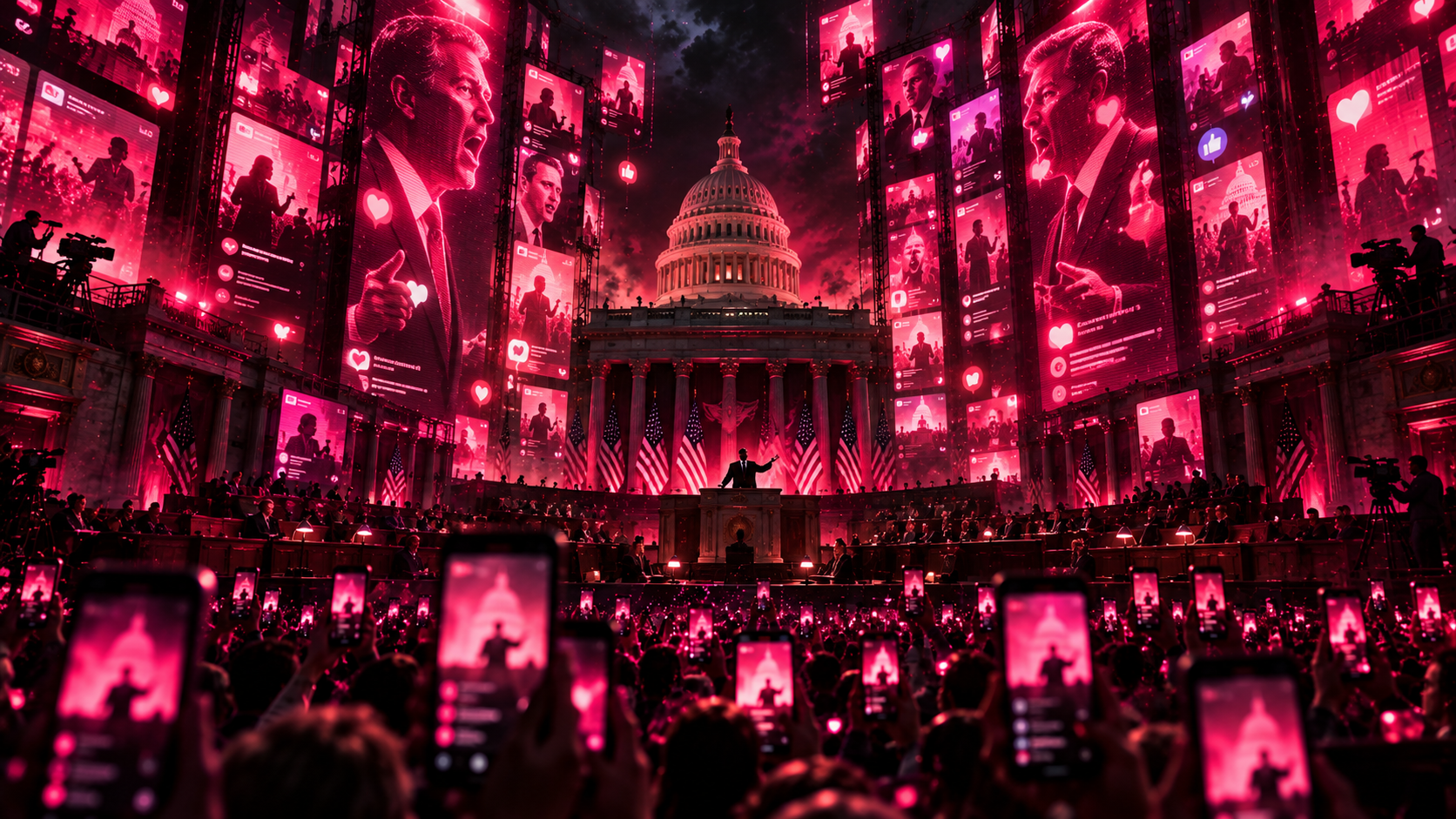
A huge, dark congressional chamber transformed into a social media feed. Generic politicians stand at podiums while towering vertical screens multiply their faces into thousands of clipped fragments. The audience is almost invisible beneath a storm of glowing phones, reaction icons, and fragmented video windows. The U.S. Capitol is recognizable in the distance, but the screens have visually overtaken it.
Slopulous treatment: near-black environment, violent magenta and hot-pink illumination, subtle crimson and violet, cinematic haze, photoreal surrealism, no identifiable politicians, no readable words, no logos, no article title.
2. The Policy Only Has to Feel True
We used to argue about whether an idea would work. Increasingly, the first test is whether it sounds right before the video ends.
THERE IS A SPECIAL category of political idea that becomes more persuasive the less time you spend thinking about it.
You hear it.
And immediately:
Of course.
Why aren't we already doing that?
Somebody should do something.
Finally.
Common sense.
Then an economist walks into the room and everyone gets irritated.
This is understandable.
Nobody likes the person who ruins a perfectly satisfying proposal by introducing second-order effects.
The politician says:
Make the corporation pay.
The economist says:
Which corporation?
Shut up.
The politician says:
Protect the jobs.
The economist says:
What happens to hiring incentives?
Nobody invited you.
The politician says:
Give people a discount.
The economist takes a breath.
Security removes him from the building.
A GOOD SLOGAN HAS NO DOWNSTREAM EFFECTS
One recent example used by economist Noah Smith involved a proposed New York bill that would require a 10 percent discount for purchases made through self-checkout.
The intuition is beautifully simple.
The customer scanned the groceries.
The customer performed labor.
The customer deserves compensation.
Smith argues that the proposal could instead encourage retailers to expand self-checkout because purchases processed through human cashiers would become relatively more expensive. That is an economic argument, and people can dispute its assumptions, but the episode neatly illustrates the slopulist problem: a policy's moral story can become much easier to understand than its mechanism.
This happens constantly.
We encounter policy first as a tiny narrative.
Bad thing exists.
Actor caused bad thing.
Proposal punishes actor.
Good thing follows.
That is an excellent format.
Unfortunately, reality often contains more than four frames.
WE ARE ALL POLICY EXPERTS FOR ABOUT SIX SECONDS
Social media created the most informed population in human history.
It also created several hundred million deputy secretaries of everything.
Watch one clip about agriculture.
You understand agriculture.
Watch another about monetary policy.
Welcome to the Federal Reserve.
Watch twelve seconds about the electric grid.
You are now deeply concerned nobody in Washington understands baseload generation.
The confidence is not entirely irrational.
Information really is more accessible.
Government really can be opaque.
Experts really can be wrong.
Institutions really do protect themselves.
Technical language really can be used to prevent ordinary people from questioning powerful systems.
All true.
Then the feed makes one tiny additional leap:
If experts can be wrong, expertise is suspicious.
That is where the floor disappears.
SLOPULISM LOVES THE FIRST CONSEQUENCE
Policy has consequences.
Then those consequences have consequences.
Then somebody adapts.
Then the policy interacts with another policy.
Then markets respond.
Then courts respond.
Then states respond.
Then humans do the deeply annoying thing humans always do:
they behave differently because the rules changed.
This is why governing is difficult.
Slopulism solves the problem by stopping at consequence number one.
Tax X.
X pays tax.
Done.
Ban Y.
Y disappears.
Done.
Subsidize Z.
More Z.
Done.
Make bad behavior illegal.
No more bad behavior.
Wonderful.
We have invented government.
Slopulist policy ends exactly where the second-order effect begins.
THIS IS NOT A LEFT OR RIGHT DISEASE
It is tempting to assign stupidity to the opposition.
The opposition is famously where all stupidity lives.
Unfortunately, every ideology contains a magical-thinking department.
The left can treat prices as moral statements rather than signals produced by complicated systems.
The right can treat trade deficits like a scoreboard where one country lost money to another.
Anti-government movements can demand enormous government interventions when the target becomes sufficiently disliked.
Pro-government movements can suddenly discover local autonomy when federal policy moves against them.
Free-market people find industries that apparently need protection.
Anti-corporate people find corporations they would like government to subsidize.
Everyone has principles.
Everyone also has a guy.
Slopulism begins when the exception becomes a vibe and the vibe becomes the policy.
POPULISM IS NOT THE PROBLEM
This distinction matters.
Populism often emerges from a legitimate failure of institutions.
Prices are high.
Jobs disappeared.
Homes became unaffordable.
Public systems became harder to navigate.
Political parties stopped speaking like normal humans.
Experts missed things.
Banks failed.
Wars went badly.
Industries hollowed out.
Corporations accumulated extraordinary power.
People noticed.
Calling those grievances irrational because they arrived without a PowerPoint is a fantastic way to produce more populism.
The problem is not that ordinary people distrust institutions.
Institutions occasionally work very hard to deserve it.
The problem begins when distrust becomes an epistemology.
The expert says X.
Therefore not X.
The mainstream media says X.
Therefore not X.
The bureaucracy recommends X.
Definitely not X.
Soon skepticism has stopped evaluating evidence.
It has become identity.
Now the easiest way to make an idea attractive is to tell people somebody they dislike says it is impossible.
SOMETIMES COMMON SENSE IS CORRECT
This also has to be said.
Technocrats have an annoying habit of acting as though anything understandable must be wrong.
Sometimes a simple policy works.
Sometimes the obvious answer was obvious because it was the answer.
You do not need a Ph.D. to notice that a bridge is collapsing.
People living beside a data center may understand local impacts that the consultant three states away does not.
Workers know things about their jobs economists cannot see from aggregate statistics.
Parents know things about schools administrators do not.
The cure for slopulism cannot be:
Shut up and trust the experts.
That slogan created half the conditions for slopulism.
The answer has to be harder.
Keep the intuition.
Then inspect the mechanism.
EVERY POLICY SHOULD HAVE TO SURVIVE THE ANNOYING PERSON
Not the partisan opponent.
The annoying person.
The person who asks:
Then what?
If we do this, what happens next?
What incentive did we just create?
Who actually pays?
Who qualifies?
Who decides?
What happens when people adapt?
What happens in year three?
What happens if the program works too well?
What happens if it works only halfway?
What happens if the company moves?
What happens if the city next door does something different?
This person is terrible for content.
They are also essential for government.
A feed rewards certainty.
A functioning political system needs people willing to say:
I don't know yet.
Those four words are devastating online.
Try putting them on a campaign sign.
THE MOST DANGEROUS POLICY IS THE ONE THAT FEELS LIKE JUSTICE
Because then opposition becomes morally suspicious.
If the mechanism is complicated, disagreement can remain technical.
If the proposal is framed as justice, disagreement begins looking like evidence of bad character.
You oppose the policy?
Interesting.
Why do you hate workers?
Children?
Farmers?
Homeowners?
Freedom?
America?
The planet?
Once policy becomes identity, the causal argument disappears.
You are no longer debating whether the instrument produces the desired outcome.
You are proving what kind of person you are.
This is exceptionally useful politically.
It is exceptionally useless administratively.
The bridge does not care whether your heart was in the right place.
It either holds.
Or everybody gets wet.
THE FEED CANNOT SEE FIVE YEARS FROM NOW
This may be slopulism's structural advantage.
Nobody gets engagement for:
WE WILL KNOW WHETHER THIS WORKED AFTER AN EIGHT-YEAR LONGITUDINAL STUDY.
People need a feeling now.
Politics increasingly supplies it.
Announcement.
Victory.
Executive action.
Ban.
Subsidy.
Tariff.
Investigation.
Name change.
Crackdown.
The action is instantly legible.
Its effectiveness can remain permanently pending.
By the time consequences arrive, the feed has moved through four hundred controversies.
Nobody remembers who promised what.
The vibes have expired.
THE POLICY HAS BECOME A MEME WITH A BUDGET
That may be the cleanest definition.
Not every populist policy is slop.
Not every technocratic policy is smart.
Not every intuitive policy fails.
Slopulism describes something else.
The substitution of emotional legibility for causal seriousness.
A policy designed to be understood immediately rather than examined carefully.
A policy whose primary evidence is the satisfaction you feel when hearing it.
A policy whose critics can be dismissed because asking how something works sounds suspiciously like refusing to believe.
This is politics optimized for the first ten seconds.
Unfortunately, countries tend to continue existing after the clip ends.
And every policy eventually encounters the most ruthless fact-checker imaginable.
Reality.
Reality does not quote-tweet.
Reality does not ratio.
Reality does not care that your framing was excellent.
Eventually the price changes.
The company responds.
The worker adapts.
The market moves.
The system breaks.
The unintended consequence quietly arrives.
And somebody opens the app to discover who should be blamed for it.