Propaganda wants you to believe something. Engagement slop just wants you to keep watching.
THERE IS SOMETHING almost comforting about old propaganda.
Somebody cared.
Awful beliefs, perhaps.
But beliefs.
There was a government.
A party.
An ideology.
A rich lunatic with a printing press.
You could ask:
Who wants me to believe this, and why?
Modern content economics has introduced a stranger possibility.
What if nobody particularly cares whether you believe it?
What if they simply noticed you click it?
Politics Is an Excellent Content Vertical
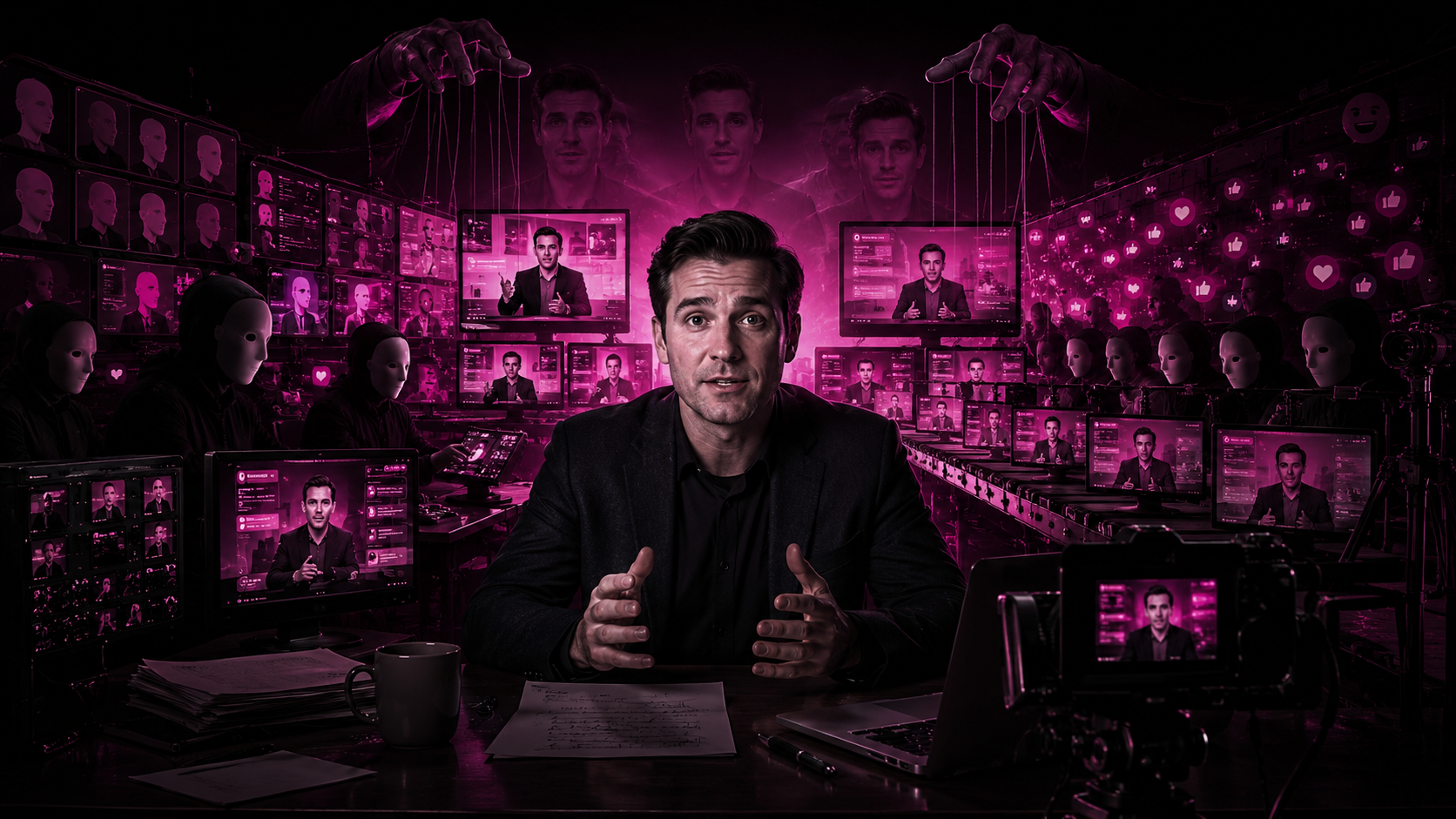
Semafor and Riddance recently documented a network of supposedly independent political commentators who were actually paid actors reading repetitive, AI-assisted scripts. The network concentrated heavily on sensational negative stories involving Democratic politicians and accumulated tens of millions of views.
The obvious interpretation is ideological.
Someone hates Democrats.
Maybe.
But reporting on the network points to a less satisfying explanation.
The people running it appear to have been growth hackers chasing traffic and advertising revenue.
The ideology may have been the format that converted.
This possibility is somehow grosser.
The content may look political while the motive is merely financial.
The Dashboard Has No Party Registration
A recommendation system does not need to wake up and think:
I am conservative today.
Or liberal.
Or socialist.
Or whatever Elon Musk is currently tweeting at 3:17 a.m.
It has metrics.
Watch time.
Clicks.
Retention.
Comments.
Shares.
Return visits.
Creators learn those incentives very quickly.
If outrage about politician A performs, make more.
If outrage about politician B performs better, pivot.
The underlying belief system may be:
CTR up 14 percent.
This is ideology stripped down into spreadsheet performance.
Be Careful With the Big Claim
The transcript that inspired this piece asks why certain anti-Democratic material appeared to perform better in this particular network.
That is a reasonable question.
It is not evidence that every platform or algorithm universally favors one political ideology.
One network's results cannot establish that.
Audience demographics differ.
Creator tactics differ.
Topics differ.
News cycles differ.
Platforms constantly change ranking systems.
And users themselves generate the behavioral signals those systems learn from.
The more interesting point is narrower:
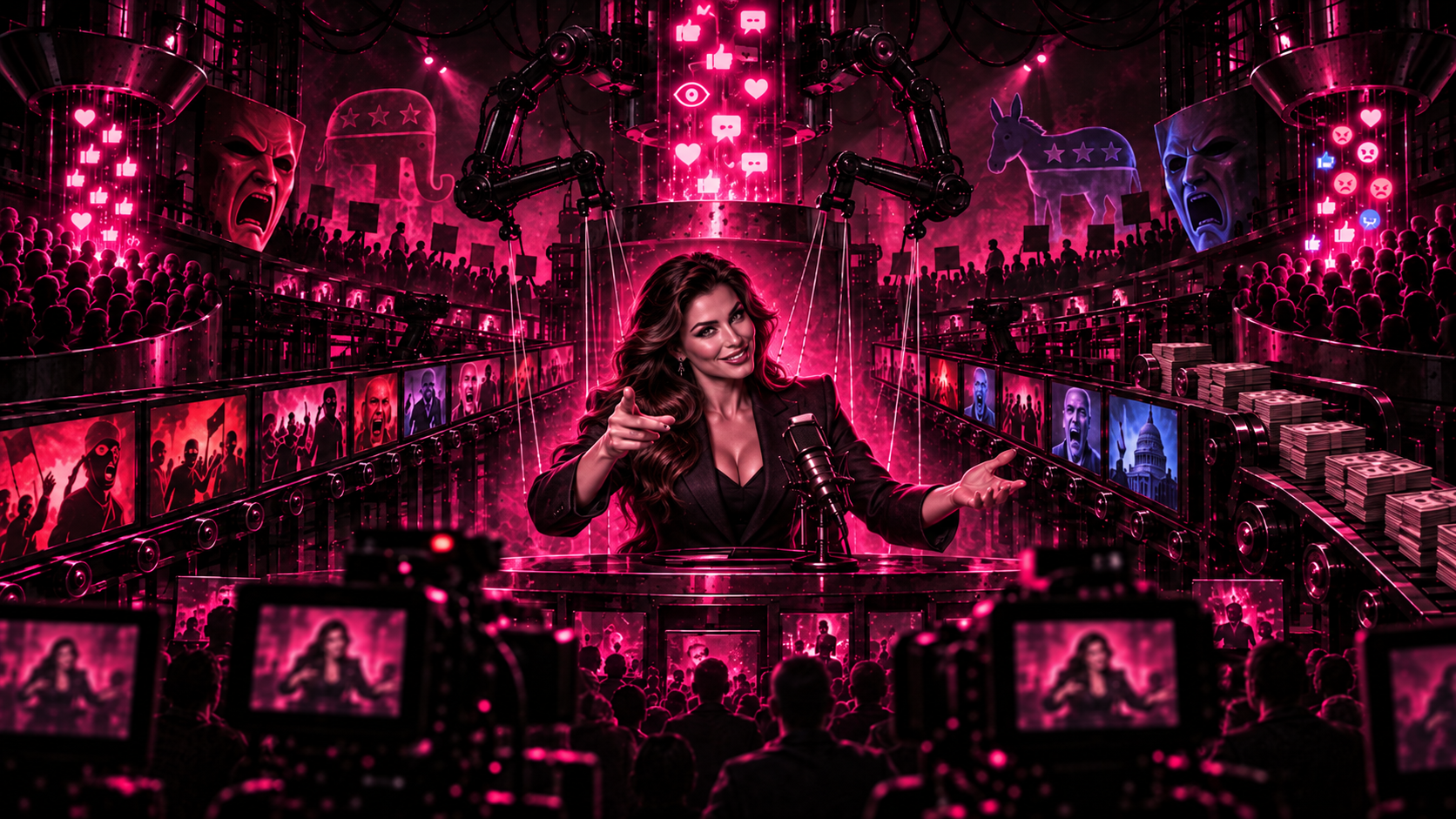
Once operators discover a political angle that performs, they can reproduce it industrially without sharing the politics.
That should bother everyone.
Because it can happen in any direction.
Belief Is Expensive
Belief creates constraints.
A genuine partisan may refuse to attack their own side.
A real activist cares whether a claim advances the cause.
A journalist, ideally, cares whether it is true.
An engagement farmer has greater creative freedom.
Today:
MAYOR DESTROYS CITY.
Tomorrow:
GOVERNOR HUMILIATED.
Friday:
CELEBRITY FLEES STATE AFTER SOCIALIST DISASTER.
The protagonist changes.
The emotional structure does not.
Semafor found videos across different channels following very similar formulas, with sensational headlines, recurring production elements and exaggerated or false claims.
That repetition is revealing.
This isn't a worldview.
It is a template.
Politics Becomes True Crime
Look at the emotional grammar.
SHOCKING.
EXPOSED.
PANICS.
FREAKS OUT.
DESTROYED.
CAUGHT.
This is not policy language.
It is entertainment language.
The politician becomes a character in a recurring procedural.
Each episode:
something happened,
your enemy is responsible,
everything is collapsing,
you were right.
Tune in tomorrow.
The civic content is just skin wrapped around an old format:
Make the viewer feel rewarded for already knowing who the villain is.
Nobody Needs a Kremlin Anymore
When coordinated political junk appears online, people naturally search for a mastermind.
Foreign government.
Campaign.
PAC.
Billionaire.
Intelligence agency.
Sometimes that is exactly what exists.
Google routinely reports and removes coordinated influence networks linked to governments and political actors around the world.
But the ghost-creator story presents a different category.
An operation can pollute political discourse without needing a geopolitical objective.
It can be domestically produced.
Commercially motivated.
Cheap.
Decentralized.
Optimized.
That is almost more unsettling.
There may be no evil room.
Only a content calendar.
The Engagement Farmer Is Ideologically Promiscuous
Imagine running one of these systems.
You test:
Anti-Trump video.
180,000 views.
Anti-Newsom video.
1.4 million.
Mamdani panic video.
800,000.
You do not need to call Karl Rove.
You need Excel.
This is what optimization does.
You follow the gradient.
Platforms call this learning.
Marketing calls it iteration.
Slopulous calls it:
the machine discovering your emotional pressure points and hiring a man from Fiverr to press them.
Outrage Becomes Market Research
This is one reason online politics feels increasingly detached from policy.
The most lucrative political content often tells creators which emotional narratives people respond to fastest.
Fear.
Humiliation.
Betrayal.
Vindication.
Disgust.
A creator learns:
This group makes the audience angry.
This phrase gets comments.
This politician increases retention.
Eventually the content market develops an extremely sophisticated picture of everyone's grievances.
Not so those grievances can be solved.
So they can be replayed.
Your anger is not merely a political emotion anymore. It is a demand signal.
What Does the Creator Actually Believe?
We still ask this question constantly.
Does this influencer really believe what he says?
Is she actually far right?
Actually far left?
Actually anti-vaccine?
Actually anti-capitalist?
Actually convinced the city is collapsing?
Maybe.
But the creator economy has made another answer increasingly plausible:
They believe in whatever kept you through the mid-roll ad.
This does not mean ideology is fake.
Plenty of people sincerely believe strong things.
The mistake is assuming every ideological-looking object was created primarily from ideology.
Sometimes politics is raw material.
The Feed Cannot Tell the Difference
Here is the structural problem.
Recommendation systems observe behavior.
They do not possess a clean column labeled:
SINCERITY.
A genuine journalist publishes a video.
A campaign publishes one.
A Russian influence operation publishes one.
A guy in Miami with twelve actors and AI scripts publishes one.
If users behave similarly toward them, the system has limited reason to care about the philosophical difference unless platform policies intervene.
Distribution collapses motive into performance.
The feed sees engagement.
You see apparent public discourse.
Those are not the same thing.
Political Slop Without Politics
Maybe we need a new category.
Not propaganda.
Not persuasion.
Not advocacy.
Political engagement arbitrage.
Find a volatile civic issue.
Produce cheaply.
Attach emotional certainty.
Route through recognizable human format.
Harvest attention.
Move to the next story.
The creator does not have to change your vote.
They only need to keep you mad until the ad plays.
That changes what political manipulation looks like.
The objective may no longer be:
Make America believe X.
It may simply be:
Make Americans impossible to look away from.
And if the side effect is a country convinced everything is collapsing?
That's not in the dashboard.
rt writing here...