We spent three years learning to count fingers. The machine noticed.
FOR A WHILE, AI WAS VERY BAD AT HANDS.
Six fingers.
Three fingers.
A thumb where a wrist should be.
The human body rendered with the anatomical confidence of a medieval monk who had heard rumors about elbows.
It was reassuring.
The machine could make a woman standing in Paris at sunset look photorealistic, but if she held up a coffee cup her hand might turn into a small seafood accident.
So we developed a folk science.
Count the fingers.
Check the teeth.
Look at the earrings.
Look at the background.
Read the sign.
If the letters say PARKLNG SHTORB, congratulations, Sherlock Holmes, you found the robot.
Then the robot got better.
Of course it did.
The Old Tells Are Dying
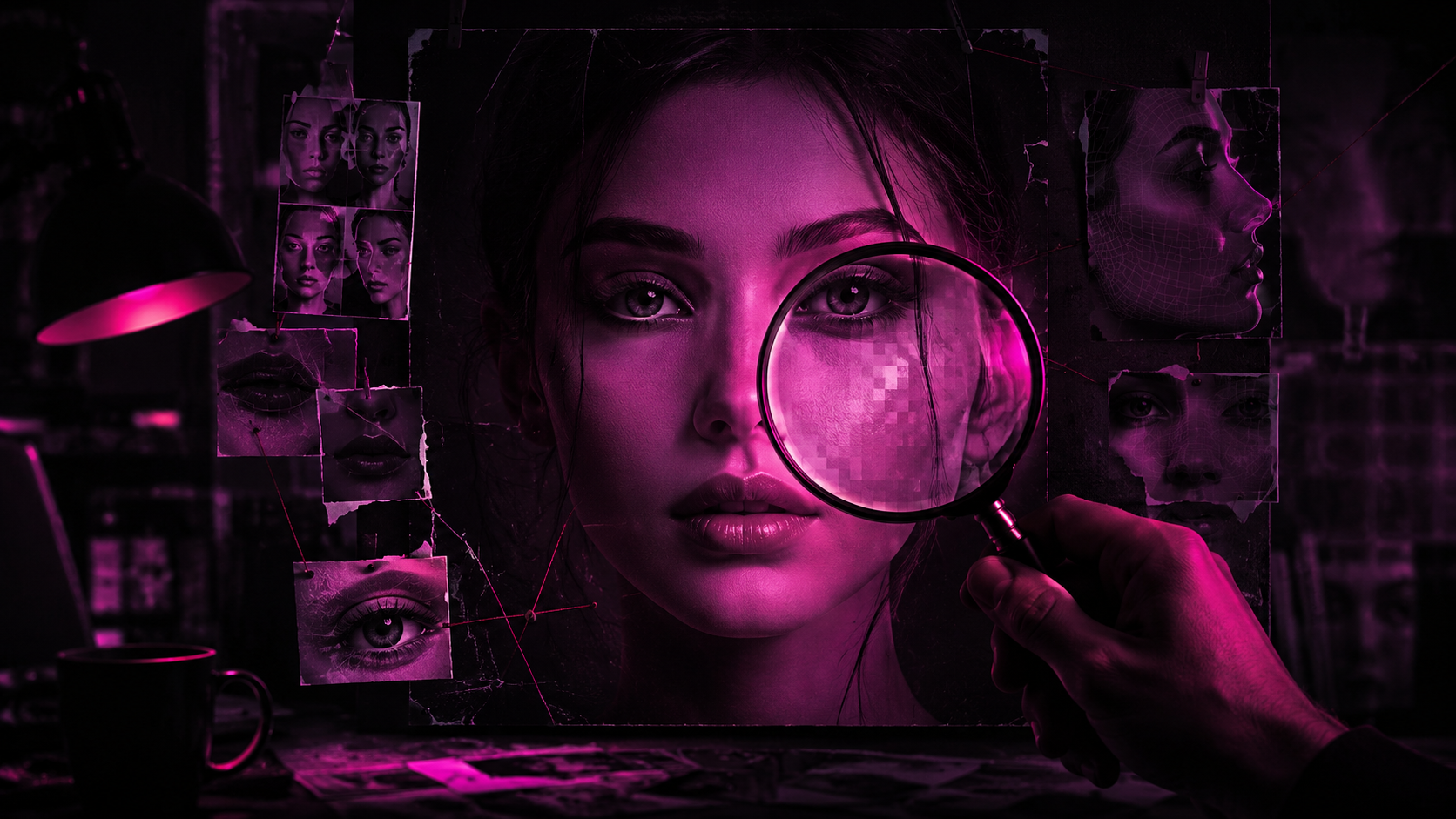
Gizmodo recently covered research from Australian National University suggesting that the most useful way to recognize AI-generated faces may no longer be hunting for glitches at all. The researchers argue that people can be trained to detect broader, more holistic differences between real and synthetic faces, focusing on qualities such as symmetry, proportionality, attractiveness, expressiveness, distinctiveness and memorability. (gizmodo.com)
This is interesting because it suggests the future of AI detection may look less like forensic inspection and more like taste.
Not:
Is the ear melting?
More:
Why does this person look like everybody and nobody at the same time?
The study found that AI-generated faces tended to be rated as more symmetrical, well-proportioned and attractive, while real human faces were judged as more expressive, distinctive and memorable. After participants were trained to pay attention to those global impressions, their accuracy reportedly improved dramatically, with the strongest participants reaching near-perfect performance in the study setting. (gizmodo.com)
The future of spotting synthetic people may therefore involve an unexpectedly human question:
Does this face have a life in it?
The Average Person Has Arrived
Generative systems do not invent faces the way a painter invents a face.
They learn patterns across enormous amounts of visual data.
And averages are powerful.
Average eyes.
Average proportions.
Average lighting.
Average attractiveness.
Average skin.
The resulting person can be beautiful in the same way a hotel lobby is beautiful.
Nothing is exactly wrong.
Nothing is exactly there.
AI does not always fail by making something grotesque. Sometimes it fails by making something too resolved.
A real face contains history.
One eyebrow sits slightly higher.
The smile pulls strangely on one side.
The nose is a little too large.
There is a scar.
The expression is doing two things at once.
Someone is trying to look happy and failing.
AI is getting much better at generating these imperfections too, but the researchers’ point is that humans may still register the broader statistical smoothness even when we cannot consciously explain what feels wrong.
The uncanny valley has apparently hired a cosmetic surgeon.
We Are Training Ourselves Too
There is something funny about the arms race.
AI image generators train on human images.
Then humans train themselves on AI images.
The machine gets better.
We become suspicious of the new aesthetic.
The machine corrects.
We move again.
This is not unlike spam.
There was a time when scam emails announced that a Nigerian prince required urgent financial assistance in a font that looked like a ransom note.
People learned.
The scams improved.
Now the phishing email looks exactly like Microsoft.
Detection becomes less about obvious stupidity and more about context.
Why is Microsoft asking this?
Why now?
Where does the link go?
Who benefits if I click?
Images are entering the same phase.
The question is shifting from:
What is wrong with the pixels?
to:
What is this image doing here?
The Most Important Clue May Be Outside the Picture
This is where the technical guides become unexpectedly useful.
SlopDetector’s 2026 guide argues that no single visual cue should convict an image. The stronger approach is convergence: multiple suspicious qualities appearing together, plus context around the account, source and purpose of the content. The same principle appears in writing detection, where the site emphasizes that clusters of signals matter more than any one “AI word” or stylistic tic. (slopdetector.org)
That feels right.
Because even if an image is synthetic, the more important question is often:
So what?
An artist used AI as part of a surreal illustration.
Fine.
A fashion brand created an obviously impossible fantasy campaign.
Okay.
A fake local-news account posts an AI image of a riot that never happened.
Now we have a problem.
The pixels do not contain morality.
Context does.
The real skill is not detecting whether AI touched the image. It is detecting whether the image is asking you to believe something that never happened.
This distinction matters more as generative media improves.
Soon “spot the AI” may become an impossible parlor game.
“Spot the manipulation” remains useful.
Detection Software Is Not God
There is a strong temptation to outsource this problem.
Upload image.
Receive percentage.
97.3% AI GENERATED.
Beautiful.
Case closed.
Except commercial detection systems can produce false positives and often provide little explanation for why they reached a conclusion. The ANU researchers explicitly framed their work as a human alternative to relying entirely on opaque machine detection. (gizmodo.com)
Text detection has already shown how ugly this can become.
SlopDetector itself warns that origin detectors are not reliable enough to treat as proof, noting that false positives can hit human writing and that motivated users can evade detection. Its preferred approach is to judge observable quality signals instead of pretending software can read authorship from the molecular structure of a sentence. (slopdetector.org)
Images are likely heading toward the same uncomfortable place.
Detection tools become useful signals.
Not verdicts.
This is less satisfying.
Reality has become administratively inconvenient.
The Slop Learns Your Test
Every public detection method contains the seed of its own obsolescence.
Tell everybody:
AI uses too many em dashes.
People stop using em dashes.
Tell everybody:
AI says “delve.”
Prompts begin:
DO NOT USE THE WORD DELVE.
Tell image models:
Hands give you away.
Hands improve.
Tell models:
Faces are too symmetrical.
Guess what happens next.
This does not make detection pointless.
It changes what detection is.
A static checklist is a losing strategy against a system optimized through continuous improvement.
What survives is judgment.
Source literacy.
Pattern recognition.
Skepticism without paranoia.
The boring human skill of asking one more question before believing something.
The Goal Is Not to Become Suspicious of Everything
There is a danger here too.
If every beautiful photograph becomes “probably AI,” we have not solved the trust problem.
We have worsened it.
A real photo gets dismissed.
Real evidence becomes deniable.
Authentic witnesses become accused of fabrication.
The machine wins without even needing to generate the fake.
This is why the detection question has to remain proportional.
Is this image consequential?
Is someone asking me to make a decision based on it?
Can I locate the original source?
Is there corroboration?
Does the account regularly publish unverifiable synthetic material?
A photograph of a six-legged golden retriever dressed as Napoleon does not require a forensic investigation.
A photograph allegedly showing a politician committing a crime probably does.
Media literacy is partly knowing when to care.
We Were Never Going to Win by Counting Fingers
Counting fingers was fun because it gave us certainty.
Six fingers.
Fake.
Easy.
The next era will not be that generous.
AI-generated media is becoming less obviously wrong at the surface precisely as it becomes easier to produce at scale.
The skill we need is shifting upward.
From anatomy to context.
From glitches to motive.
From asking:
Was AI used?
to:
What am I being asked to believe?
That is harder.
It is also probably the only question that survives the next model update.