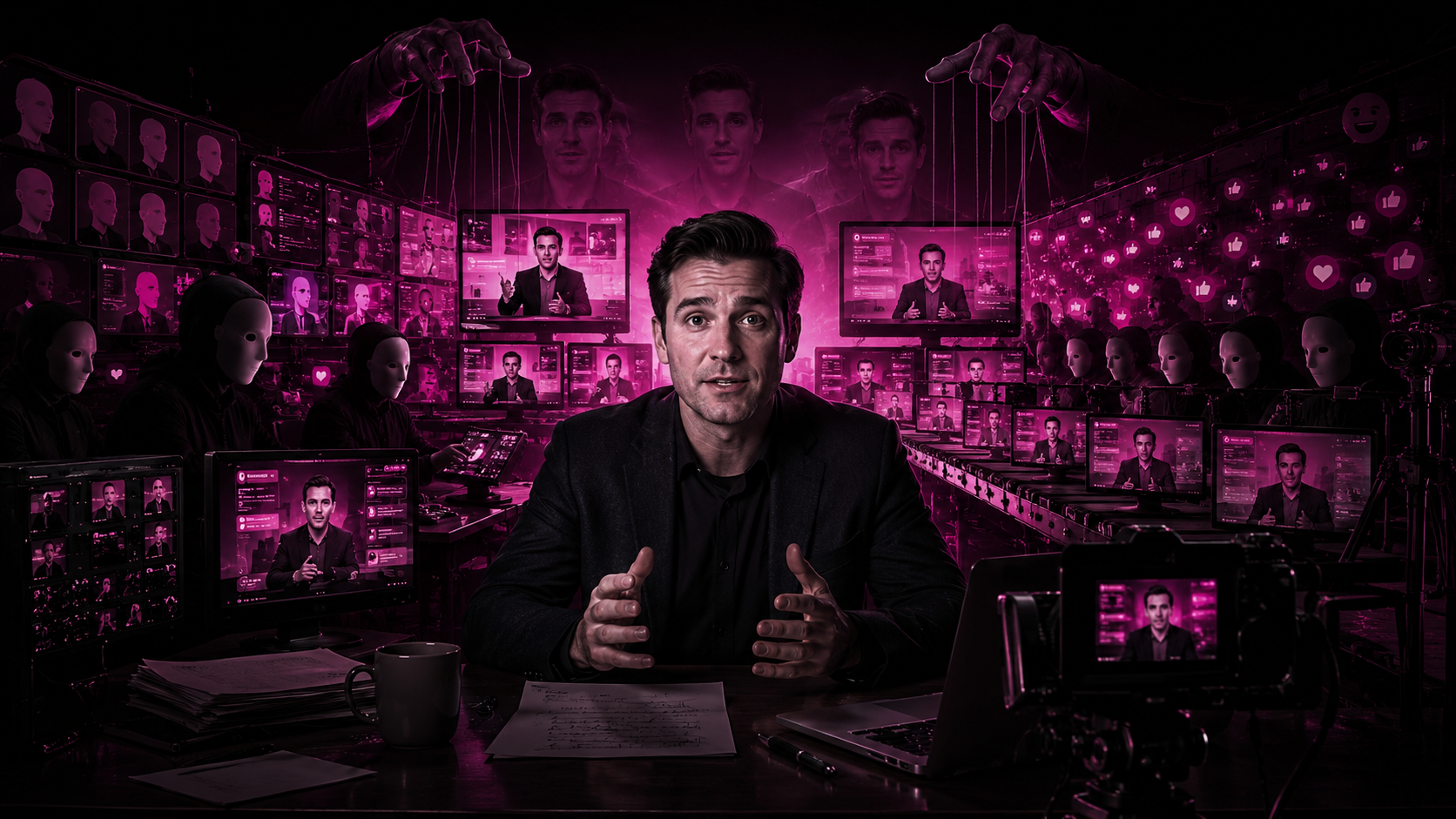
The podcast was three hours long. The evidence was twenty-two seconds.
WE HAVE DEVELOPED A STRANGE NEW WAY OF LEARNING WHAT PEOPLE BELIEVE.
First, somebody talks for six hours.
Then somebody else cuts out seventeen seconds.
Then a third person puts subtitles on it.
Then an account you've never seen before posts it with:
THIS IS INSANE.
Eight million people watch.
Someone from television watches.
Someone on television describes what happened.
Someone clips the television segment.
You see that clip tomorrow.
Congratulations.
You are informed.
The Podcast Was Three Hours Long
You watched eighteen seconds.
This is now an entirely normal relationship to another person's worldview.
Someone sat down.
Talked.
Qualified something.
Changed direction.
Made a joke.
Read something from chat.
Explained context.
Said something dumb.
Corrected themselves.
Eventually, somewhere around hour four, they produced one sentence with excellent distribution characteristics.
The sentence escaped.
Vertical crop.
Captions.
Progress bar.
Maybe a little zoom when the speaker says the interesting bit.
The conversation remains online.
Nobody goes there.
The full context has become source material for the short version. The short version has become reality.
There Are People Being Paid to Find the Moment
Clipping is not a hobby anymore.
It is infrastructure.
TheWrap reported in March that a growing industry now pays freelance editors to take long-form streams, podcasts, movies, music campaigns and creator content and turn them into huge quantities of short-form videos. One clipping company reported more than 23,000 editors; Whop says millions of clippers in its ecosystem have helped generate $1.5 billion in sales. Agencies can charge creators thousands of dollars per month to push clips across TikTok, Instagram Reels and YouTube Shorts.
This is not necessarily deceptive.
A movie studio promoting a movie is marketing.
A podcaster promoting a podcast is marketing.
MrBeast would like you to watch MrBeast.
Understood.
The interesting part is that many clips are deliberately designed to look like they came from ordinary users rather than a coordinated campaign. TheWrap notes that the size of the clipping economy is difficult to measure partly because the clips often resemble fan-made content.
The ad has learned to dress like a viewer.
Quantity Is the Strategy
The old editor asked:
What is the best clip?
The new system can ask:
Why choose?
Make fifty.
Make five hundred.
Let the platforms decide.
Twitch CEO Dan Clancy described the shift plainly to TheWrap: clipping has increasingly moved from quality toward quantity, with editors allowing short-form algorithms to determine which pieces win.
This is important because the algorithm is not selecting for representativeness.
It is selecting for performance.
And performance has preferences.
TheWrap's reporting says the clips most likely to travel tend to feature the “most combative moments,” inflammatory statements, and opinions difficult to defend.
Very healthy incentive.
Talk calmly for three hours.
Say one deranged thing.
Guess which version of you gets eight million views.
You are increasingly famous for the part of yourself most compatible with an algorithm.
Clip Farming Changes the Speaker Too
Eventually people learn.
If conflict clips better, create conflict.
If outrageous lines spread, produce outrageous lines.
TheWrap describes clip farming as intentionally creating controversial moments inside a stream specifically so they can be extracted and go viral later.
This is fascinating because the content begins anticipating its own mutilation.
The conversation no longer accidentally contains viral moments.
It manufactures handles for the scissors.
You can almost hear the streamer thinking:
This part will travel.
Which means clipping does not merely distort media after the fact.
It can change the thing being recorded.
The tail begins wagging the podcast.
Then a Clip Becomes Evidence
This is where the Hasan Piker story becomes useful.
Not because you need to like Hasan Piker.
You don't.
He says provocative things professionally.
That is part of the product.
The interesting issue is what happens when a clipping culture built for speed, outrage and virality crosses into a factual claim about what somebody actually believes.
In August, conservative commentator Scott Jennings posted and aired a compilation that portrayed Piker as saying America should resume lynching Black people.
The clips contained Piker's real voice.
The words were real.
That is exactly what made the montage powerful.
Except the meaning wasn't.
Lead Stories traced the source footage and found that Piker had been reading racist comments from his livestream chat and condemning them, rather than expressing the views himself. The longer footage changed the meaning of the excerpt.
Piker subsequently said he and his lawyers were preparing possible defamation action against Jennings and Salem Media.
There is something almost perfect about this as a clipping-era controversy.
No deepfake.
No cloned voice.
No AI-generated politician.
The raw material was authentic.
The context was not.
“Listen for Yourself”
This phrase appears constantly online.
Listen for yourself.
Fine.
To what?
The clip?
Because that is the problem.
Jennings' post urged viewers to listen to Piker “in his own words.”
And technically they were his own words.
But words do not carry their entire context inside themselves.
Sarcasm doesn't.
Quotation doesn't.
Reaction doesn't.
A streamer reading chat doesn't.
A joke does not arrive with metadata explaining:
JOKE.
You need the before.
Sometimes the after.
Occasionally the expression on someone's face.
Human communication is irritatingly high-bandwidth.
Clipping is compression.
A clip can preserve every word and still destroy what the words meant.
This is why “but he literally said it” has become such an unreliable endpoint.
Yes.
Why?
To whom?
Quoting what?
Responding to what?
What happened twelve seconds earlier?
Damn.
Now we have to watch the whole thing.
Context Has Terrible Engagement
Context is badly designed for short-form video.
It often begins with sentences like:
Okay, so there are three things you need to understand first.
Swipe.
Or:
I don't actually agree with this, but...
Too late.
Or:
I'm reading what someone in chat just wrote...
Boring.
The viral clip starts at the sentence after that.
This is not always malicious.
Sometimes an editor needs brevity.
Sometimes a creator genuinely made a terrible argument.
Sometimes additional context makes the statement worse.
The point isn't that every viral clip is deceptive.
The point is that the medium systematically rewards removal.
Remove setup.
Remove qualification.
Remove ambiguity.
Remove the boring bits.
Leave the emotional object.
It travels better.
The Clip Is Becoming Its Own Work
One observation in TheWrap's reporting gets to the heart of this.
Adam Bumas of Garbage Media said people increasingly treat clips as complete works in their own right, rather than fragments of a larger stream or creator persona.
Exactly.
Nobody says:
I watched an excerpt.
They say:
I saw what he said.
Those statements feel identical.
They're not.
An excerpt is an editorial product.
Somebody picked the beginning.
Somebody picked the ending.
Somebody decided what survived.
Even a neutral clip has an author.
Forty-Four Million Views From Fifteen Thousand Viewers
The numbers show how bizarre this can become.
TheWrap gives the example of streamer Clavicular, who averaged around 15,000 viewers on his livestreams while just three outside clips from those streams accumulated more than 44 million views.
Who is the real audience?
The 15,000 people who actually watch?
The 44 million who encountered fragments?
Both?
If millions of people know you primarily through thirty seconds selected by someone else, your clip-self may be culturally more important than you are.
There are now two people.
The person.
And the distributable version.
The second one travels farther.
Your Enemy Is Easier to Clip Than to Understand
Politics absolutely loves this.
A long argument may contain tradeoffs.
An enemy clip contains an enemy.
One sentence.
One face.
One outrage.
Done.
This is why clipping can be especially destructive in political discourse.
A complicated person becomes a library of possible indictments.
Stream enough hours and eventually you will phrase something terribly.
Everyone will.
Imagine having every conversation you have this year recorded.
Then allowing somebody who despises you to select your worst twenty seconds.
Good luck.
This does not excuse horrible things people genuinely say.
Context is not an automatic pardon.
Sometimes you watch the full version and think:
Oh.
That's much worse.
But the principle remains.
The clip is evidence that the clip happened.
It is not automatically evidence of the larger interpretation attached to it.
We Are All Editors Now
There is an uncomfortable truth here.
Nobody forced us to prefer clips.
We like them.
They're efficient.
I do not always want a three-hour podcast.
You probably don't either.
Short-form video solves a real problem.
There is too much media.
Clips help us navigate.
The danger arrives when navigation becomes destination.
Trailer becomes film.
Quote becomes article.
Excerpt becomes ideology.
Snippet becomes person.
Eventually we consume an entire culture composed of the most distributable fragments of longer things.
Then we wonder why everyone appears angry, stupid and insane.
Maybe because calm people generate terrible clips.
The Most Viral Moment Is Usually Not the Most Representative One
This should probably become a basic law of the modern internet.
The moment most likely to travel is often precisely the moment least useful for understanding the whole.
Because ordinary moments do not require distribution.
Nobody clips:
STREAMER MAKES REASONABLE POINT WITH TWO IMPORTANT CAVEATS
Nine views.
One from his mother.
Meanwhile:
STREAMER GOES TOO FAR
We're back.
This incentive applies to everything.
Politicians.
Creators.
Celebrities.
Professors.
Random civilians accidentally becoming the main character.
We increasingly learn about people through the moments an optimization system determined other people could not resist.
That is not necessarily a portrait.
It is a highlight reel assembled by appetite.
Watch the Edges
There is no realistic solution where everyone consumes everything in full.
The internet would require several additional lifetimes.
But maybe clips need to trigger a tiny mental warning.
Not:
Fake.
Just:
Incomplete.
Who clipped this?
Is the source available?
What happened immediately before?
Was this stitched from separate moments?
Is the caption making a larger claim than the excerpt itself proves?
Would thirty more seconds change anything?
Sometimes the answer will be no.
Fine.
Sometimes the answer will change the entire story.
The Piker montage is a useful example precisely because the words were not invented.
The interpretation was constructed through selection.
That may be harder to spot than a deepfake because there is no broken finger.
No weird lighting.
No synthetic voice.
Only scissors.
The Whole Conversation Is Still Sitting There
This is what makes the clipping era especially strange.
We did not lose context.
We simply stopped visiting it.
The original stream exists.
The full interview exists.
The entire speech exists.
The complete podcast is three taps away.
Never in history has context been so available.
Never has context seemed so exhausting.
The clip gives us the psychological satisfaction of knowing without requiring the labor of understanding.
That is an incredible product.
And occasionally a catastrophic way to learn what someone believes.
The podcast was three hours long.
The evidence was twenty-two seconds.
Maybe check the other two hours, fifty-nine minutes and thirty-eight seconds before deciding what the person meant.