Hasan Piker does not hold office. He cannot pass a bill, veto a budget, command an army or raise your rent. Somehow, he has become one of the most discussed political problems in America.
THERE ARE PEOPLE IN WASHINGTON WITH ACTUAL POWER. THIS STORY IS MOSTLY ABOUT A GUY WITH A WEBCAM.
Hasan Piker is a Twitch streamer.
That sentence should probably end the story.
He is enormously popular, politically influential, frequently inflammatory and capable of saying things that generate enough discourse to power a midsize city. He has millions of followers. Politicians appear with him. Young people listen to him. People who hate him listen to him even more carefully.
But Hasan Piker is not a senator.
He is not a congressman.
He is not a governor.
He does not run the Department of Defense.
He does not set interest rates.
He cannot sign legislation.
He cannot raise your taxes.
He cannot lower the price of groceries.
He cannot deploy troops anywhere except perhaps to a particularly difficult Hearts of Iron campaign.
And yet American politics has developed an extraordinary ability to spend enormous amounts of energy litigating the existence of people like him.
This may be one of the clearest symptoms of slopulism yet.
Not political slop exactly.
Political slop is the content.
Slopulism is what happens when the people around government begin behaving according to the incentives of that content.
And suddenly the person with the microphone becomes more politically useful than the person with the vote.
America Discovers Its Main Character
The Piker saga is particularly useful because everyone involved understands the content economy perfectly.
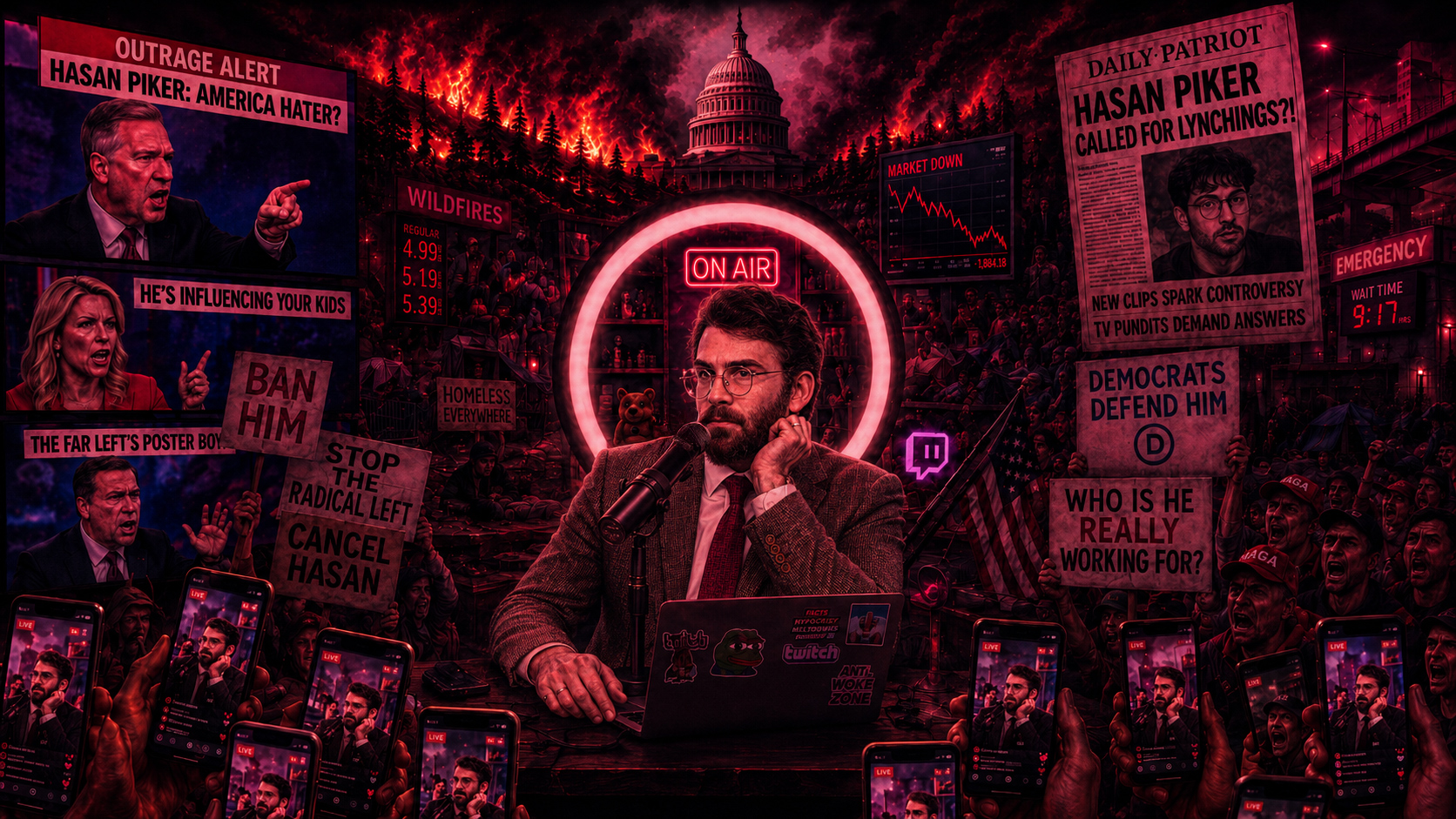
Conservative commentator Scott Jennings posted an edited compilation in August that portrayed Piker as saying the United States should resume lynching Black people. Independent fact-checkers who reviewed the longer footage found that Piker was actually reading and condemning racist comments from his livestream chat, not advocating lynching himself. Piker subsequently said he was preparing possible defamation action against Jennings and Salem Media.
Think about the machinery for a moment.
A streamer talks for hours.
Someone extracts seconds.
Context disappears.
A political commentator packages those seconds.
The clip travels.
Outrage begins.
News outlets report on the outrage.
Other commentators comment on the commentators commenting about the streamer.
The streamer responds.
Possible lawyers appear.
More clips are produced.
And somewhere an algorithm whispers:
Yes. More of this.
This is almost a perfect closed-loop slop ecosystem.
The scandal is no longer something that happened. The scandal is a renewable energy source.
Nobody needs to invent the personalities.
Nobody needs AI.
Nobody even necessarily needs a sophisticated lie.
You need a person who talks for thousands of hours, another person willing to cut selectively, an audience already prepared to hate somebody and a platform that treats fury as evidence of quality.
The factory can run all night.
The Man Who Isn't Running for Anything
What makes the fixation especially strange is that Piker himself isn't running for office.
He has supported candidates. He appeared with Michigan Democratic Senate nominee Abdul El-Sayed. He has influence within a younger segment of the political left. And some of his past statements are legitimately controversial.
Criticism of him is therefore perfectly fair game.
But the scale of the political fascination starts becoming interesting.
A Daily Nebraskan opinion column published earlier this year framed the Democratic Party's conflict with Piker as part of a larger tendency to turn internal ideological policing into a political project of its own. The author described Piker as a left-wing pundit who attracts an extraordinary amount of attention and disdain from within Democratic politics. That is an opinion rather than an objective description of the party, but the phenomenon it points toward is real enough: national political actors repeatedly find themselves being asked to define their relationship to a Twitch streamer.
Read that sentence again.
Define their relationship to a Twitch streamer.
This is apparently one of the tests of political seriousness now.
Foreign policy.
Healthcare.
Housing.
Wages.
Hasan.
Infrastructure.
Taxes.
Hasan again.
It would be funny if it weren't such a perfect example of the attention economy swallowing politics whole.
The Proxy War Is Better Content
The reason is obvious once you stop thinking politically and start thinking like a producer.
Housing policy is terrible television.
Health-insurance regulation is worse.
You want to explain why rents are high? Wonderful. Please begin with zoning, construction costs, interest rates, household formation, labor supply, permitting and local taxation.
Half the audience is now dead.
Hasan Piker says something outrageous?
We're back.
There is a face.
There is a villain.
There is a clip.
There is conflict.
There is absolutely no need for a chart.
This is why personalities are so useful to political media.
Policy has variables.
People have thumbnails.
A streamer can become a stand-in for an entire political movement because a human face compresses complexity better than a white paper ever will.
Suddenly you don't have to debate the future of the American left.
You can debate Hasan.
You don't have to examine competing Democratic approaches to healthcare, labor or foreign policy.
You can ask whether a candidate should denounce Hasan.
You don't have to understand why younger voters are moving toward particular economic ideas.
Look at this thing Hasan said.
Case closed.
The pundit becomes the ideology.
The ideology becomes the clip.
The clip becomes politics.
Meanwhile, There Is an Actual Candidate Here
The current Michigan Senate race makes the contrast almost embarrassingly literal.
El-Sayed has been forced to respond repeatedly to controversy surrounding Piker while attempting to steer attention back toward healthcare and affordability. Recent reporting describes him emphasizing cost-of-living concerns even as journalists, opponents and fellow Democrats ask about his association with the streamer.
Whatever you think of El-Sayed politically, there is something almost beautifully stupid about the structure.
One man is campaigning for the United States Senate.
The other man livestreams.
Guess which one produces easier content.
The Republican opponent can connect the candidate to the controversial influencer.
Democrats can demand distance from the controversial influencer.
Conservative media can publish the latest controversial influencer moment.
Progressive media can publish outrage about the outrage surrounding the controversial influencer.
The streamer can stream about everyone discussing the streamer.
And everybody gets something.
Except possibly the voter.
This Is What Slopulism Looks Like
Political slop does not always mean AI-generated photographs of politicians shaking hands with Satan.
That stuff is almost refreshingly obvious.
Slopulism is subtler.
It is when political life starts adopting the hierarchy of importance created by the feed.
Things become important because people are reacting to them.
Then people react because the things have become important.
Eventually nobody remembers who reacted first.
This is how a media personality without formal political power can occupy more collective attention than officials actually exercising it.
Not because the media personality secretly runs the country.
Because he runs better as content.
Power and attention used to overlap. The internet has made it possible for them to separate almost completely.
Someone can possess immense institutional power and be algorithmically boring.
Someone else can possess almost none and dominate the conversation for three days.
The feed does not care which one can actually change your life.
It cares which one keeps you looking at the feed.
Every Tribe Needs a Monster
This is not uniquely a Democratic problem.
Republicans do it.
Democrats do it.
Everyone does it because everyone now operates inside the same machine.
The right can spend days discussing a professor nobody had heard of last Tuesday.
The left can elevate an obscure right-wing activist into a national symbol of fascism.
A school-board member becomes representative of conservatism.
A college student becomes representative of liberalism.
An influencer becomes representative of socialism.
A podcast guest becomes representative of MAGA.
One person behaves badly.
Within hours:
THIS IS WHO THEY ARE.
Political life has become a museum where each faction curates the most embarrassing specimens from the opposing tribe.
Admission is free.
The gift shop sells outrage.
Freaks Are Statistically Guaranteed
There are more than 340 million people in the United States.
This means something important for political content production:
You will never run out of idiots.
Want a progressive saying something completely insane?
Give me fifteen minutes.
Want a conservative saying something completely insane?
Do you have twelve?
Want someone at a protest holding a sign apparently conceived during a gas leak?
The inventory is extraordinary.
The internet then performs a simple transformation.
Someone did this
becomes:
They do this.
The individual becomes representative.
The anecdote becomes sociology.
The freak becomes ambassador.
And because the underlying clip may be authentic, the resulting slop becomes unusually resistant to fact-checking.
Yes, that person really said it.
No, that does not mean forty million other people believe it.
That second sentence never performs as well.
And Sometimes Even the Freak Has Been Edited
The Jennings-Piker dispute adds another layer because the viral material itself was stripped of relevant context.
That is important.
The modern political clip does not always need to fabricate words.
It can simply change what the words appear to mean.
Lead Stories reviewed the Jennings video and concluded that Piker had been quoting racist comments in order to criticize them; the edited presentation made it appear that the sentiments were his own. Kentucky Lantern likewise reported that reviews of the longer footage found the viral clips had been heavily edited and removed from their original setting.
This is political slop in one of its purest forms.
Real footage.
Real words.
False understanding.
Nothing synthetic required.
We worry constantly about AI deepfakes while human beings continue demonstrating that ordinary editing software works perfectly well.
Content Requires an Enemy
The more depressing possibility is that politics has become structurally dependent upon enemies who are entertaining enough to sustain attention.
You cannot continuously produce content about incremental progress.
Imagine the thumbnails.
INFRASTRUCTURE REPAIR PROCEEDING ROUGHLY AS EXPECTED
Six views.
MEDICAID ADMINISTRATIVE RULE UPDATED AFTER NORMAL REVIEW PROCESS
Three views.
Your mother accidentally clicked twice.
But:
HASAN PIKER MELTDOWN
Now we're cooking.
Politics organized around content requires conflict because content organized around engagement requires emotion.
It is difficult to make compromise viral.
Nobody makes a reaction face because two committees successfully reconciled minor differences in legislation.
A boring functioning society may actually be incompatible with the incentives of political entertainment.
Which presents a small problem.
Boring functioning societies are generally preferable to exciting collapsing ones.
The Attention Audit
There is a question I have started finding useful whenever political discourse becomes consumed by some new personality.
What power does this person actually have?
Not followers.
Not visibility.
Not cultural influence.
Power.
Can they make law?
Command an institution?
Spend public money?
Hire people?
Fire people?
Imprison anyone?
Deploy anything?
Regulate anything?
If the answer is no, perhaps the ratio between attention and authority has become a little strange.
That does not mean ignore public figures.
Ideas matter.
Propaganda matters.
Influence matters.
But attention is finite.
Every hour spent discussing a personality is an hour not spent examining an institution.
And institutions are where the boring people hide the consequential stuff.
The feed trains us to watch the loudest person in the room. Power frequently belongs to someone who isn't speaking.
That may be one of the oldest tricks in politics.
The internet simply gave it autoplay.
The Country Is Still There When the Stream Ends
Eventually the Hasan controversy will move on.
Another person will say something.
Another clip will appear.
Another main character will be appointed.
Somebody you've never heard of today will become morally essential to have an opinion about tomorrow.
You will see their face forty times.
By Friday you will know their biography.
By Monday nobody will mention them again.
The healthcare system will still be there.
Housing will still cost too much.
Schools will still need teachers.
Roads will still need fixing.
Wars will still have consequences.
Budgets will still contain numbers.
Government will continue performing thousands of boring acts that affect your life considerably more than anything said during a Twitch stream.
But boring acts do not scream.
They do not make reaction videos.
They do not quote-tweet you.
And so the political attention economy returns to the person who does.
That is slopulism.
Not merely bad political content.
A political culture increasingly unable to distinguish what is important from what is interesting.
The country has problems.
Politics has a streamer.
Guess which one is trending.