COMEDY HAS A VERY inconvenient requirement.
Somebody has to be there.
Not philosophically.
Physically.
A person has to say the line slightly too fast.
Another person has to wait.
Someone looks at someone else.
The silence lasts half a second longer than expected.
A face changes.
Someone almost laughs.
Someone actually laughs and ruins the take.
The director keeps it anyway.
That tiny imperfection becomes the funniest moment in the episode.
This is an extremely inefficient way to manufacture entertainment.
You need actors.
A room.
Lights.
Cameras.
Sound.
Wardrobe.
Editors.
People moving cables around for reasons no audience member will ever understand.
Somebody needs lunch.
Eventually somebody says the magical phrase that has destroyed countless budgets:
“Can we do one more?”
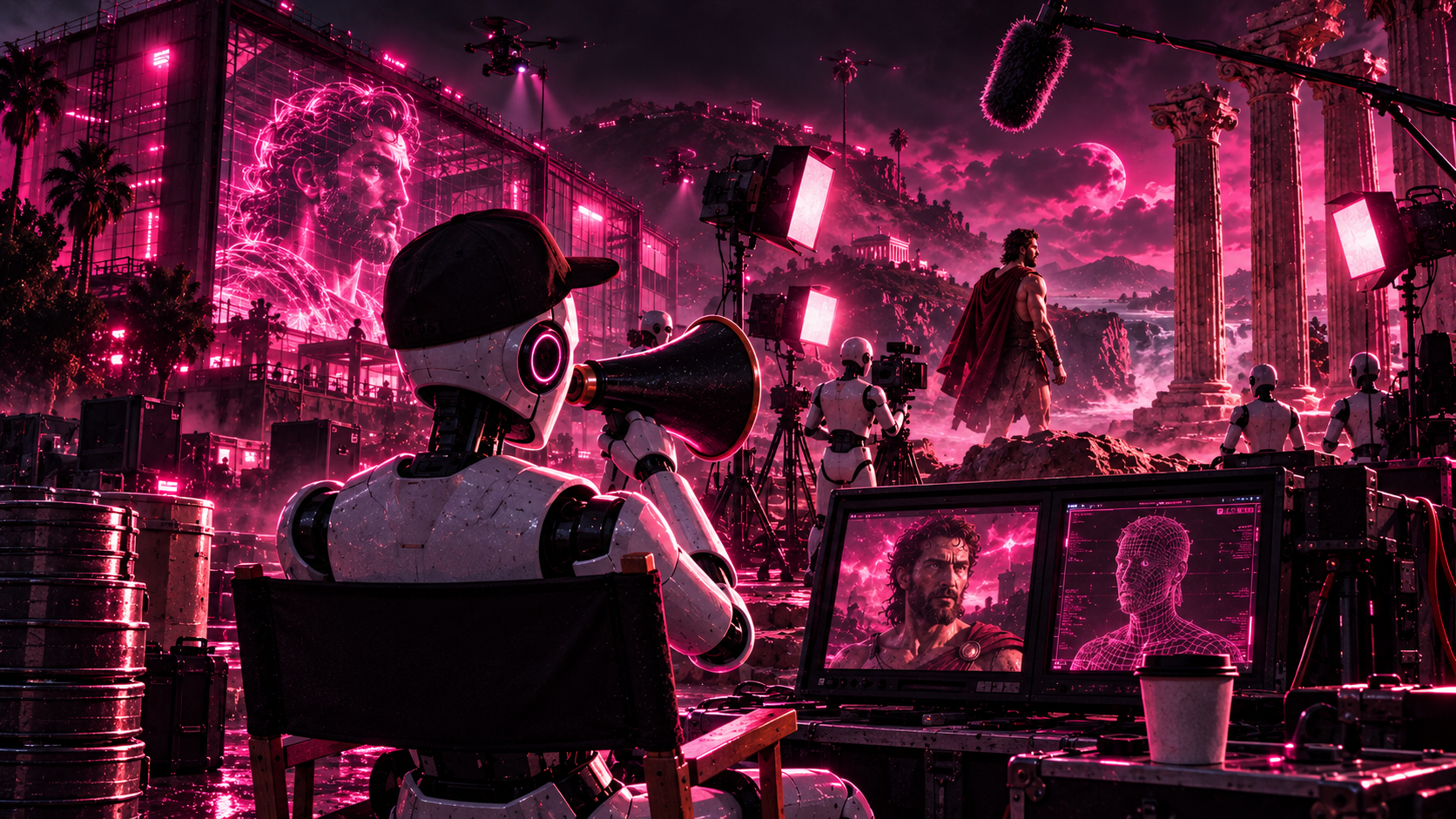
Artificial intelligence has looked at this whole ridiculous arrangement and asked a perfectly reasonable question.
What if we simply got rid of the people?
THE SITCOM ARRIVED BEFORE THE CAST
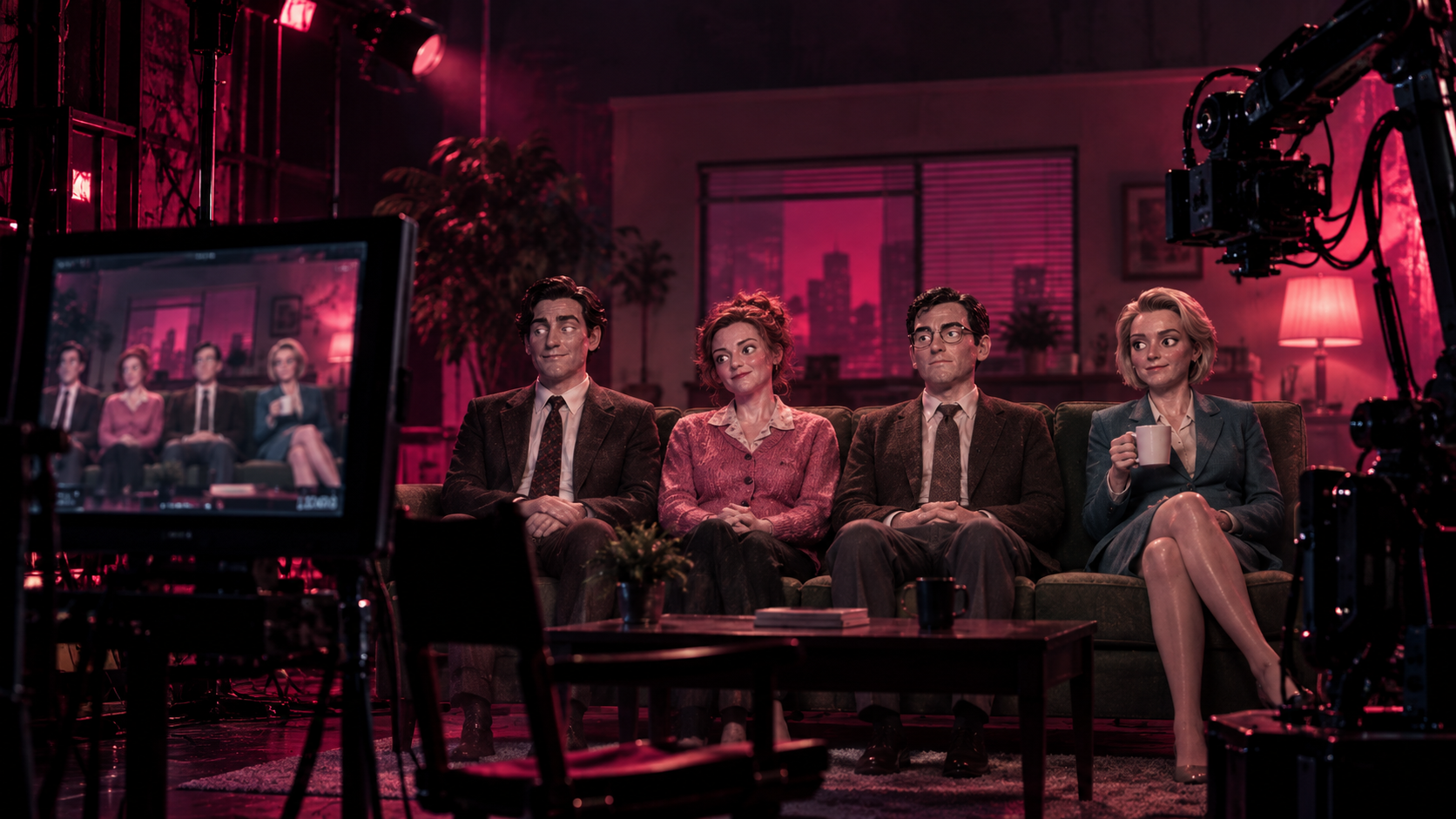
A British workplace comedy called No Big Deal recently became an unusually clean experiment in what happens next.
The pilot was written and created by former investor Andrew Dickinson and produced by UK AI studio ModeLabs.ai. The show follows a dysfunctional investment firm chasing absurd startup ideas, something like The Office wandering into a venture-capital pitch meeting. Dickinson originally wanted to produce it traditionally, but said the cost and speed of conventional television made that difficult. So the team used AI production tools to build the episode instead.
This was not somebody typing one prompt and going for lunch.
Dickinson says the script was rewritten more than 65 times during production, with shots, performances, locations, line readings and camera movements repeatedly refined.
That detail matters.
Because the interesting criticism is not:
They were lazy.
Apparently they weren't.
The interesting criticism is:
They worked very hard to remove something that television may actually need.
A SCRIPT IS NOT A SHOW
This sounds obvious until technology makes us forget it.
A script is words describing potential events.
A television show is what happens when hundreds of small human interpretations attack those words.
The actor does not say the sentence exactly as it looked on the page.
The director changes the blocking.
The editor realizes the reaction is funnier than the line.
Someone pauses unexpectedly.
Someone misunderstands the intention and accidentally improves it.
The costume makes the character stranger.
The room changes the scene.
The chemistry changes the joke.
Production is not merely the expensive mechanical process required to transport a screenplay onto a screen.
Production is interpretation.
That is the part the efficiency conversation keeps flattening.
If your goal is simply:
SCRIPT → VIDEO
then actors, sets, cinematographers, rehearsals and editors begin looking like expensive middleware.
AI appears miraculous because it collapses the pipeline.
But if those people were adding information rather than merely transporting it, collapsing the pipeline changes the product.
The expensive part of filmmaking was not always friction. Sometimes the friction was where the film happened.
COMEDY IS PARTICULARLY RUDE ABOUT THIS
Drama can occasionally survive stiffness.
Horror practically feeds on it.
Science fiction can convince you that the uncanny character is supposed to seem uncanny.
Comedy is less forgiving.
Comedy is microscopic.
Timing matters.
Rhythm matters.
Embarrassment matters.
The distance between two people matters.
The exact amount somebody believes their own stupid statement matters.
Good sitcom acting often involves characters taking absurd things completely seriously while the performers quietly understand exactly how ridiculous everything is.
That is a difficult little human contradiction.
The reviews of No Big Deal focused heavily on this absence. The Guardian gave it zero stars, describing lifeless characters, broken continuity and performances that never become convincing human behavior. Gizmodo similarly argued that there are fleeting moments where the familiar sitcom grammar briefly works before the illusion falls apart again.
But the technical defects are almost beside the point.
AI faces will improve.
Lip sync will improve.
Motion will improve.
Continuity will improve.
The hands will eventually stop conducting independent foreign policy.
That is the easy problem.
The difficult problem is whether improving simulation produces performance.
WE KEEP CONFUSING REMOVING PEOPLE WITH DEMOCRATIZING ART
There is a legitimate argument underneath all of this.
Television is expensive.
Film is expensive.
Thousands of good scripts never become anything because somebody cannot convince a group of executives to give them millions of dollars.
That system is not sacred.
Hollywood gatekeeping has killed countless interesting ideas while financing projects whose entire creative premise appears to have been:
remember that other thing you liked?
So yes.
A technology that lets someone visualize an ambitious idea without access to a studio can be meaningful.
That deserves consideration.
But democratizing filmmaking and automating filmmaking are not necessarily the same project.
A cheap camera democratized filmmaking because it allowed more humans to make films.
Affordable editing software democratized filmmaking because more humans could edit.
YouTube democratized distribution because more people could show work.
Generative AI introduces a stranger possibility.
What if the democratization happens partly by eliminating the need to collaborate with other humans?
Actor.
Gone.
Cinematographer.
Gone.
Production designer.
Maybe.
Extras.
Gone.
Location.
Generated.
Voice.
Generated.
Weather.
Generated.
The creator becomes sovereign.
Nobody says no.
Nobody misunderstands.
Nobody brings an unexpected idea.
Nobody ruins the plan.
This sounds incredibly efficient.
It also sounds lonely.
THE BEAUTIFUL PROBLEM WITH OTHER PEOPLE
Anyone who has ever made anything with other humans knows they are terrible.
They have opinions.
They are late.
They ask questions.
They misunderstand instructions.
They want credit.
They want money.
They occasionally have better ideas than you.
That last part is especially irritating.
Collaboration creates compromise, but it also creates mutation.
The thing you imagined becomes something else because reality keeps touching it.
An actor finds the character.
A composer hears something you didn't.
An editor kills the scene you loved.
A production designer puts something in the background that quietly changes the entire mood.
The finished work contains people you can no longer separate from it.
That contamination is one of the reasons art feels alive.
AI offers the creator an increasingly tempting alternative:
What if nothing resisted you?
That sounds like artistic freedom.
It may also be artistic solitary confinement.
THE MACHINE CAN PERFORM THE TROPE
One fascinating thing about AI-generated entertainment is how quickly it can reproduce the surface grammar of genres.
Office.
Reaction shot.
Awkward pause.
Establishing shot.
Boss says something inappropriate.
Cut to horrified employee.
You recognize it instantly.
Sitcom.
The machine knows the furniture.
It knows where the camera usually goes.
It knows what a vaguely British workplace comedy is supposed to resemble because the culture has produced thousands of examples.
That is exactly why the result can feel so dead.
The shape is present.
The event is missing.
This is the central Slopulous distinction.
Slop is often extremely good at looking like the category.
Article-shaped.
Song-shaped.
Photograph-shaped.
Movie-shaped.
Human-shaped.
The problem is what happens when you lean closer.
Slop does not fail because it cannot recognize culture. It fails because recognition is increasingly being mistaken for participation.
MAYBE BAD AI COMEDY IS USEFUL
There is something almost generous about an experiment like No Big Deal.
It exposes what we usually cannot see.
When television works, nobody watches the credits and thinks:
Thank God the second assistant director was there.
Nobody appreciates the continuity supervisor until continuity disappears.
Nobody thinks about background performers until the background becomes populated by entities whose relationship to anatomy feels legally ambiguous.
Nobody praises actors for blinking correctly.
The normal functioning of a human production hides an enormous amount of competence.
AI makes some of that invisible labor visible by removing it.
Suddenly you notice.
Oh.
Somebody used to do that.
And that.
And that.
The machine did not merely eliminate jobs.
It revealed that those jobs contained judgment.
EVENTUALLY THIS WILL LOOK BETTER
It will.
That is why “AI looks bad” is a weak foundation for criticism.
AI video from three years ago already looks ancient.
The flickering faces will stabilize.
Characters will remain wearing the same shirt.
Coffee mugs will stop teleporting.
Dialogue delivery will improve.
At some point an AI sitcom may become visually indistinguishable from an ordinary mediocre sitcom.
Congratulations.
Television has reached one of its oldest achievements.
But then the interesting question finally arrives:
Why am I watching this?
Not:
Can the machine generate a television episode?
It obviously can.
Not:
Can it become convincing?
Probably.
The question is why somebody else's generated simulation deserves thirty minutes of your finite life.
That is where the technological demonstration has to become art.
And art has a much more annoying standard.
Somebody has to have noticed something.
Somebody has to care.
Something has to surprise even the person who made it.
The joke needs resistance.
The joke needs risk.
Sometimes the joke needs somebody to miss the timing.
Because then another human being has to find it.
And that strange little act of finding may be the thing we were laughing at all along.