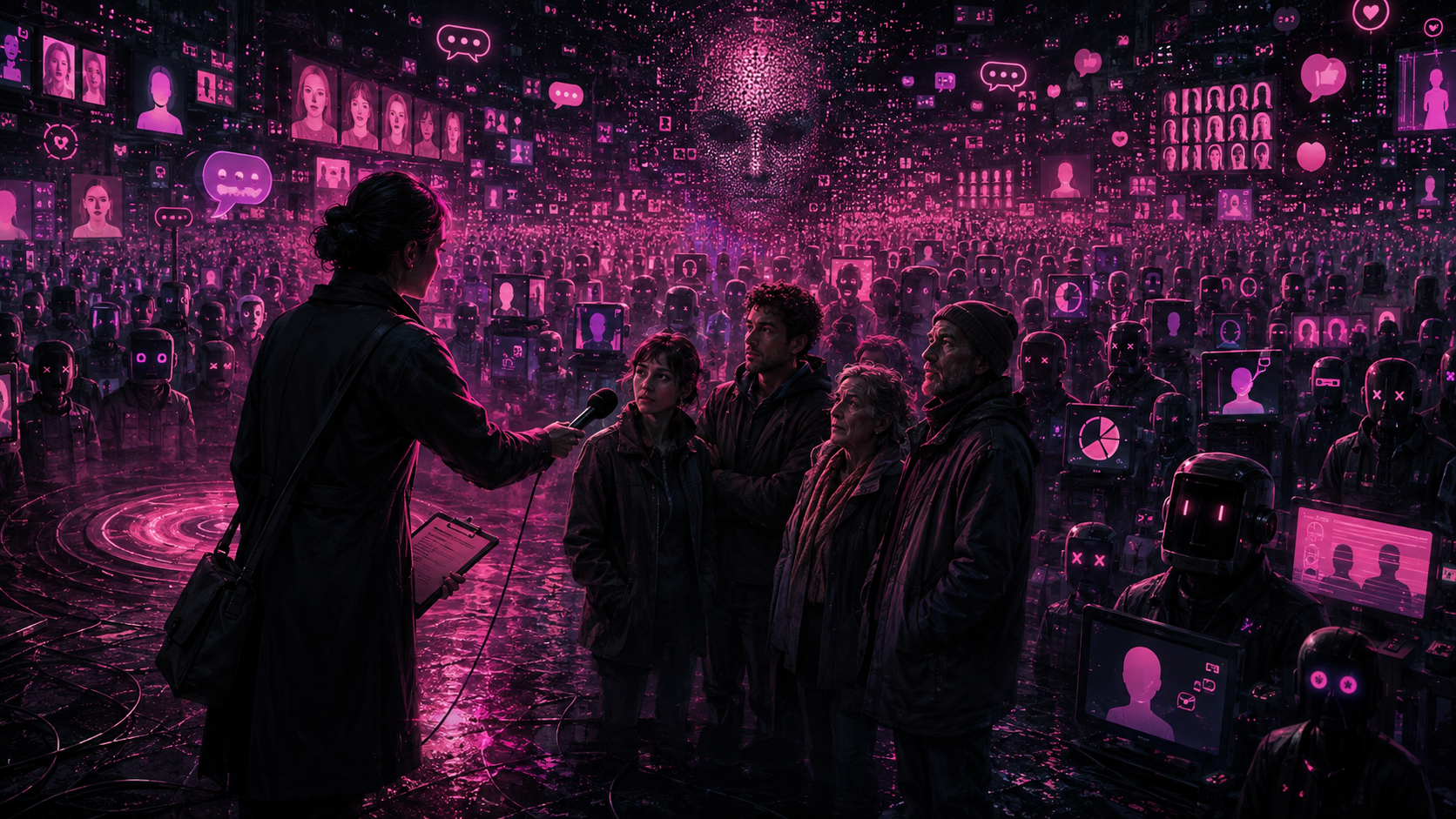
AI was supposed to help government move faster. Nobody quite explained what happens when the thing moving faster is the legal language itself.
THERE IS A PARTICULAR kind of typo that makes an entire institution look haunted.
Not a misspelled word.
Not a missing comma.
A sentence that should never have escaped the machine in the first place.
In June, a summary attached to a congressional amendment contained the phrase “Claude responded:” along with other stray chatbot text. Rep. Anna Paulina Luna said AI had been used for the summary, not to draft the underlying legislation. Her office’s explanation may be completely accurate.
That is almost beside the point.
Because the little artifact was useful.
For one brief second, the backstage door opened.
You could see the prompt-shaped machinery sitting behind the polished government document.
Then the door closed again.
THE INTERN HAS INFINITE CONFIDENCE.
Legislative drafting has never been some pure act of solitary statesmanship.
Members of Congress have staffs.
Staffs have lawyers.
Interest groups propose language.
Think tanks circulate model bills.
Lobbyists send suggestions.
Committees revise things.
The romantic image of one elected official sitting under a green lamp writing statutory prose with a fountain pen is mostly something we made up because democracy photographs better that way.
So the problem is not that politicians are getting help.
They always have.
The interesting change is what kind of helper has entered the room.
Generative AI can produce legal-looking language instantly, which means people who previously would have sent an idea can now send something that resembles finished legislation.
That sounds like efficiency.
Sometimes it is.
It can also mean the professional lawyer at the end of the pipeline now receives thirty pages of confident pseudo-law instead of three paragraphs explaining what somebody wants.
AI does not have to replace the lawyer to change the legal system. It only has to increase the amount of legal-looking material the lawyer must inspect.
THE BILL FACTORY DISCOVERS THE PROMPT BOX.
The House Office of Legislative Counsel exists largely to turn policy ideas into actual legislative language and make sure proposed text fits into the giant, interconnected machine of federal law.
Recent reporting based on interviews with current and former officials described congressional staffers and outside groups increasingly sending AI-generated legislative language into that process. One adviser told Politico that the office can spend more time repairing AI-drafted text than it would have taken to draft the proposal properly from the beginning.
There is an important numerical wrinkle here.
A widely repeated figure said requests to Legislative Counsel had increased 72 percent compared with the same early period two years earlier. More recent testimony covering a longer period showed a much smaller increase: 23,239 requests in the first 13 months of the current Congress compared with 21,979 in the comparable period of the previous Congress, or roughly 5.7 percent.
That distinction matters.
“The machines caused a 72 percent explosion” is a fantastic headline.
Reality, as usual, insists on becoming annoying.
The stronger evidence is not that AI has caused one gigantic measurable surge in congressional workload.
It is that people inside the drafting system are encountering AI-generated legislative text often enough to be worried about what it does to the work.
LAW IS AN EXTREMELY BAD PLACE FOR “CLOSE ENOUGH.”
Large language models are unusually convincing when operating in domains most people cannot independently evaluate.
Law.
Medicine.
Finance.
Software.
Tax.
Anything where the syntax of expertise is easier to imitate than the expertise itself.
Legislative language makes this problem almost comical.
A chatbot can produce something that looks gloriously statutory.
Subsections.
Definitions.
Cross-references.
Capitalized terms.
The works.
And the entire thing can still be wrong.
Former Legislative Counsel officials interviewed for the reporting pointed to errors that sound tiny until you remember these words become enforceable rules: confusing tax credits with deductions or exclusions, mishandling existing statutory references, or defining terms in ways that accidentally leave out jurisdictions or populations.
The danger is not:
AI writes gibberish.
Gibberish is easy.
The danger is:
AI writes something that survives the first glance.
THIS IS THE SAME PROBLEM SHOWING UP IN COURT.
You can already see a parallel version happening downstream.
Researchers studying people who represent themselves in court, known as pro se litigants, found evidence that generative AI is increasingly appearing in filings. A study discussed by the New York Times and summarized by Gizmodo estimated that about 18 percent of pro se filings in the dataset contained AI-generated text after widely available large language models arrived. The study was described as not yet peer reviewed at the time of that reporting.
Again, the remarkable part is not simply that AI can write a lawsuit.
Microsoft Word can write a lawsuit if you define “write” generously enough.
The real transformation is one of friction.
Before:
I am furious.
I want to sue.
I have no lawyer.
I do not know how to format a complaint.
I do not know what cause of action means.
I have no idea what jurisdiction is.
Maybe I eventually stop.
Now:
I am furious.
I ask the machine.
Thirty seconds later I possess sixteen pages of something that looks enough like a federal complaint to make me dangerous to an intake clerk.
The machine has not necessarily improved my legal argument.
It has removed the embarrassment between my impulse and the docket.
That is a very different technological achievement.
SLOP LOVES A BOTTLENECK.
This is one of the recurring misunderstandings about AI productivity.
We keep measuring the person who pressed the button.
Look.
They produced the document in nine minutes.
Productivity!
Then the document moves downstream.
A lawyer checks the citations.
Another attorney compares definitions.
Someone notices the cross-reference points to the wrong statute.
A committee staffer rewrites the tax provision.
Legislative Counsel rebuilds three sections.
Someone else asks why “state” appears to exclude the District of Columbia.
The nine-minute productivity miracle has now eaten twelve professional hours.
Corporate America already knows this trick.
Slopulous has been staring at it for months.
The productivity gain is hiding in someone else's calendar.
Government simply makes the consequences more interesting.
The output is no longer a PowerPoint deck nobody wanted.
It may be a law.
EUROPE IS FINDING THE SAME GHOST.
This is not only an American story.
Researchers from Chalmers University of Technology and Edinburgh Napier University analyzed 13,565 Swedish parliamentary motions and 4,209 British parliamentary statements published between 2021 and April 2026.
Their systems classified about 15 percent of UK parliamentary statements examined in 2026 as containing at least one AI-generated paragraph. In Sweden, 9.4 percent of motions during the 2025–26 parliamentary year contained at least one paragraph classified as AI-assisted.
The researchers said they found no AI disclosure in the texts they flagged.
The numbers deserve caution.
AI detectors are not magical provenance machines.
The researchers themselves could not establish which model had been used or exactly how it had been used. Their methodology compared contemporary parliamentary writing against human-written pre-generative-AI material and AI-generated counterparts, and they reported very low false positives when testing full documents from 2021.
So this is not proof that fifteen percent of British politics has been secretly replaced by a server rack.
It is evidence that machine-assisted political language is becoming common enough to leave a measurable stylistic trace.
That may be stranger.
THE SPEECH IS NOT THE LAW.
There are really several different questions hiding inside the phrase “politicians use AI.”
Using AI to:
summarize a report,
translate a document,
brainstorm questions,
clean up grammar,
organize constituent correspondence,
draft a press release,
write a speech,
or produce statutory language
are not equivalent activities.
Congress already permits certain AI tools for official work, and reporting from The Washington Post found members and staff using them for speeches, releases, constituent mail, hearing preparation and amendments. House guidance reportedly prohibits some uses, including placing sensitive constituent information into chatbots and allowing AI to finalize legislation, although enforcement appears limited and office-level practices vary.
That last distinction is where this becomes important.
A speech represents someone.
A law governs someone.
We should probably demand more from the second category than:
The prose looked fine when we pasted it.
THE DISCLOSURE PROBLEM IS WEIRDLY HARD.
Suppose a staffer writes a bill.
Then asks Claude:
“Can you identify ambiguities?”
AI involvement?
Obviously.
Suppose Claude suggests changing four words.
Still AI involvement?
Probably.
Suppose the staffer describes the desired policy and asks for an outline.
AI-assisted?
Yes.
Suppose an outside advocacy organization generates the entire proposed statute with ChatGPT and sends it to Congress, where lawyers heavily rewrite it.
Who discloses what?
This is the problem with treating AI as a binary contaminant.
AI touched this. AI did not touch this.
Modern authorship is becoming a supply chain.
The useful question is not whether a machine appeared somewhere in the process.
It is whether somebody competent remained responsible for the result.
ACCOUNTABILITY IS THE PART THE MODEL CANNOT AUTOMATE.
If a legislative lawyer makes a mistake, there is a person.
If a staffer misunderstands a provision, there is a person.
If an outside group writes something misleading, there is an organization.
You can question them.
You can examine their process.
You can ask what they intended.
Generative AI introduces a seductive ambiguity.
The sentence came from the model.
But the model did not introduce the bill.
It did not submit the amendment.
It did not vote.
It cannot explain why this particular definition survived.
The humans can.
Which is why “the AI did it” can never become a meaningful institutional defense.
A machine can generate the sentence. Only a person can accept responsibility for turning it into law.
THE PROBLEM IS NOT THAT THE MACHINE HAS POLITICS.
It is tempting to turn this into a robot-government story.
That is the cinematic version.
Claude takes over Congress.
ChatGPT filibusters.
Grok becomes chairman of Ways and Means.
Very funny.
The actual version is much duller and probably more consequential.
Busy people discover a tool that produces plausible work extremely quickly.
Then other busy people inherit the responsibility for determining whether the plausible work is correct.
That is it.
No sentient machine required.
No ideological conspiracy required.
No singular villain.
Only the ancient institutional urge to save time.
THE MORE EXPENSIVE THE SENTENCE, THE MORE FRICTION IT DESERVES.
AI can be useful in government.
Of course it can.
Searching enormous bodies of text.
Comparing versions.
Finding inconsistencies.
Summarizing public documents.
Helping staff understand technical material.
Making information more accessible.
The interesting question is not whether government should use AI.
It already does.
The question is where we decide speed stops being the primary virtue.
Some sentences are cheap.
Some sentences become policy.
Some sentences tell millions of people what they may do, what they must pay, what they qualify for, what is prohibited, what counts as a crime, what counts as a benefit and which agency gets to decide.
Those sentences deserve friction.
They deserve boring lawyers.
They deserve irritating reviews.
They deserve someone saying:
Wait.
What does this word mean here?
AI's greatest promise is that it can remove friction from knowledge work.
That is also precisely why government has to decide which friction was secretly doing something useful.
The chatbot can finish the sentence.
The rest of us still have to live inside it.