MUSIC USED TO HAVE A PERSON PROBLEM.
The singer was difficult.
The guitarist wanted more money.
The drummer disappeared.
The producer hated the mix.
Someone needed six months to make the record.
Someone else needed rehab.
Bands broke up.
Artists changed their minds.
Human beings repeatedly got in the way of music production.
We have apparently solved this.
The musician is now optional.
Seventy-Five Thousand Songs Walk Into a Server
In June, Deezer said it was receiving nearly 75,000 fully AI-generated tracks every day, representing more than 44% of daily uploads to its platform. The company had already begun identifying and labeling synthetic music, and it has now made its detection technology available as a free tool that can scan playlists from rival services including Spotify and Apple Music. (gizmodo.com)
Think about that number.
75,000.
Every day.
Not songs written with some AI assistance.
Not producers using machine learning for mastering.
Fully generated tracks.
A river of music with nobody late to rehearsal.
No one arguing about the bridge.
No bassist dating the singer.
No childhood.
No breakup.
No terrible van.
Just files.
Deezer says nearly half of users transferring playlists from other services have AI tracks somewhere inside them. (gizmodo.com)
Which introduces one of the strangest questions modern music listeners have ever had to ask:
Who made this?
And for the first time, “nobody” is a plausible answer.
The Song Is Fine
This is what makes AI music more complicated than Shrimp Jesus.
Some of it sounds fine.
Not transcendent.
Not obviously broken.
Fine.
The drums drum.
The bass basses.
The singer sounds sad in approximately the correct location.
The chorus arrives when expected.
There may even be a hook.
That is enough.
Gizmodo notes that AI-generated tracks have already broken into major charts, including “Walk My Walk” by Breaking Rust topping Billboard’s Country Digital Song Sales chart and the AI persona IngaRose reaching No. 1 on the U.S. iTunes chart with “Celebrate Me.” (gizmodo.com)
This is not the robot singing badly in a laboratory.
It is music functioning as music.
People listen.
People add it.
People may not know.
The troubling part is not that the machine can produce sound.
Drum machines produce sound.
Synthesizers produce sound.
Auto-Tune produces sound.
Computers have been inside records for decades.
The weird part is the disappearance of authorship.
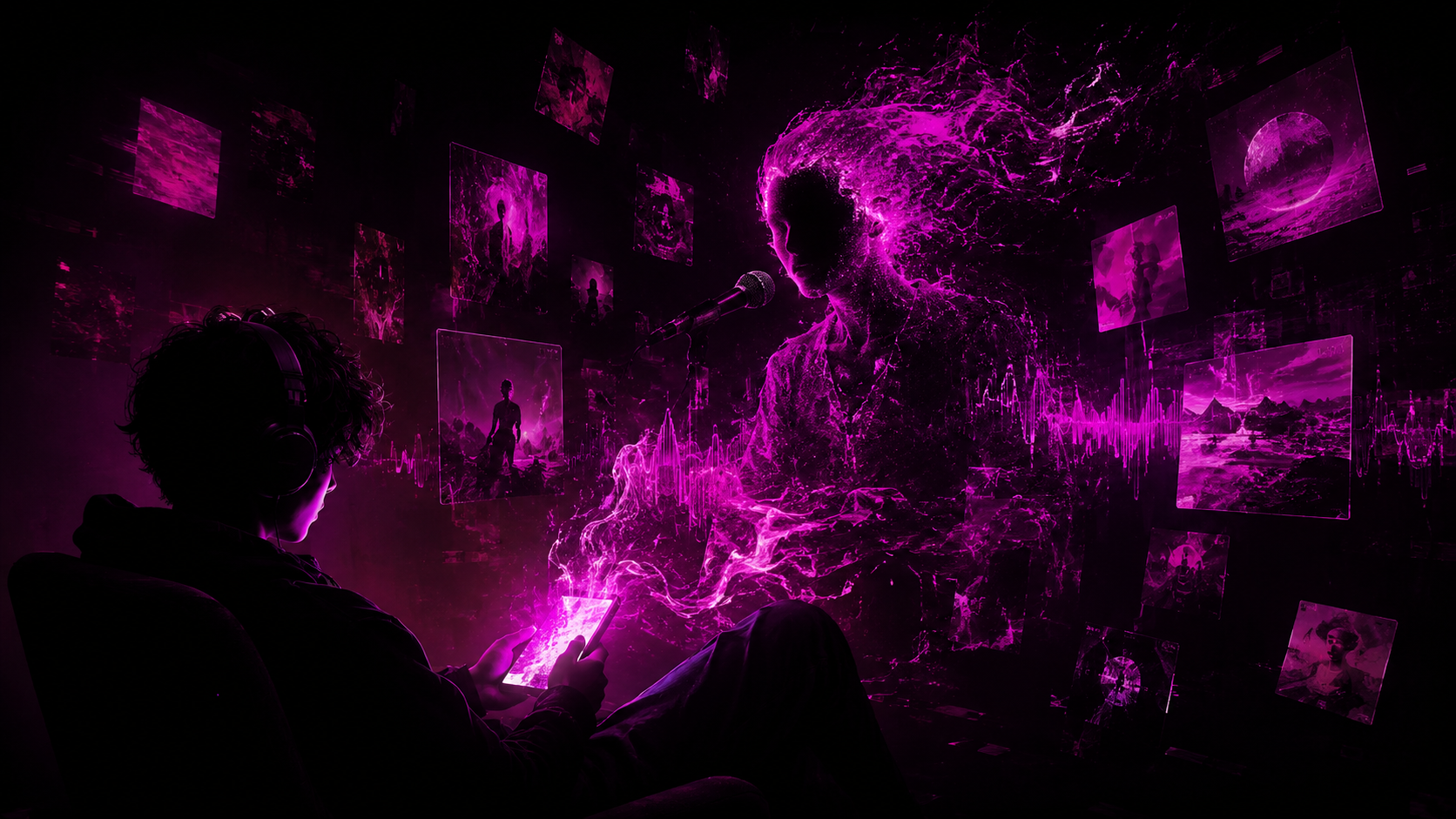
AI music turns the artist from a person into metadata.
We Already Trained Ourselves Not to Ask
Streaming created the perfect environment for this.
Remember buying an album?
There was an object.
Cover art.
Credits.
A booklet.
A photograph of the band trying extremely hard not to smile.
You knew who made the thing because ownership forced you to encounter the maker.
Streaming gradually changed music into atmosphere.
Focus.
Workout.
Dinner.
Rainy morning.
Chill.
Deep sleep.
Coffeehouse acoustic.
Lo-fi beats to remain technically alive while answering email.
The artist becomes less important than the function.
You do not necessarily know who made track 37 of Peaceful Piano for Productive Mornings.
You barely know track 37 exists.
It arrived.
It performed its duty.
It left.
This is exactly where synthetic music thrives.
Music without identity enters an environment where identity has already become optional.
The Playlist Is the Product
Streaming services did not invent background music, obviously.
Elevators beat them by decades.
But playlist culture reorganized enormous portions of music consumption around mood rather than artist.
The listener says:
Give me something calm.
The platform responds.
What song?
Doesn't matter.
Which performer?
Doesn't matter.
Who wrote it?
Why are you making this difficult?
The recommendation system learns that you stay longer when the piano is soft and there is no unexpected trumpet incident.
Now imagine being able to manufacture infinite variations of exactly that.
No royalties negotiation.
No tour.
No artistic crisis.
No label dispute.
No person asking why their song was placed beneath “Ambient Productivity Beige.”
The economics start looking fairly obvious.
ReHack argues that this is the underlying engine of slop more broadly: digital systems reward volume, low production costs and constant engagement, so synthetic content has an enormous structural advantage even when it is mediocre. (rehack.com)
AI music is simply the version with a kick drum.
The Detector Is a Strange New Consumer Product
This is why Deezer's tool is fascinating.
You connect a Spotify or Apple Music playlist.
It scans the tracks.
It tells you which may be AI-generated.
We have created antivirus software for vibes.
There is something absurd about this.
You heard a song.
You liked it.
Now you run a provenance scan.
Threat detected: bass line may not have experienced childhood.
But the demand makes sense.
Deezer's CEO said the company's data suggests most listeners want to know when AI music is being recommended to them. (gizmodo.com)
That desire reveals something important.
Apparently authorship still matters.
Even when the song sounds identical before and after the label appears.
Nothing About This Is Actually About Sound
Suppose you hear two songs.
You like them equally.
One was written by a twenty-three-year-old living in Detroit who spent a year recording it in a bedroom.
The other was generated in thirty seconds by a system operated by someone running 4,000 artist profiles.
Sonically, maybe you cannot tell.
Does that difference matter?
There is no universal answer.
If music is merely a pleasant arrangement of frequencies, perhaps not.
But we have historically treated art as something more than the file.
The person matters.
Where it came from matters.
Why it exists matters.
Knowing that Nina Simone sang something is not irrelevant information attached to the audio.
Knowing that Elliott Smith wrote the song is part of hearing the song.
Knowing that a teenager recorded something alone in a bedroom can change what the imperfections mean.
Context enters the sound.
AI music challenges this because it asks whether we actually meant any of that.
Maybe we only cared about the frequencies.
Streaming has been quietly running that experiment for years.
Slop Is Not the Same Thing as AI
This distinction still matters.
A human can make terrible music.
An AI system can be used thoughtfully inside a real creative process.
SlopDetector makes the same point about text: the useful question is not necessarily whether a machine was involved but whether the result contains substance, care and specificity. (slopdetector.org)
Music deserves the same nuance.
An artist using generative tools as one instrument among many is not equivalent to an automated operation uploading thousands of interchangeable tracks to harvest streams.
One contains authorship.
The other contains inventory.
The line is not human versus machine. It is creation versus production.
That sounds pretentious until your Discover Weekly fills with sixteen artists who have no interviews, no live performances, no history and suspiciously identical cover art.
Then it starts feeling practical.
Synthetic Music Has a Fraud Problem Too
AI music does not only create aesthetic questions.
It creates economic ones.
If generating tracks becomes nearly free, uploading at industrial scale creates opportunities to game streaming systems.
The broader platform response is already becoming visible. A recent New York Times report, republished by The Indian Express, described major tech companies trying to clean up synthetic junk across their platforms and noted that Spotify removed 75 million bulk uploads, duplicates and other spammy tracks in the previous year. (indianexpress.com)
Not all of those tracks were necessarily AI-generated.
That is almost beside the point.
AI makes the old spam model easier.
Generate inventory.
Upload inventory.
Manipulate discovery.
Collect fractions of pennies at scale.
The musician becomes unnecessary because the business is no longer music.
The business is throughput.
The Ghost Artist Has Excellent Availability
There are advantages to an artist who does not exist.
No scandals.
No contract disputes.
No controversial tweets from 2012.
No demands.
No sick days.
No political opinions.
No requests for ownership.
No aging.
No death.
No inconvenient desire to make a jazz album after the label asked for another pop single.
The ghost artist is wonderfully cooperative.
And perhaps this explains why the question matters beyond novelty.
Art has always contained friction because artists are people.
Remove the people and you remove some costs.
You may also remove the thing we were ostensibly paying for.
Maybe the Label Is Enough
Transparency does not solve every problem, but it changes the relationship.
If a track is AI-generated and clearly labeled as such, the listener can decide.
Fine.
Play it.
Skip it.
Put it in the robot jazz playlist.
The deception disappears.
This is part of why platforms are experimenting with labels and provenance systems rather than simply trying to ban synthetic media outright.
The difficult future is not one where AI music exists.
It obviously will.
The difficult future is one where synthetic music quietly enters every playlist until authorship becomes impossible to see and eventually irrelevant to ask about.
At that point, music becomes content in the purest sense.
Mood-shaped material.
Something to keep the silence away.
The song still plays.
The chorus still arrives.
You may even love it.
There is just nobody on the other side.