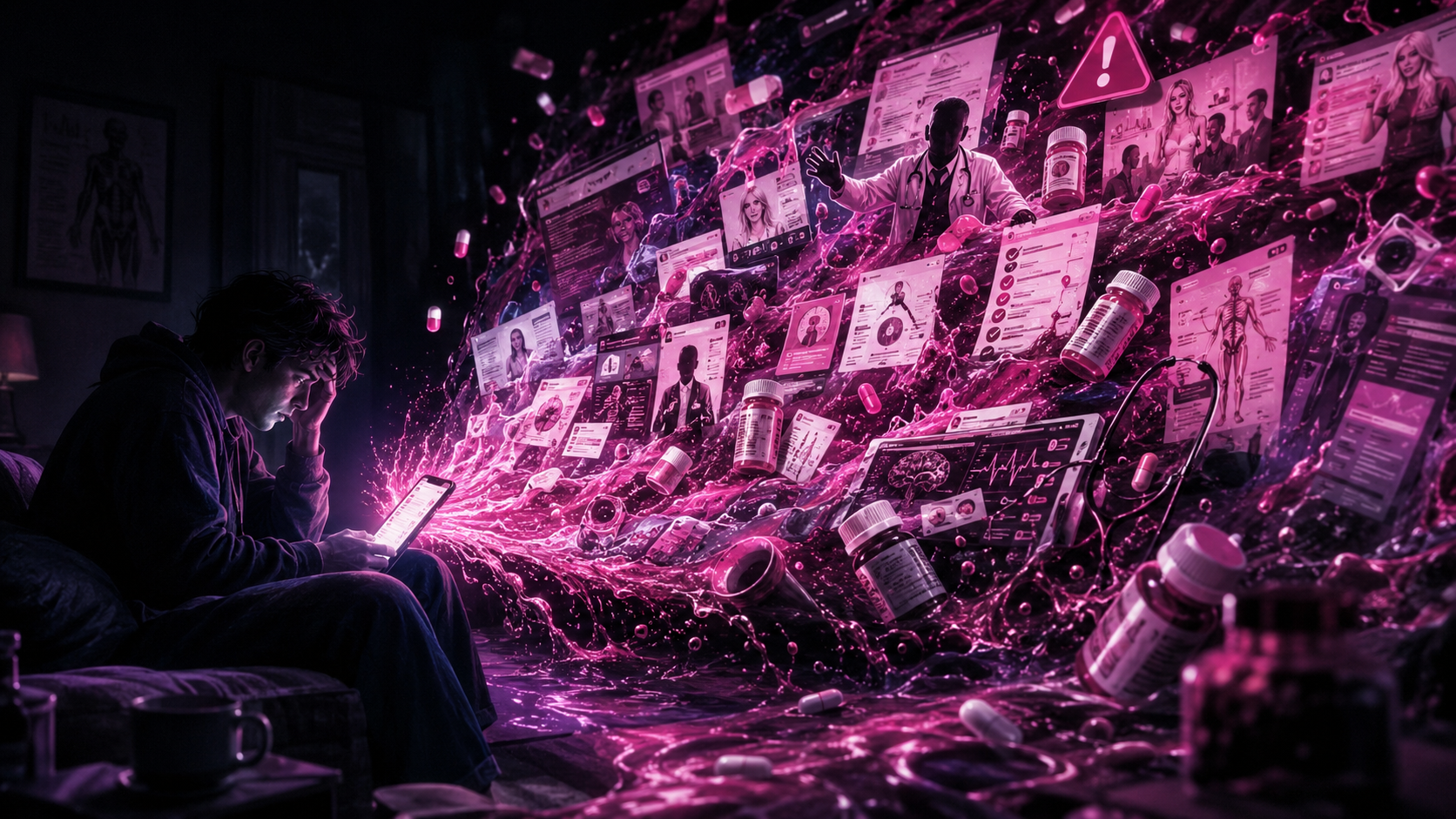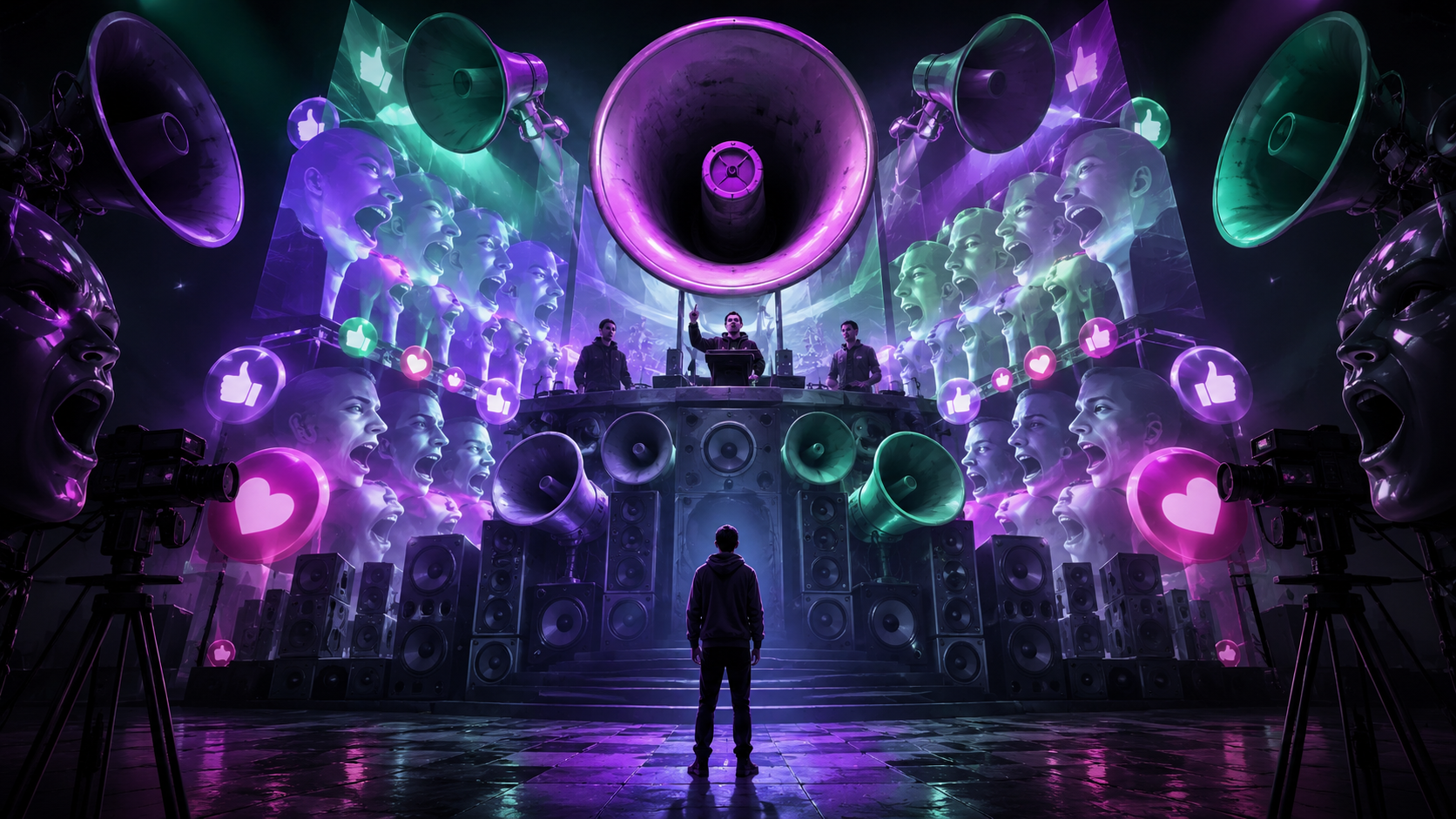
There is a particular kind of image that seems to exist primarily for Facebook.
An elderly woman has crocheted a full-size pickup truck.
A ten-year-old has apparently constructed a cathedral from toothpicks.
A veteran with no identifiable military insignia is celebrating his 112th birthday alone beside a cake roughly the size of a washing machine.
Jesus is there too.
Jesus is often there.
Sometimes he is standing beside a lion. Sometimes he is holding a small child. Sometimes, for reasons nobody involved seems capable of explaining, he is partially made of shrimp.
Below the image:
Amen.
Beautiful.
God bless.
Such talent.
Your aunt has shared it.
Someone named Gary has written, “Kids today could learn something from this.”
And somewhere behind the entire exchange sits a machine that has never had a birthday, never met Jesus, never crocheted anything, and has absolutely no idea what Gary means.
Welcome to the generational aesthetics of AI.
Or at least what they appear to be.
Because there is a problem with the idea that boomers are uniquely obsessed with artificial intelligence: they aren't.
Younger people use generative AI far more.
University of Cincinnati's overview of generational AI adoption found that baby boomers were the least likely generation to have used standalone generative AI tools. Gen Z, unsurprisingly, was miles ahead.
So this is not actually a story about boomers embracing AI while younger people refuse it.
The younger generations are using the machine.
Boomers are just more likely to post the weird shit it makes.
And that difference is much more interesting.
The Future Used to Be Something You Could Touch
Baby boomers have already experienced several versions of “the future.”
Television.
Microwave ovens.
Credit cards.
Calculators.
Home computers.
Cable.
Cellphones.
The internet.
Digital cameras.
Facebook.
Each technology arrived with a fairly straightforward demonstration of its magic.
Push this button and something happens.
Call someone who lives 2,000 miles away.
Take a photograph without film.
Send a letter without a stamp.
Search for a fact without going to the library.
Technology, for much of the late twentieth century, repeatedly performed the same trick: it removed friction from something people already understood.
Generative AI does this too, except now the trick borders on sorcery.
You type:
A golden retriever dressed like Frank Sinatra performing in Las Vegas.
And there he is.
Thirty seconds ago he did not exist.
Now he has a tuxedo.
If you remember when taking twenty-four photographs required buying film, carrying a separate camera, dropping the roll at a pharmacy and waiting several days to discover that nine pictures contained somebody's thumb, image generation is objectively astonishing.
We have become numb to how insane this is.
The first time somebody sees a machine produce a plausible image from a sentence, there is still a tiny moment of magic.
People who live inside technology professionally tend to kill that moment almost immediately.
We start examining fingers.
We look for hallucinations.
We complain about training data.
We inspect shadows.
We ask what model generated it.
We notice the suspiciously airbrushed skin and the strange plastic sheen.
We know too much.
Grandpa is looking at the dog in a tuxedo.
And Grandpa thinks it is fantastic.
AI Arrived Wearing Different Clothes
There is another generational divide that has very little to do with intelligence and quite a lot to do with employment.
For a twenty-six-year-old graphic designer, AI did not necessarily arrive as a toy.
It arrived as a meeting.
Someone from management had made a presentation.
There were words like efficiency.
There were phrases like content velocity.
There was probably a slide about “doing more with less,” which is corporate for somebody is about to have a terrible quarter.
Writers saw machines producing articles.
Illustrators saw image generators trained on mountains of human work.
Developers saw executives asking whether ten programmers might eventually become three programmers and an enterprise ChatGPT account.
Students encountered accusations of cheating.
Teachers encountered synthetic homework.
Artists encountered imitation.
For younger people still building careers, AI often arrived carrying a clipboard.
For a retired person, it can arrive carrying a paintbrush.
That changes the emotional relationship completely.
One person sees a machine capable of making a ridiculous image of Rod Stewart riding a dragon.
Another sees the early stages of an industry trying to eliminate their job.
Neither is misunderstanding the technology.
They are simply standing in different places when it arrives.
And this may explain why some older public figures have approached AI imagery with an enthusiasm younger internet culture finds almost unbearably uncool.
Rod Stewart used AI-generated visuals during his tour.
Other celebrities have posted obviously synthetic jokes and images with the delight of someone who has just discovered Photoshop filters in 1998.
The response from younger audiences is often instantaneous:
Cringe.
But cringe is itself a cultural technology.
You have to learn it.
The Internet Became a Place Where Everyone Is Slightly Embarrassed
Younger internet users have developed extremely sensitive aesthetic radar.
We can smell a corporate stock photo from six tabs away.
We recognize LinkedIn voice.
We recognize AI voice.
We recognize Millennial brand minimalism.
We recognize the strange smoothness of generated photography.
We recognize the Facebook meme font of our parents' internet.
We recognize when someone is trying too hard.
Entire online identities are constructed around avoiding the appearance of sincerity.
Irony becomes protective clothing.
Boomers often don't seem particularly interested in wearing it.
This is why an AI image can produce two entirely different reactions.
A 23-year-old sees a glowing eagle flying above a firefighter while Jesus watches from the clouds and thinks:
This is the worst image ever created.
A 68-year-old sees the same thing and thinks:
Hell yeah.
There is something almost enviable about this.
Not the image.
The freedom.
The ability to enjoy a thing without first asking whether enjoying it will make you look stupid.
The younger internet is much more technologically fluent, but it is also exhausted by its own literacy.
We know when the strings are showing.
Sometimes knowing ruins the puppet show.
Then the Computer Starts Being Nice to You
There may be another reason older users find conversational AI particularly seductive.
Computers have spent most of their history being terrible teachers.
Anyone who used technology in the 1990s remembers this.
You clicked the wrong thing and received:
ERROR 0x00004F8B
Wonderful.
Thank you.
Extremely helpful.
Software expected you to learn the software.
You memorized commands.
You read manuals.
You learned where files lived.
You learned what drivers were even though nobody really wanted to know what drivers were.
Every few years the interface changed and you were expected to change with it.
This gets more frustrating as you age because technology begins quietly announcing that it was designed for somebody else.
The slang changes.
The buttons move.
Your children send messages containing three letters and a skull emoji.
A website you finally learned redesigns itself.
Your television needs a password.
Your refrigerator would like to join the Wi-Fi.
Then AI arrives.
You can simply talk to it.
“Why won't my printer connect?”
It answers.
“Rewrite this email so I don't sound angry.”
It answers.
“What does ‘mid’ mean?”
Unfortunately, it answers.
It does not laugh.
It does not sigh.
It does not say:
“Dad, I literally showed you this yesterday.”
The machine meets you where you are.
That may be one of the most consequential things about conversational AI and one of the least discussed.
For the first time, the computer is adapting itself to the user rather than demanding that the user adapt themselves to the computer.
That is enormously powerful.
Especially if technology has spent the previous twenty years making you feel increasingly obsolete.
And the Machine Thinks You Are Brilliant
Then there is the flattery.
AI has the conversational style of someone trying desperately to earn a five-star customer-service review.
You ask a questionable question.
Great question!
You present an idea.
That's a fascinating perspective.
You propose something profoundly ordinary.
You've identified something really important here.
The machine is endlessly patient.
Endlessly available.
Endlessly impressed.
This is pleasant when your job involves asking it to fix an Excel formula.
It becomes more complicated when you start confusing affirmation with expertise.
This is not a boomer problem.
It is a human problem.
Everyone enjoys being told they are making sense.
But for somebody who increasingly encounters technology as a reminder that the world has moved ahead without asking permission, the experience can be particularly intoxicating.
Suddenly the most advanced technology on Earth isn't making you feel behind.
It is telling you that your question is excellent.
Maybe your children should try that sometime.
Facebook Was Already Ready for This
And then there is Facebook.
AI slop did not invade Facebook so much as discover that Facebook had spent fifteen years preparing the soil.
The platform had already trained users to interact primarily through instantaneous emotional signals.
Like.
Heart.
Angry.
Share.
Comment.
Repeat.
A picture does not have to be true to function inside this system.
It only has to produce the correct feeling quickly enough.
Cute.
Sad.
Patriotic.
Religious.
Inspirational.
Outrageous.
That is precisely what generative AI is excellent at producing.
Not meaning.
Legibility.
A crying veteran.
A smiling child.
A heroic dog.
A giant birthday cake.
Jesus.
It doesn't matter that the story collapses if examined for more than twelve seconds.
Nobody asked it to survive examination.
It was designed to survive the scroll.
And the modern content economy has discovered that emotional shorthand can be manufactured industrially.
The dog does not need to exist.
The child does not need to exist.
The grandmother who allegedly built a house entirely from recycled bottle caps does not need to exist.
The emotion only needs to exist long enough for someone to press the heart.
That is slop's preferred unit of time.
Long enough to react.
Not long enough to think.
Maybe Boomers Are Just Getting the Prototype
It is easy to laugh at all of this because boomer slop looks absurd.
The aesthetics are obvious.
The patriotism is fluorescent.
The sentimentality is radioactive.
The Photoshop glow practically announces itself from orbit.
But every generation gets its own slop.
That is the part younger people should probably worry about.
Your slop does not look like grandma's slop.
It looks better.
It has good typography.
It knows how to edit video.
It uses references you recognize.
It talks like the creators you trust.
It explains research that may not exist in a voice that sounds extremely confident.
It arrives as a beautifully color-graded TikTok explaining nutrition.
A finance thread written by someone who appears credible.
A lifestyle video showing an apartment nobody actually lives in.
A political clip missing twenty-three seconds of context.
A synthetic influencer with excellent lighting.
A Reddit post generated to sell something.
A product review written by nobody.
Same machinery.
Better taste.
And because the slop aimed at us matches our aesthetics, we are far less likely to recognize it as slop.
Eventually Everyone Becomes the Person Who Can't Tell
Every generation believes its technological fluency will last forever.
It won't.
One day TikTok will look like AOL.
Instagram will feel like cable television.
Some new interface will emerge that twenty-year-olds understand instinctively and forty-year-olds describe using slightly incorrect terminology.
Today's digital natives will ask their children how something works.
Their children will sigh.
And somewhere in whatever replaces Facebook, an impossible image will appear.
Maybe it will be indistinguishable from reality.
Maybe the concept of an “image” itself will seem antique.
Maybe everybody will have a personal synthetic universe continuously rearranging itself around their preferences.
And some teenager will look at us with absolute disbelief.
You can't tell that's fake?
No.
Eventually we can't.
That is why laughing at boomers and AI is fun but insufficient.
Boomers are not uniquely gullible.
They are simply useful previews of what happens when a generation encounters a technology whose outputs advance faster than its cultural defenses.
The rest of us have better defenses.
For now.
The machine is learning faster than we are.
And the slop is getting prettier.
Grandma gets Shrimp Jesus.
You get a perfectly edited explanation of the world created by somebody who does not exist.
Different generation.
Different aesthetic.
Same trough.